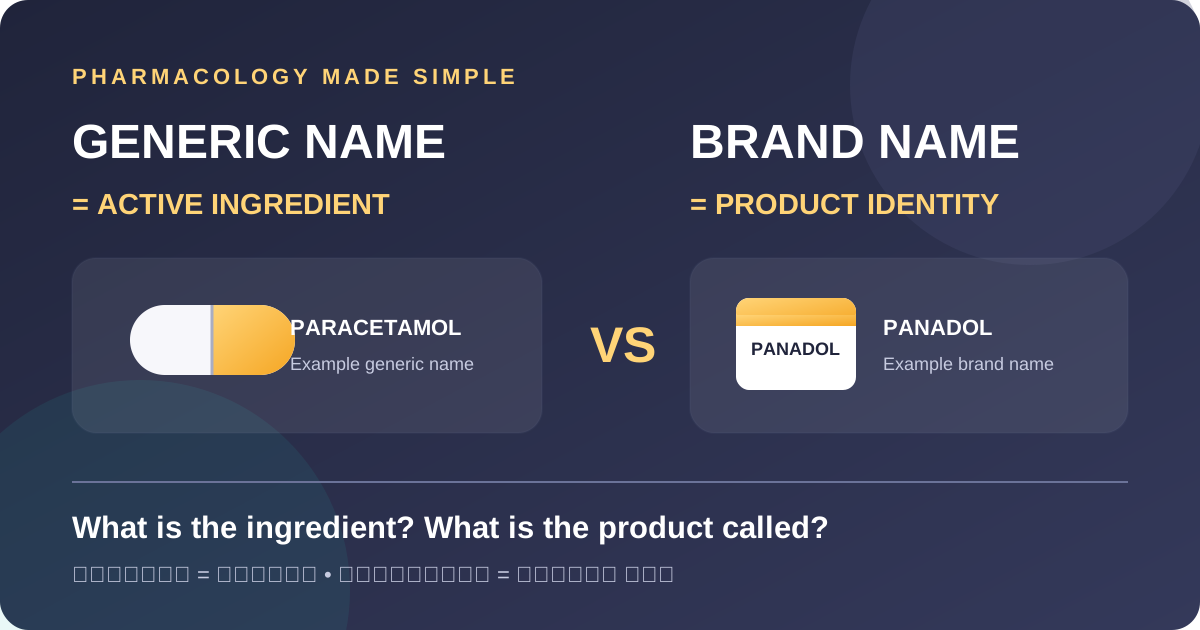
Quick answer: A generic name identifies the active ingredient in a medicine. A brand name is the name a manufacturer uses to market a particular product. The same active ingredient may be sold under different brand names, so the two names answer different questions: “What ingredient is it?” and “What is this product called?”
\n1. What is a generic name?
The generic name is the recognised name of the active ingredient—the substance responsible for the medicine’s intended pharmacological effect. For example, paracetamol is a generic name used for pain and fever relief.
2. What is a brand name?
A brand name is a product name selected by a company. For example, Panadol is a brand name associated with paracetamol products in many markets. Product formulations, strengths and availability can differ, so always read the label rather than relying on the name alone.
3. Generic name vs brand name at a glance
| Generic name | Brand name |
|---|---|
| Names the active ingredient | Names a marketed product |
| Often used across manufacturers | Usually specific to a company/product |
| Example: paracetamol | Example: Panadol |
Real-life pharma example
In Bangladesh, rabeprazole is the generic/active-ingredient name used in products such as Finix. Finix is a brand name. Finix MUPS also describes a particular formulation/technology presentation—MUPS is not the generic name. Always verify the exact active ingredient, strength and approved pack label before comparing products.
Generic name
Names the active ingredient.
Example: rabeprazoleBrand name
Names a product marketed by a company.
Example: FinixFormulation / technology
Describes how the product is prepared or presented.
Example: MUPSA useful three-part check: ingredient name, marketed product name, and formulation are related—but they are not interchangeable terms.
4. A real-life label check
Imagine two medicine boxes with different brand names. Before assuming they are the same, compare the active ingredient, strength (for example, 500 mg), dosage form (tablet, capsule or liquid), and directions. A shared generic name is an important clue, but it does not prove that every product is suitable for every person or situation.

5. An easy trick to remember
G = Ingredient; B = Business label. The generic name tells you what the active ingredient is; the brand name tells you what the product is called. This is a memory aid, not a substitute for checking the package.
6. Common questions
Can one generic name have many brand names?
Yes. The same active ingredient may be marketed under different brand names by different companies.
Are generic and brand names the same thing?
No. The generic name identifies the active ingredient; the brand name identifies a marketed product.
Is every product with the same generic name identical?
Not necessarily. Strength, dosage form, release characteristics and other ingredients may differ. Check the product label and follow professional advice.
References and further reading

Sayedul Abrar
A Grade Pharmacist · Registration Code: A-22040
Product Executive, Product Management Department (PMD) · Opsonin Pharma Ltd.
Educational content only; it does not replace individual medical advice. Examples are illustrative and may vary by country. Ask a pharmacist or prescriber before changing a medicine.