 Sayedul Abrar
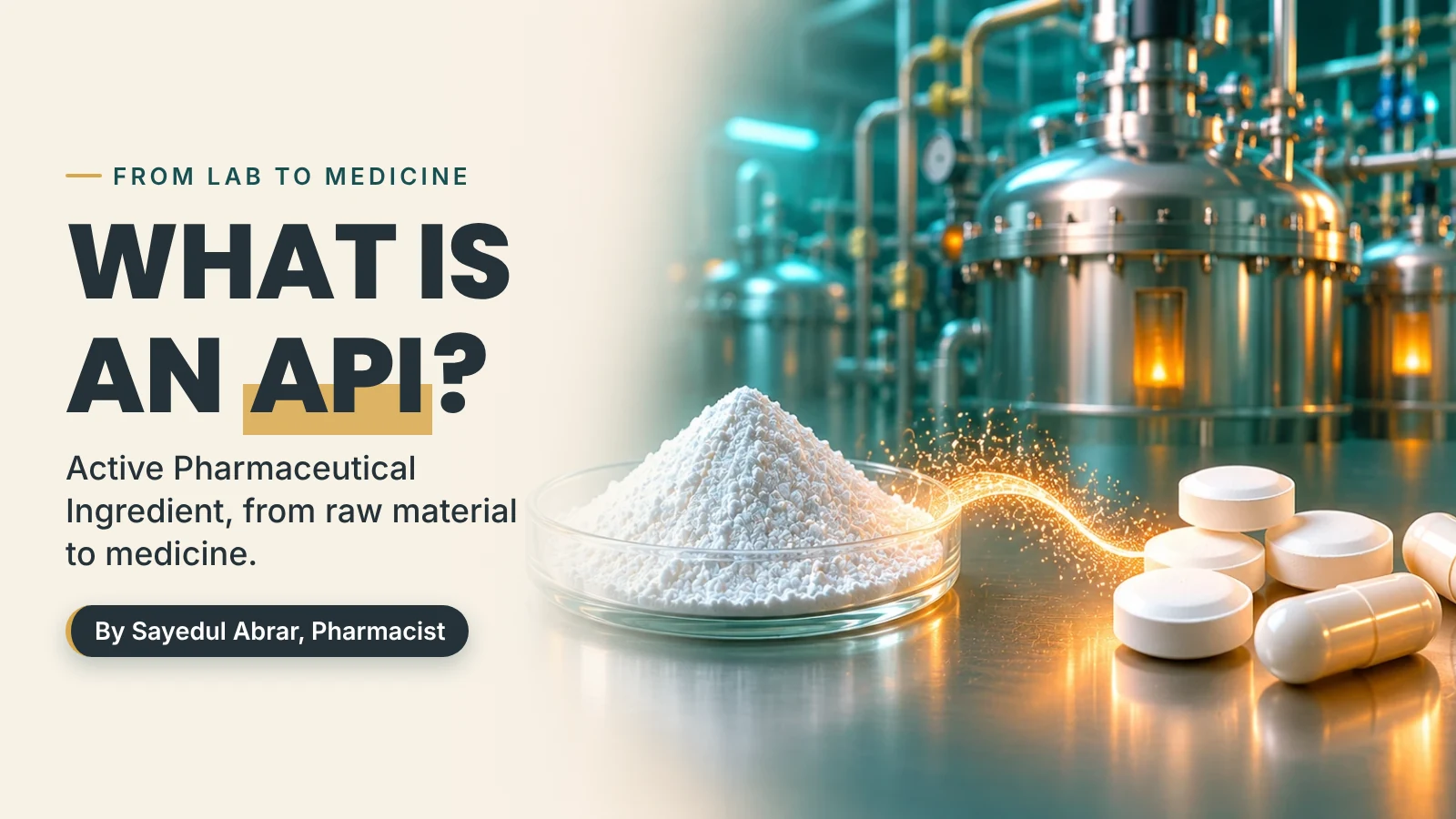
When you look at a tablet, you see the finished dosage form. But before that tablet is manufactured, its active ingredient must be produced or sourced, purified, tested and released under controlled quality systems. That active ingredient is the API.
1. What exactly is an API?
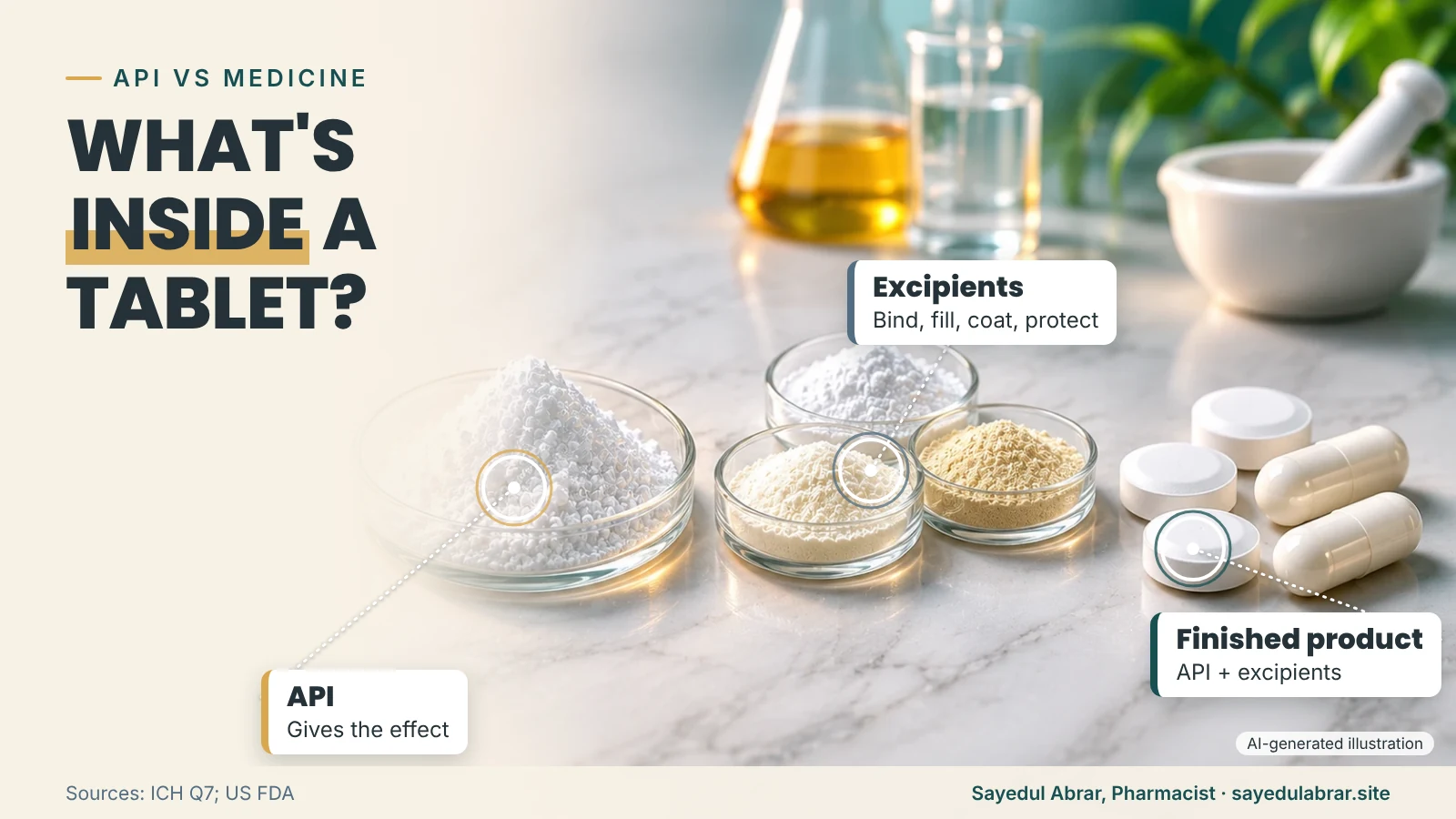
The International Council for Harmonisation (ICH) and the US Food and Drug Administration (FDA) describe an API as a substance or mixture of substances intended for use in manufacturing a drug product that becomes the active ingredient of that product. It is intended to provide pharmacological activity or another direct effect in diagnosis, cure, mitigation, treatment or prevention of disease, or to affect the structure or function of the body.
For example, in a conventional paracetamol tablet, paracetamol is the API. The tablet also contains excipients—ingredients that support manufacturing, stability, disintegration, appearance or other product characteristics. Excipients are not interchangeable with the API: they serve different functions.
2. API vs finished pharmaceutical product
An API is the active drug substance. A finished pharmaceutical product (FPP) is the medicine in its final dosage form, such as a tablet, capsule, oral liquid or injection, ready for the relevant packaging and supply steps.
- API: the active substance that provides the intended pharmacological effect.
- Excipients: other formulation ingredients used for functions such as binding, filling, coating, preservation or helping the dosage form perform as designed.
- FPP: the formulated medicine containing the API and excipients in a defined dosage form and strength.
One company may manufacture the API and another may formulate it into tablets. Some organisations perform both activities. The business arrangement does not change the need to control the quality of the materials and processes.
3. How is an API manufactured?
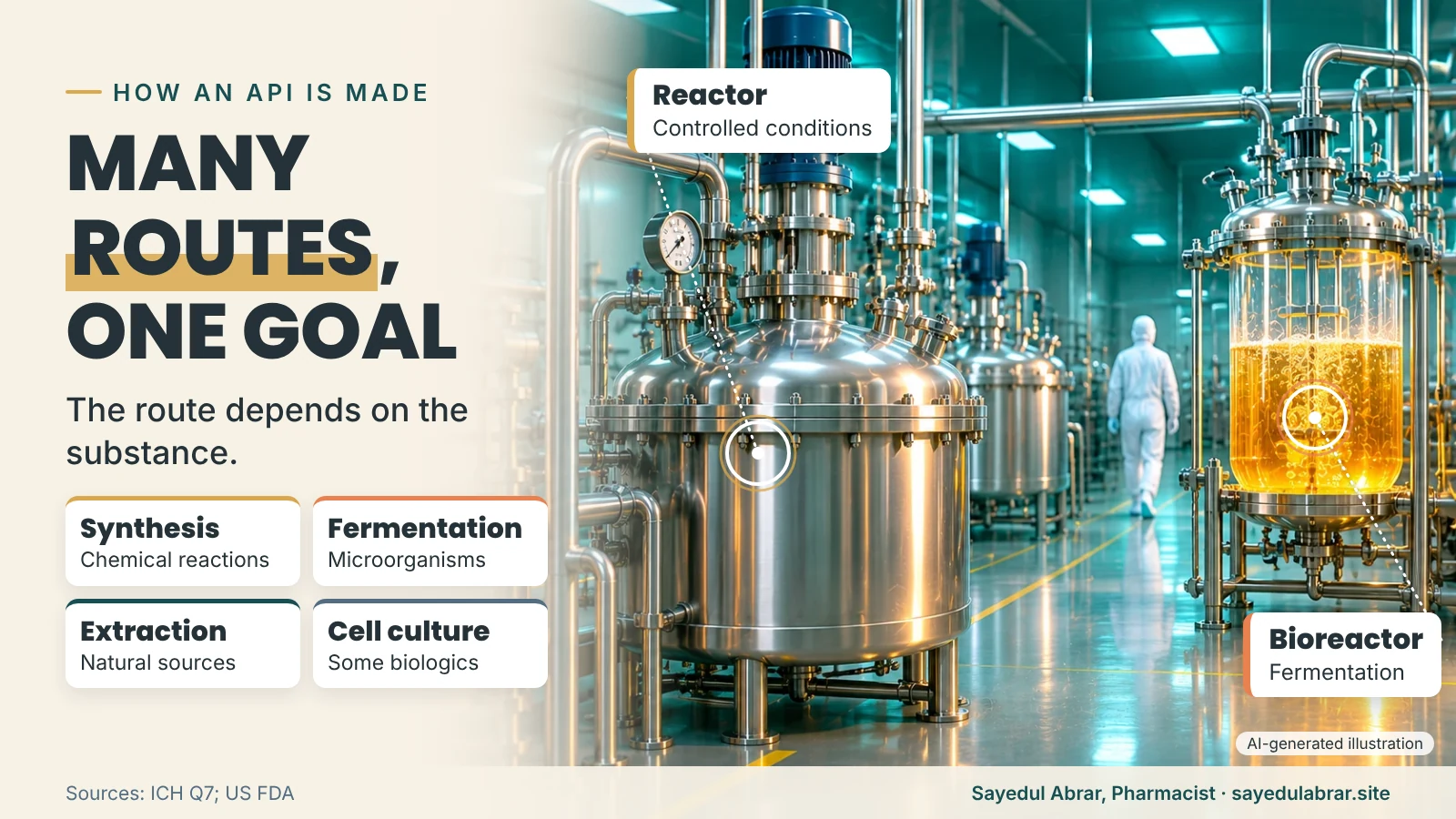
There is no single manufacturing route for every API. ICH Q7 recognises several broad approaches, including chemical synthesis, extraction, fermentation or cell culture, and recovery from natural sources. The appropriate process depends on the substance and its chemistry or biology.
A simplified manufacturing journey
Conceptual overview only. Actual manufacturing steps, process controls and acceptance criteria vary by API and approved process.
Step 1: Starting materials
Manufacturing begins with defined starting materials, reagents, solvents or biological inputs. Their identity, quality and suitability must be assessed. Supplier qualification, specifications, sampling and traceability help prevent unsuitable materials from entering production.
Step 2: Production and process control
In chemical synthesis, controlled reactions convert starting materials through one or more intermediates into the desired substance. Other APIs may be produced through extraction, fermentation or cell-based processes. Manufacturers monitor relevant parameters such as temperature, time, pH, mixing or other process-specific variables. The exact controls depend on the process.
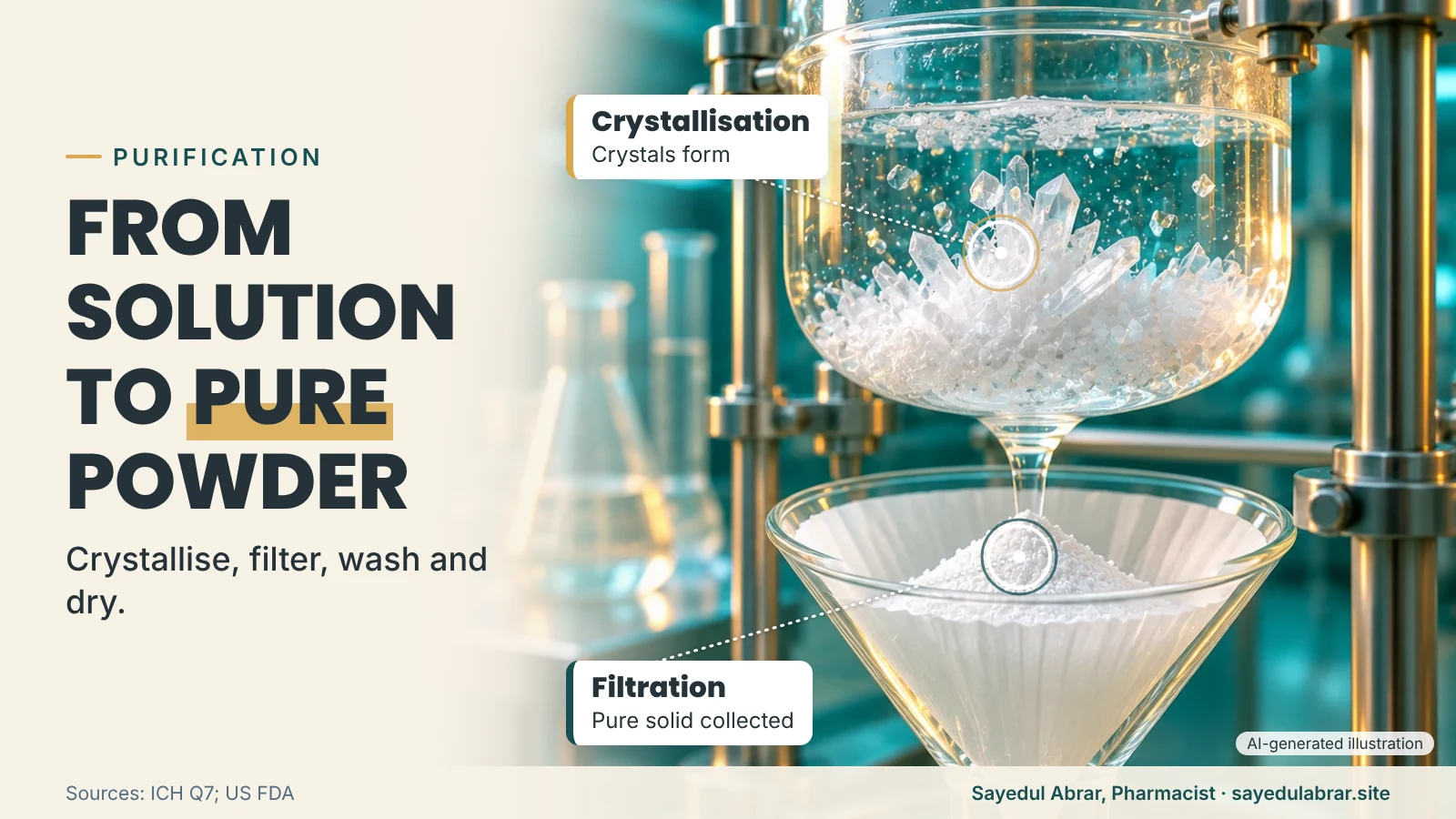
Step 3: Isolation and purification
The desired substance is separated from process mixtures and unwanted materials. Depending on the process, operations may include filtration, crystallisation, washing, drying or other purification techniques. The aim is to obtain material that meets its defined quality requirements.
Step 4: Physical processing and packaging
Some APIs undergo milling, micronisation, blending or other physical processing to achieve specified properties. The API is then packed in suitable containers with appropriate identification and storage controls to protect it during handling and transport.
4. How do manufacturers know an API is suitable?
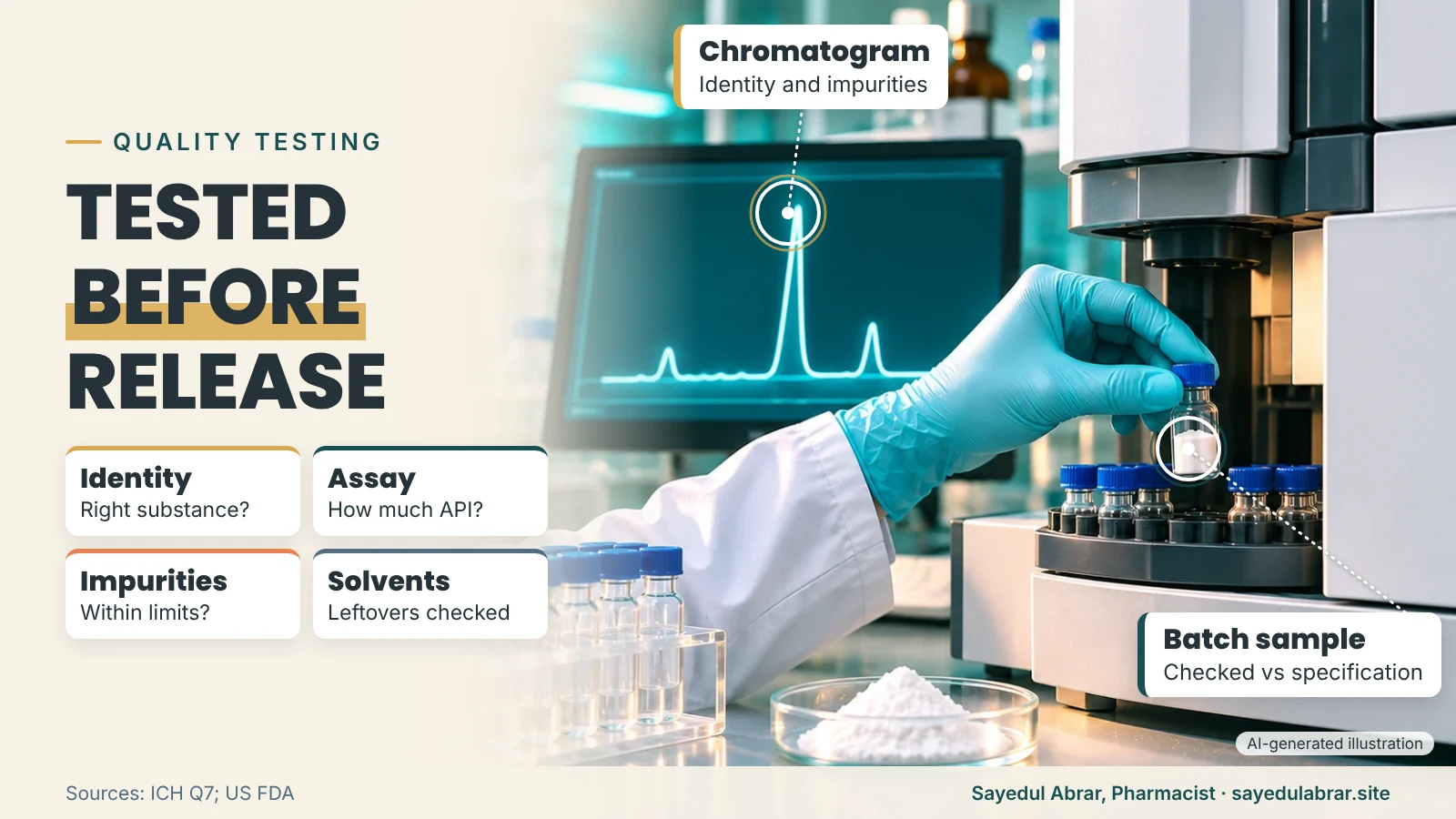
Testing is performed against approved or otherwise established specifications. The precise tests depend on the API and its intended use, but may include:
- Identity: confirms that the material is the intended substance.
- Assay or content: measures the amount or strength of the API.
- Related substances and impurities: evaluates specified and other relevant impurities.
- Residual solvents: checks solvents that may remain from manufacturing.
- Water content and physical properties: assessed when relevant to the substance and its specifications.
- Microbiological quality: tested where required by the API type and intended use.
Passing one test does not automatically establish overall quality. Results must be evaluated against the complete specification, relevant procedures and batch documentation. A designated quality unit reviews the appropriate records and makes the release or rejection decision.
5. Why does GMP matter in API manufacturing?
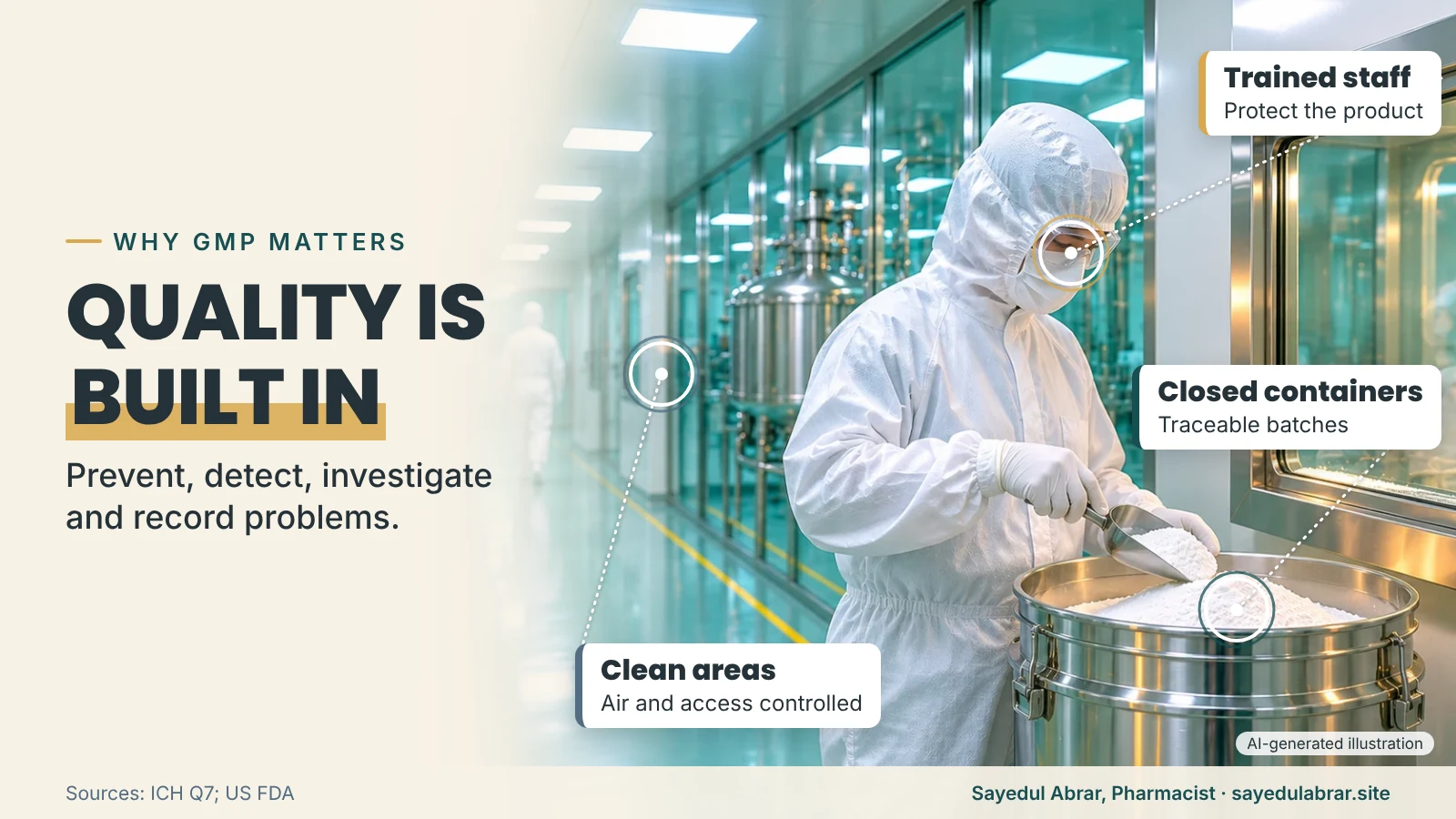
Good Manufacturing Practice (GMP) is a system of controls designed to help ensure that materials and products are consistently produced and controlled according to appropriate quality standards. ICH Q7 provides GMP guidance specifically for APIs.
In practical terms, GMP includes trained personnel, suitable premises and equipment, written procedures, controlled production records, cleaning and maintenance, investigations of deviations, change control, laboratory controls, supplier oversight and quality-unit responsibilities.
GMP does not mean that errors are impossible. It means there should be systems to prevent problems where possible, detect them, investigate them, document decisions and protect product quality.
6. Why does API quality matter to patients?
The quality of the API contributes to the quality of the finished medicine. If the identity, strength, impurity profile or other critical attributes are not controlled, the finished product may not meet its intended specifications. That is why API quality cannot be judged only by the appearance of the powder or by the reputation of a supplier.
Finished-product manufacturers also need to control formulation, manufacturing, packaging and stability. API quality is essential, but it is one part of a wider pharmaceutical quality system.
7. What about API manufacturing in Bangladesh?
Bangladesh has an established finished-medicine manufacturing sector and has also pursued greater local capacity for API production. The policy and investment context can be explored through Bangladesh's official investment and medicines-regulatory sources. However, a general article should not assume that every medicine ingredient used locally is manufactured domestically. The origin and supply route can differ by substance and manufacturer.
The Directorate General of Drug Administration (DGDA) is Bangladesh's national medicines regulatory authority. For current regulatory requirements, readers should consult DGDA publications and applicable laws rather than rely on a general explainer.
Key takeaways
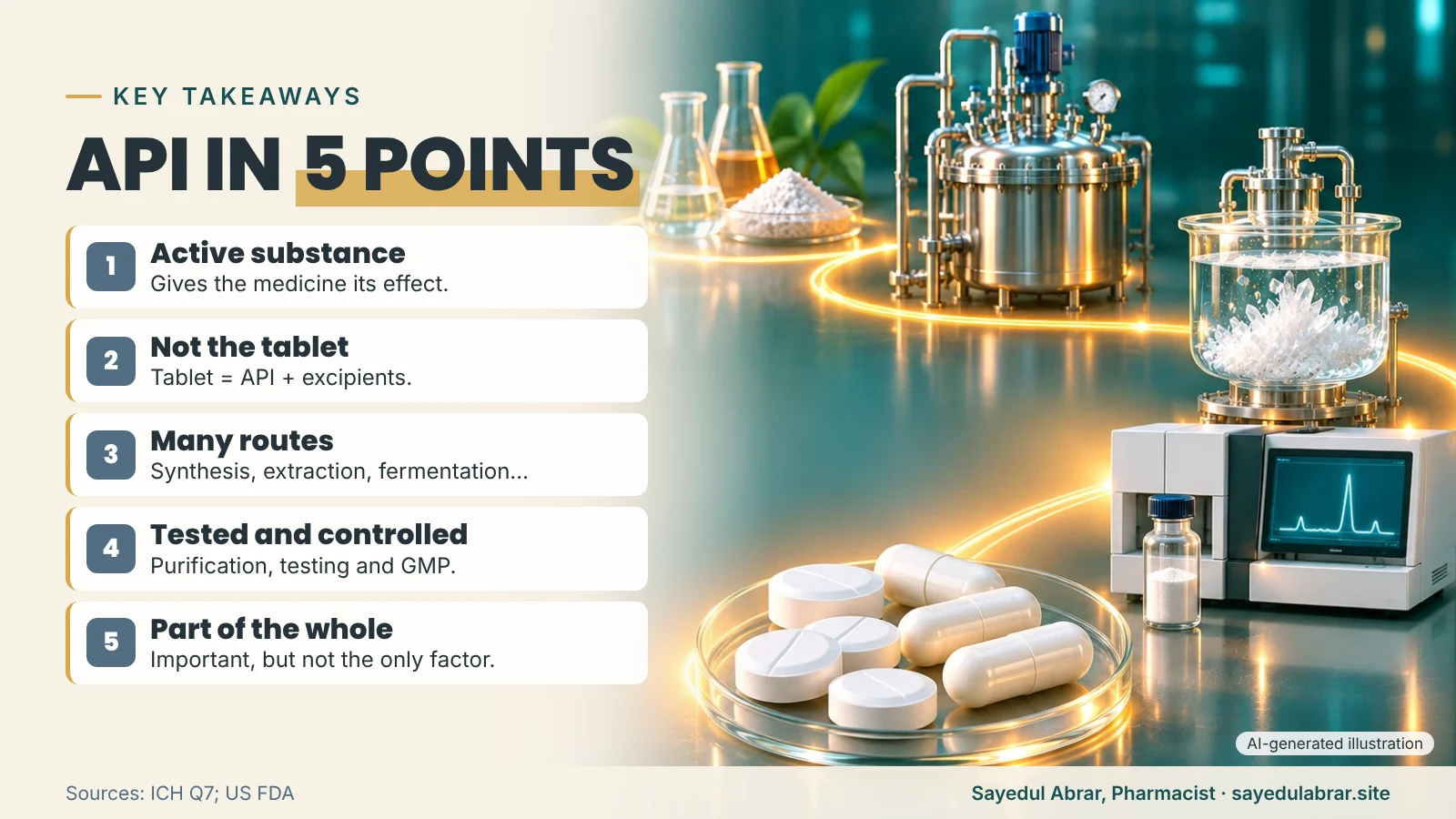
- API means active pharmaceutical ingredient; it is the active substance in a medicine.
- The API is different from the finished tablet, capsule or liquid.
- Manufacturing routes vary: chemical synthesis, extraction, fermentation and other processes may be used.
- Purification, testing, documentation and GMP controls support API quality.
- The quality of the API contributes to—but does not alone determine—the quality of the finished medicine.
Frequently asked questions
Is API the same as a drug?
In pharmaceutical manufacturing, API or drug substance refers to the active substance intended to provide the pharmacological effect. In everyday language, “drug” can have broader meanings.
Is an API the same as a tablet?
No. The API is the active substance. A tablet is a finished dosage form that usually contains the API plus excipients.
Can one company manufacture both API and tablets?
Yes. Some companies perform both API production and finished-product manufacturing, while others specialise in one activity or outsource part of the process.
Are all APIs made by chemical synthesis?
No. Depending on the substance, APIs may be produced through chemical synthesis, extraction, fermentation, cell culture or other suitable routes.
Why are API impurities tested?
Impurities can arise from starting materials, reactions, processing or storage. Testing and process controls help ensure that the API meets its defined quality requirements.
Does GMP guarantee that a medicine will never have a quality problem?
No system can guarantee that problems will never occur. GMP establishes controls for consistent production, detection, investigation and prevention of quality issues.
For the wider Bangladesh context, read What is the pharmaceutical industry? to see how APIs fit into the medicine manufacturing and supply chain.
References and further reading
- US Food and Drug Administration. Q7: Good Manufacturing Practice Guidance for Active Pharmaceutical Ingredients.
- International Council for Harmonisation. ICH Quality Guidelines — Q7.
- FDA. Q7 Questions and Answers.
- Bangladesh Directorate General of Drug Administration. Official website and regulatory information.
- Bangladesh Investment Development Authority. Official investment information.

A Grade Pharmacist · Registration Code A-22040
Product Executive, Product Management Department · Opsonin Pharma Ltd.
About the author