1. What is a clinical trial phase?
A clinical trial is a planned research study in people. In a medicine-development programme, researchers use trials to learn how an investigational medicine behaves in the human body, what effects it may have, which dose may be appropriate, and what unwanted effects may occur.
A phase describes the main development question a study is designed to answer. It is not the same as the study design. For example, randomised, double-blind, placebo-controlled and parallel-group describe methods used to reduce bias or compare treatments; they are not separate phases.
This article focuses on interventional trials of medicines. In an observational study, researchers do not assign participants to receive an intervention; they observe what happens under usual care or existing exposure. Both types of research can be valuable, but the familiar Phase I–IV framework is mainly used for medicine development.

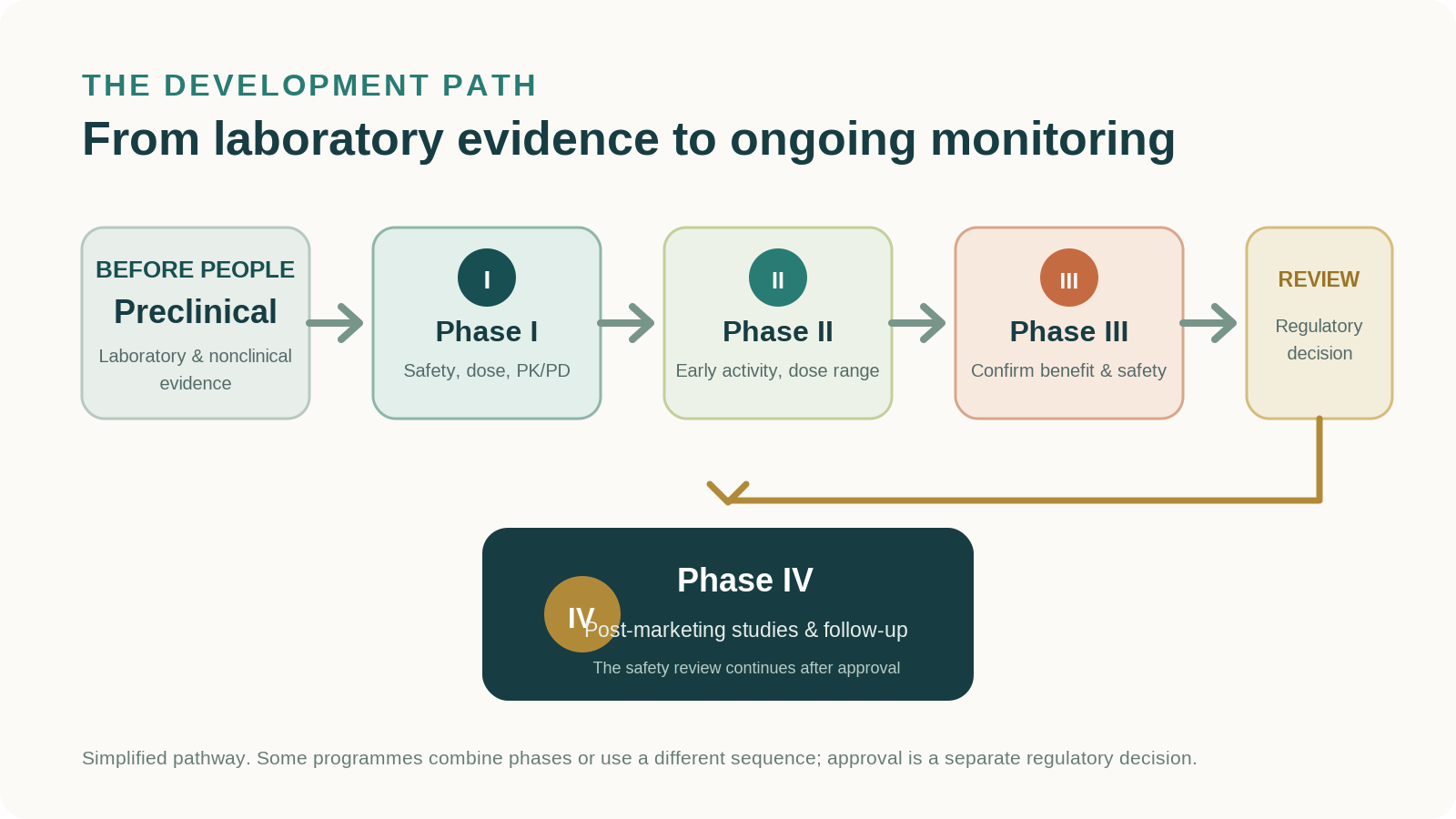
- Phase Isafety, tolerability and dose
- Phase IIearly activity in people with the condition
- Phase IIIlarger-scale confirmation of benefit and risk
- Phase IVplanned studies after marketing authorisation
There are no universal participant numbers that define a phase. Sample size depends on the disease, expected effect, outcome being measured, study design, statistical assumptions and safety considerations.
2. Before Phase I: preclinical research and preparation
Before a new medicine is first given to people, researchers build a body of evidence from laboratory studies and appropriate non-clinical testing. This may include pharmacology, toxicology, dose-related effects, safety pharmacology and information about how the product is made and controlled.

- Non-clinical evidencepharmacology, toxicology and safety pharmacology
- Product informationhow the medicine is made and controlled
- A clinical protocolquestion, eligibility, dose, monitoring and rules for stopping
These studies cannot predict every human response. Their purpose is to help decide whether there is a reasonable scientific basis to begin carefully controlled human research and what precautions are needed. A clinical protocol then sets out the research question, eligibility criteria, dose, procedures, monitoring, endpoints, analysis plan and rules for stopping or changing the study.
Regulatory and ethics requirements depend on the country. For example, the U.S. FDA uses an Investigational New Drug (IND) framework; that is a U.S. pathway, not a universal form used by every country. In Bangladesh, the DGDA’s national GCP guideline sets out the local oversight framework for trials on pharmaceutical products.
3. Phase I: first-in-human safety and dose
Phase I is usually the first carefully monitored exposure of people to an investigational medicine. The main questions are: How does the human body handle it? What dose can be tolerated? What short-term effects appear as the dose changes?

- The questionshow the body handles it, what dose is tolerated, what short-term effects appear
- PK and PDwhat the body does to the medicine, and what it does to the body
- Participantsoften healthy volunteers, but not in every case
Researchers may study pharmacokinetics (PK)—what the body does to the medicine—and pharmacodynamics (PD)—what the medicine does to the body. They may measure absorption, blood concentrations, metabolism, elimination, biological effects and dose-related adverse events.
Many Phase I studies enrol healthy volunteers. However, this is not a rule for every medicine. When the expected risk or the nature of the disease makes healthy-volunteer testing unsuitable, patients may be enrolled instead. Some early cancer-drug studies, for example, are conducted in people with the relevant disease.
Phase I is not a promise that a medicine is safe. It is a closely supervised way to identify and understand risks before broader testing. If the findings are not acceptable, the programme may be changed, paused or stopped.
4. Phase II: early evidence in patients
Phase II generally moves into people who have the condition the medicine is intended to treat. Researchers look for an early sign of therapeutic activity while continuing to study safety. They may compare doses, schedules or formulations and explore a dose–response relationship.

- Who takes partpeople who have the condition the medicine is meant to treat
- What is exploreddoses, schedules and early signs of activity
- Not final proofsmall studies can give uncertain estimates
These studies are often smaller than Phase III. They can help researchers decide whether the evidence is strong enough to justify a larger confirmatory programme, which outcomes matter most and how a later trial should be designed.
An encouraging Phase II result is not final proof. Small studies may produce uncertain estimates, and early signals can fail to appear in larger trials. A medicine may also work for one outcome or subgroup without showing a meaningful overall benefit.
5. Phase III: larger-scale confirmation
Phase III trials usually involve larger and often more varied groups of participants. Their purpose is to confirm the medicine’s benefits, further characterise its risks and compare its overall benefit–risk profile with an appropriate control, such as standard treatment or placebo when ethically suitable.

- Confirmbenefits, and further describe risks
- Comparewith an appropriate control, such as standard treatment or placebo when ethically suitable
- Still limitedrare or very long-term problems may not appear before approval
These trials may be randomised and blinded, but the best design depends on the question. They may take place at several research centres and follow participants for longer than early studies. They can provide important evidence about how consistently the medicine works and about adverse effects that were too uncommon to appear in smaller studies.
Even a large Phase III programme cannot identify every rare or very long-term problem. The participants and follow-up period are still limited compared with years of use across a whole population. That is one reason safety monitoring continues after approval.
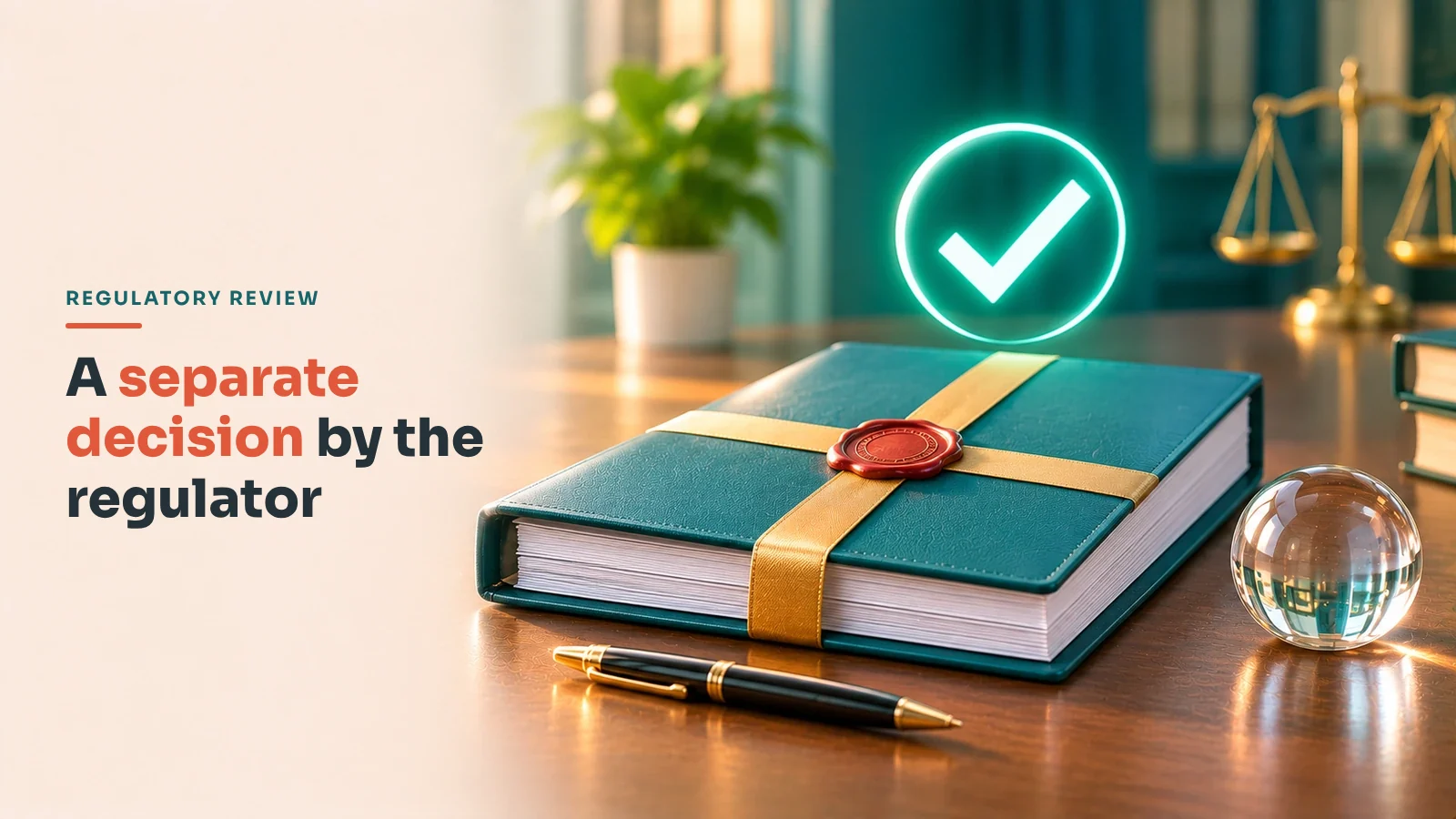
6. Regulatory review is a separate decision
After the required development evidence is submitted, the relevant regulatory authority reviews the whole application. The review is not limited to the phase labels. It considers the quality and consistency of the product, manufacturing controls, non-clinical findings, clinical results, proposed use, labelling and the balance between expected benefits and known or potential risks.
- The whole packagequality, manufacturing, non-clinical and clinical evidence, proposed use and labelling
- Possible outcomesapprove for a defined use, ask for more information, require further studies, restrict or refuse
- A positive Phase IIIdoes not automatically mean approval in every country
The regulator may approve the medicine for a defined use, request additional information, require further studies, restrict the proposed use or refuse the application. A positive Phase III result is important evidence, but it does not automatically mean that a product will be approved in every country or for every indication.
7. Phase IV: research after marketing authorisation
Phase IV studies are conducted after a medicine has received marketing authorisation. They may examine longer-term safety, effectiveness in broader populations, use in routine practice, a new formulation, a different treatment strategy or a new indication.

- After authorisationlonger-term safety, broader populations and routine use
- Planned studiesPhase IV is not identical with pharmacovigilance
- Wider systempharmacovigilance also uses spontaneous reports and safety databases
Phase IV is related to, but not identical with, pharmacovigilance. Phase IV refers to planned studies. Pharmacovigilance is the wider ongoing system for detecting, assessing, understanding and preventing medicine-related problems. It can use spontaneous reports, published research, safety databases and other information from routine use. Read the separate guide to pharmacovigilance and post-marketing medicine safety.
Approval therefore marks a regulatory decision for a defined use—not the end of learning about a medicine.
8. What about Phase 0, and can phases overlap?
Some development programmes use an optional Phase 0 or exploratory study before conventional dose-escalation studies. These are very early studies with limited human exposure, sometimes involving a microdose, and are not intended to provide treatment or demonstrate therapeutic benefit. They are not required for every medicine.
Phases I, II and III are useful categories, but they are not rigid boxes. The Bangladesh DGDA GCP guideline itself notes that distinct boundaries between phases cannot always be drawn. Some programmes use combined Phase I/II or Phase II/III designs, and study plans may adapt as evidence emerges. The design must still protect participants and answer a clearly defined scientific question.
9. How are clinical-trial participants protected?
Participant protection is not a final checklist added after a study is designed. It should shape the protocol, the site, the monitoring plan and every interaction with participants. Important safeguards include:
- Independent ethics review: an Institutional Review Board or Independent Ethics Committee reviews the protocol, consent materials and participant-facing information.
- Informed consent: people should receive understandable information about the purpose, procedures, experimental aspects, possible risks, possible benefits, alternatives and costs before deciding.
- Voluntary choice: a participant may refuse or withdraw without penalty or loss of benefits to which they are otherwise entitled.
- Ongoing safety monitoring: adverse events, serious events, protocol deviations and new information are assessed and reported through the required pathways.
- Confidentiality and reliable data: participant identity is protected, and records must be accurate enough to support trustworthy conclusions.

- Independent ethics reviewof the protocol and consent materials
- Informed consentunderstandable information before deciding
- Voluntary choicerefuse or withdraw without penalty
- Ongoing safety monitoringadverse events assessed and reported
- Confidentialityprotected identity and reliable records
Taking part does not guarantee a personal medical benefit. A trial may not work, may cause harm, or may provide information that helps future patients rather than the person enrolled. Anyone considering a study should ask the research team about the purpose, alternatives, known risks, follow-up, costs and whom to contact if a problem occurs.
10. What does this mean in Bangladesh?
Bangladesh has a national document titled Guidelines for Good Clinical Practice (GCP) for Trials on Pharmaceutical Products Bangladesh, document NRA-CT-G-001, Version 02. The DGDA document states an effective date of December 2023 and describes the local framework for Phase I–IV trials, ethics review, informed consent, safety reporting and regulatory oversight.
For pharmaceutical-product trials, the guideline says the principal investigator should submit the protocol to DGDA with the approved ethical clearance before the trial begins. It also describes DGDA’s responsibilities for protocol review, GCP inspection, oversight of ethics committees and monitoring of serious adverse events. The guideline specifies that written participant information and consent forms should be in Bangla, use language participants can understand, and explain that participation is voluntary and withdrawal is possible without penalty.
These are Bangladesh-specific requirements. A sponsor or researcher should consult the current DGDA guideline, applicable law and the relevant ethics committee rather than assuming that a process used in another country applies locally. The official DGDA website provides the regulator’s published information.
Key takeaways

- Phase I: first-in-human safety, tolerability, dose and PK/PD.
- Phase II: early activity and dose exploration in people with the condition.
- Phase III: larger-scale confirmation of benefit and further safety evidence.
- Regulatory review: a separate decision based on the whole quality, safety and efficacy package.
- Phase IV: planned studies after marketing authorisation; broader safety monitoring continues.
- Phases can overlap, and their boundaries are not always rigid.
- Ethics review, understandable consent, safety monitoring and the right to withdraw are essential throughout.
Frequently asked questions
What is the main purpose of Phase 1?
Phase 1 is the first carefully monitored testing of an investigational medicine in people. It mainly studies safety, tolerability, dose and how the body handles the medicine. It is not designed to prove that the medicine works for everyone.
Are Phase 1 trials always conducted in healthy volunteers?
No. Healthy volunteers are common in many Phase 1 studies, but patients may be enrolled when that is more appropriate or safer—for example, in some cancer-drug studies or when the medicine’s risks make healthy-volunteer testing unsuitable.
Does Phase 3 mean a medicine will be approved?
No. Phase 3 provides important evidence, but a regulator makes a separate decision after reviewing the full evidence package, including quality, nonclinical findings, clinical results, manufacturing and the overall benefit–risk balance.
What is a Phase 0 clinical trial?
Phase 0 usually refers to an optional, very early exploratory study with very limited human exposure, sometimes using a microdose. It is not intended to provide treatment or prove benefit and is not a mandatory step in every development programme.
Can clinical trial phases overlap?
Yes. The phases are useful descriptions of development goals, not rigid boxes. Some programmes combine phases or conduct studies with overlapping objectives. The design depends on the medicine, disease, evidence and regulatory context.
Is Phase 4 the same as pharmacovigilance?
No. Phase 4 refers to planned studies after marketing authorisation. Pharmacovigilance is broader and includes the ongoing collection, assessment and prevention of medicine-related safety problems, including reports from routine use.
Does a ClinicalTrials.gov listing mean a study is approved or endorsed?
No. Sponsors and investigators submit study records. A listing helps make information public, but it does not mean the U.S. government has reviewed or approved the science or safety of every listed study.
Continue learning
- Biosimilars explained: how similar are they to original biologic medicines?
- How are medicines monitored for safety after approval?
- Good Manufacturing Practices and medicine quality
- How medicines work inside the human body
References and further reading
- U.S. FDA — Step 3: Clinical Research
- U.S. FDA — Drug Development and Review Definitions
- U.S. FDA — Exploratory IND Studies Guidance
- U.S. FDA — Phase 1 IND Frequently Asked Questions
- ICH — E8(R1): General Considerations for Clinical Studies
- Bangladesh DGDA — Guidelines for Good Clinical Practice (GCP) for Trials on Pharmaceutical Products, Version 02, effective December 2023
- ClinicalTrials.gov — Learn About Studies
- ClinicalTrials.gov — About the database
Evidence note: Phase descriptions are simplified educational summaries. Actual development programmes vary by product, disease, risk, study design and regulatory jurisdiction. The Bangladesh section is based on the DGDA GCP guideline cited above; it is not a substitute for current regulatory or ethics advice.

Sayedul Abrar
A Grade Pharmacist · Registration Code: A-22040
Product Executive, Product Management Department (PMD) · Opsonin Pharma Ltd.