 Sayedul Abrar
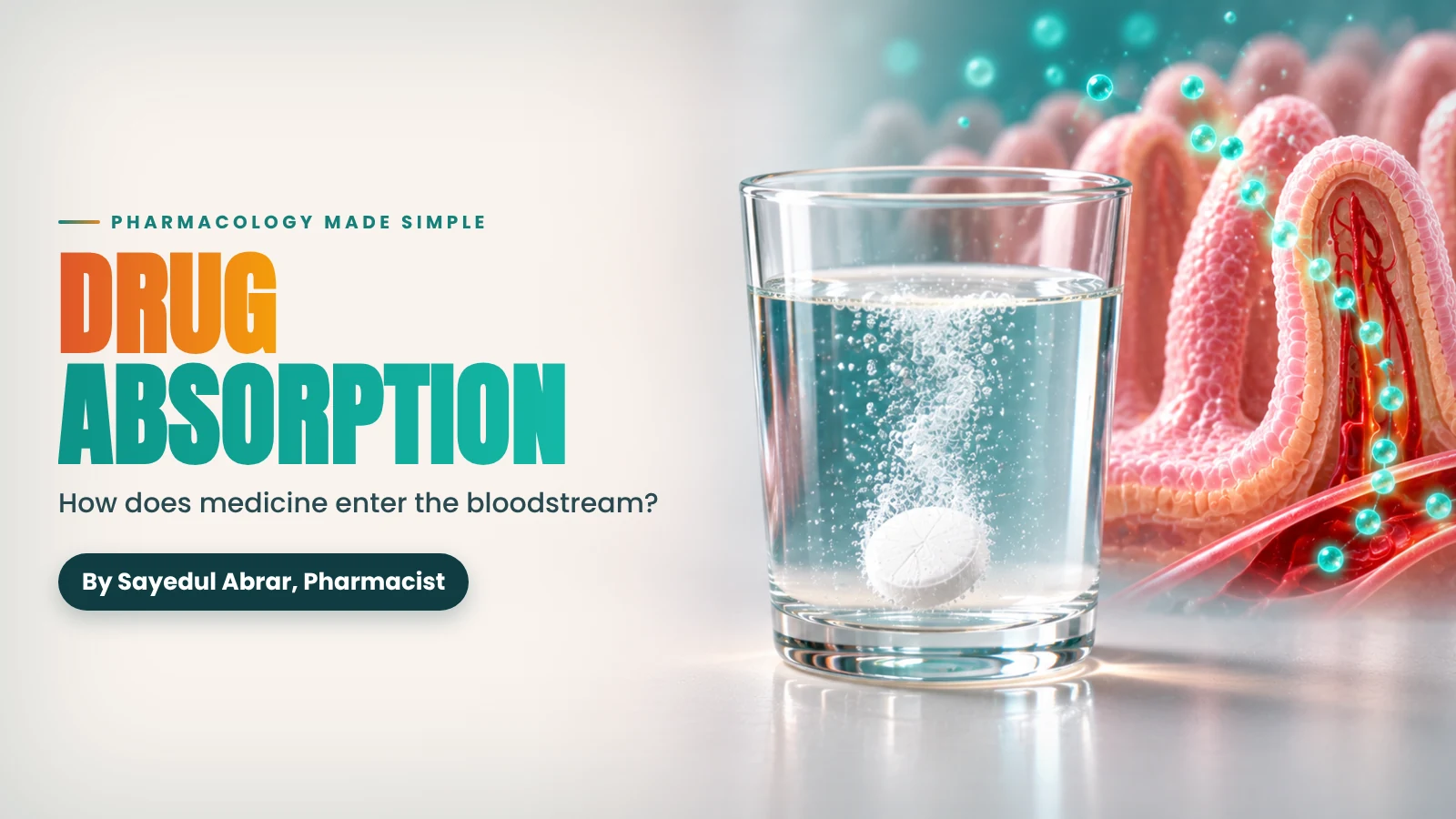
When you swallow a tablet, does it go directly into your blood? No. Several steps usually take place before the active ingredient becomes available in the circulation. Let us understand these steps in simple language.
1. What is drug absorption?
Drug absorption is the movement of a drug from its site of administration into the blood. It is an important part of pharmacokinetics—the study of what the body does to a medicine.
Absorption depends on the route of administration. A swallowed tablet, an inhaled medicine, an injection and a skin patch do not enter the body in the same way.
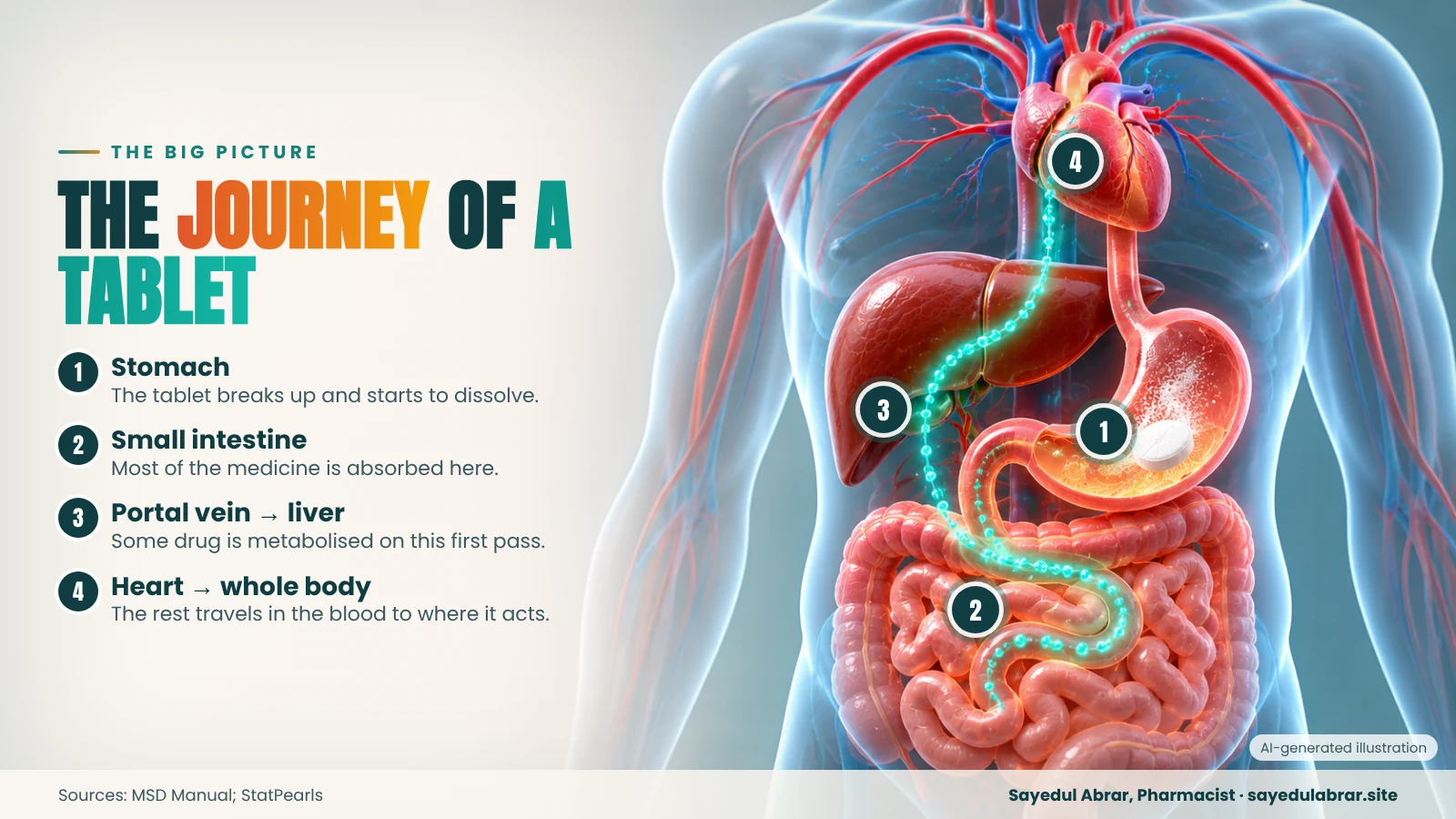
2. What happens after you swallow a tablet?
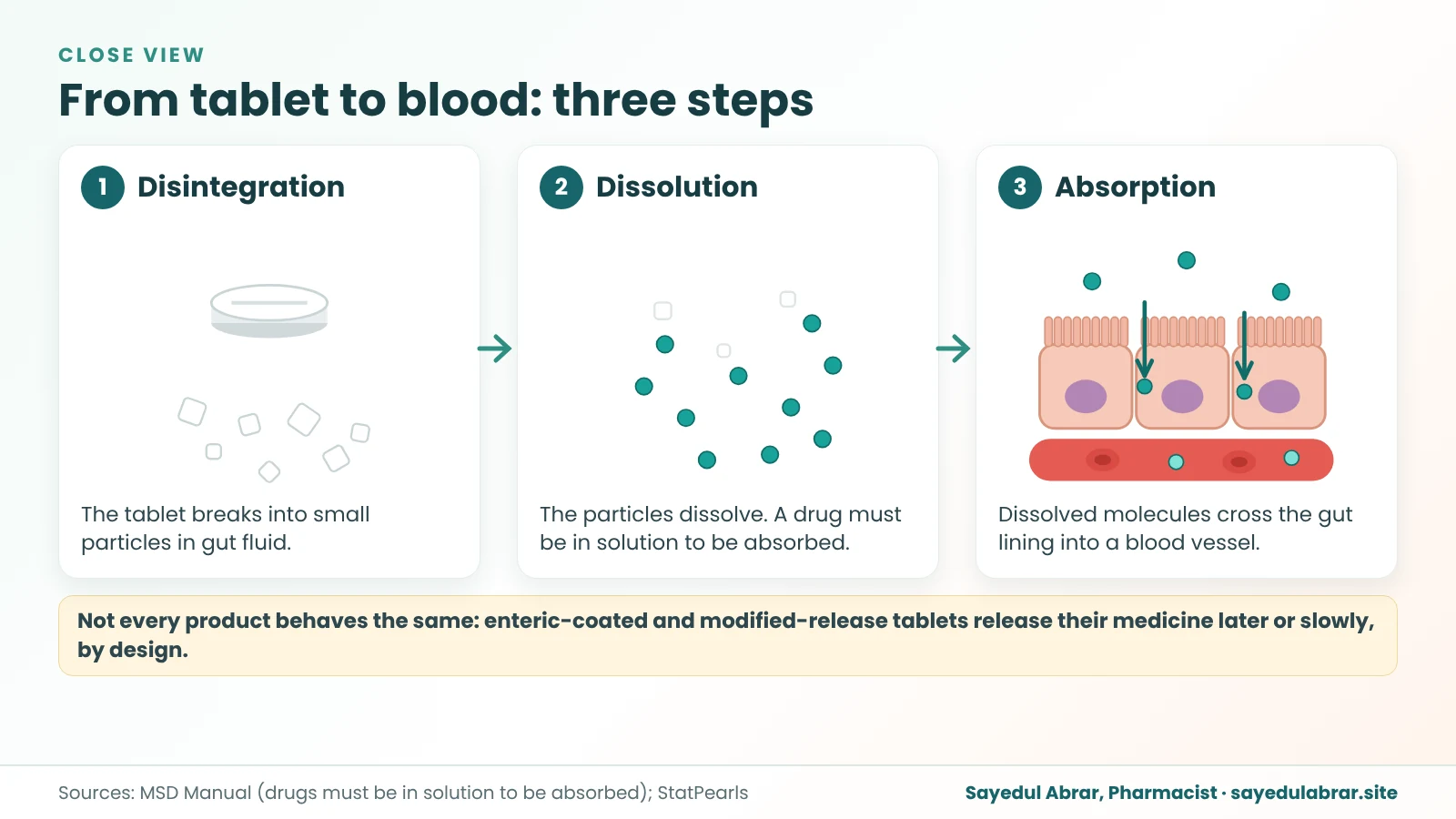
For many conventional oral tablets, the process can be understood in three main stages:
Step 1: Disintegration
The tablet breaks into smaller particles after contact with fluid in the gastrointestinal tract. This process is called disintegration. Capsules may open and release their contents, while modified-release products behave differently by design.
Step 2: Dissolution
The drug particles dissolve in gastrointestinal fluid. The active ingredient must generally be in a dissolved form before it can cross biological membranes and be absorbed. A medicine's solubility and formulation can therefore affect how quickly and how much drug becomes available.
Step 3: Crossing the intestinal wall
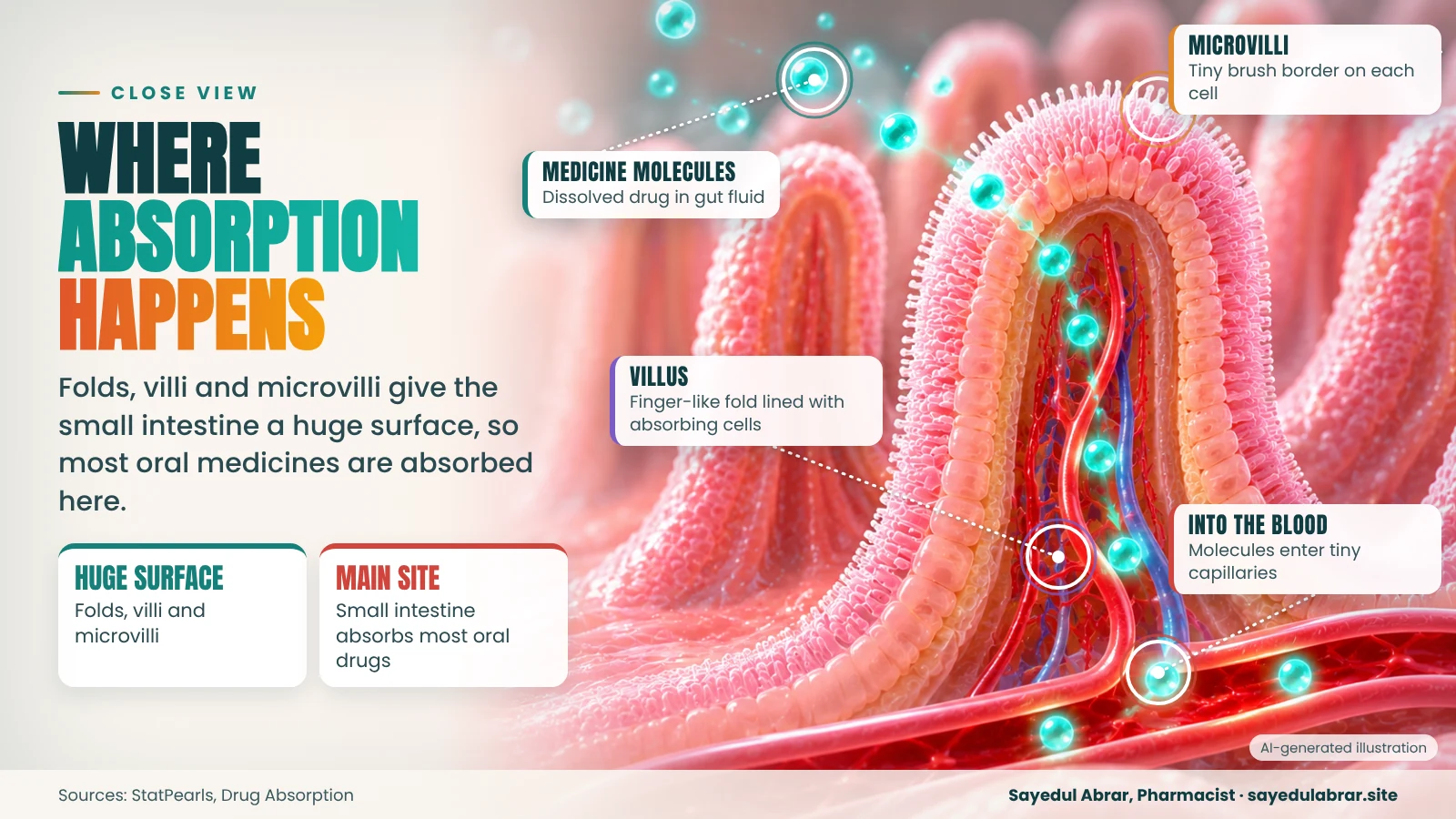
Many medicines are absorbed mainly through the small intestine. Dissolved drug molecules move across the intestinal lining and enter nearby blood vessels. The small intestine has folds and tiny projections called villi and microvilli, which provide a large surface area for absorption.
3. Does every medicine get absorbed in the same place?
No. The site and extent of absorption depend on the medicine and its formulation. Some medicines are absorbed in the stomach, while many are absorbed mainly in the small intestine. Some products are designed to release their ingredients later or at a particular part of the gut.
For example, an enteric-coated tablet is designed to resist breaking down in the stomach and release its medicine further along the gastrointestinal tract. This is a formulation feature, not a guarantee that all of the drug will be absorbed.
4. How do medicine molecules cross the gut wall?
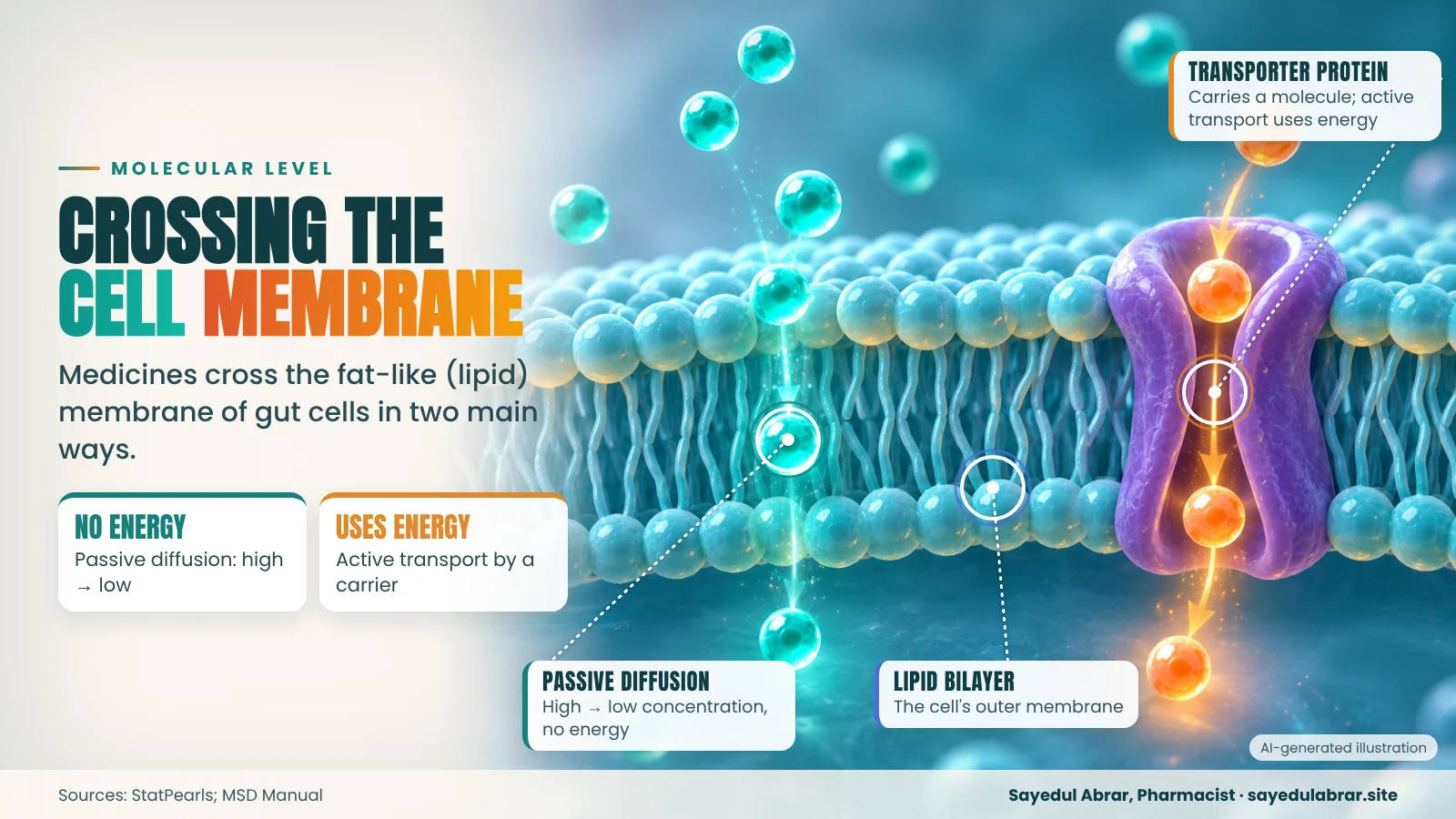
Dissolved molecules still have to pass through the cells that line the gut. The outer layer of each cell, the cell membrane, is made of fat-like (lipid) molecules. Medicines cross it mainly in two ways:
- Passive diffusion: the most common way. Molecules move from where there is more drug (the gut) to where there is less (the blood), without using energy. Fat-soluble, un-ionised molecules cross most easily.
- Carrier-mediated transport: special proteins in the membrane carry certain molecules across. Active transport uses energy and can move a drug against its concentration gradient. These carriers can become saturated, and similar drugs can compete for them.
Some proteins work in the opposite direction. Efflux pumps such as P-glycoprotein push some drugs back into the gut, which can reduce how much is absorbed.
5. What is bioavailability?
Bioavailability describes the rate and extent to which the active ingredient reaches the systemic circulation. For an intravenous injection, bioavailability is 100% because the drug is placed directly into the bloodstream. For an oral medicine, the amount reaching the systemic circulation may be lower.
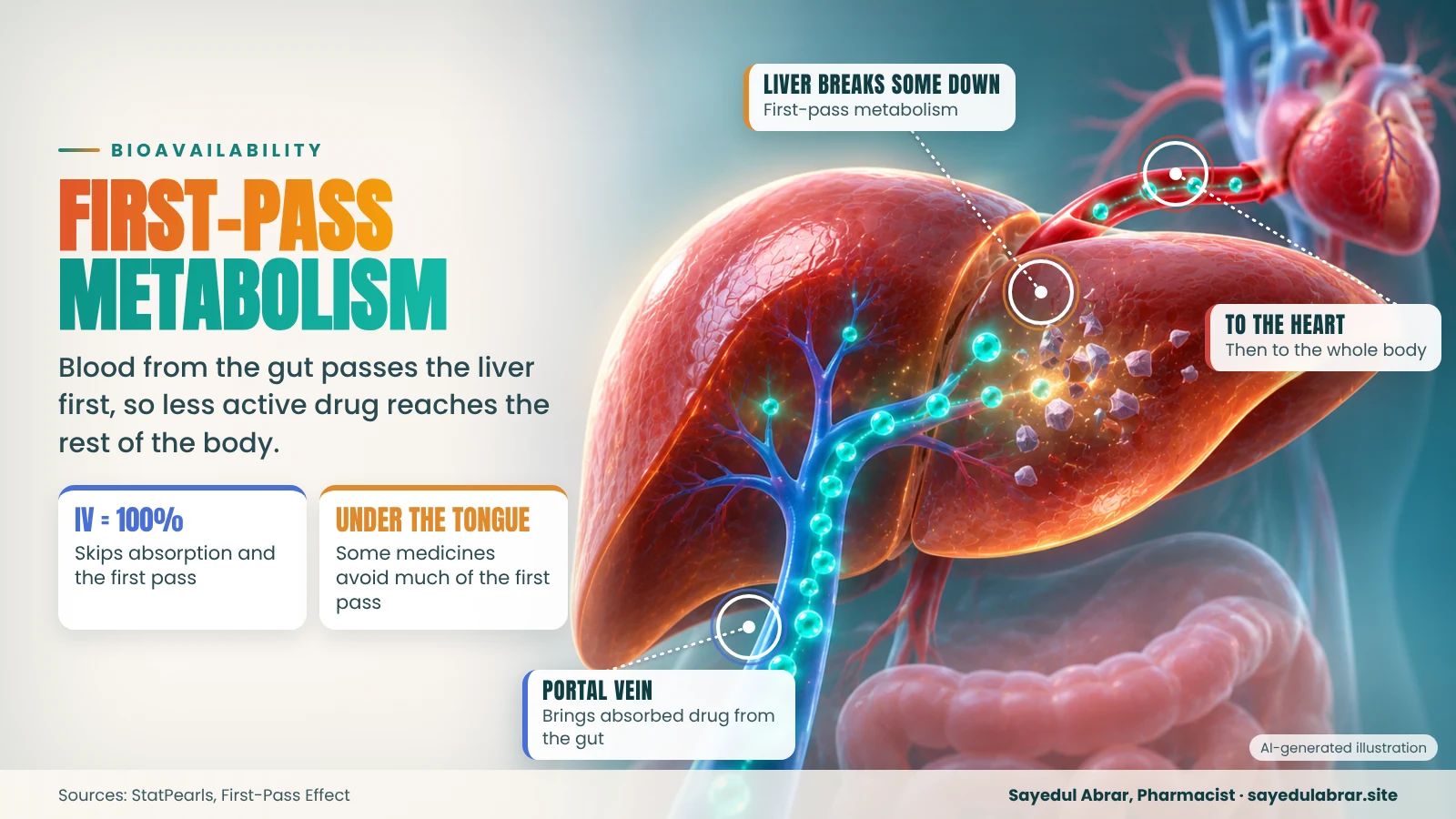
Why? Some of the dose may not be absorbed, and some may be metabolised in the intestinal wall or liver before it reaches the general circulation. This is known as first-pass metabolism.
Here is the route behind first-pass metabolism. Blood leaving the intestine does not go straight to the rest of the body. It first travels through the portal vein to the liver. Some of the drug can be broken down in the gut wall and the liver on this first pass, so less active drug reaches the general circulation. A medicine given into a vein skips this step, and some medicines absorbed under the tongue, such as nitroglycerin, can bypass much of it.
6. What can affect drug absorption?
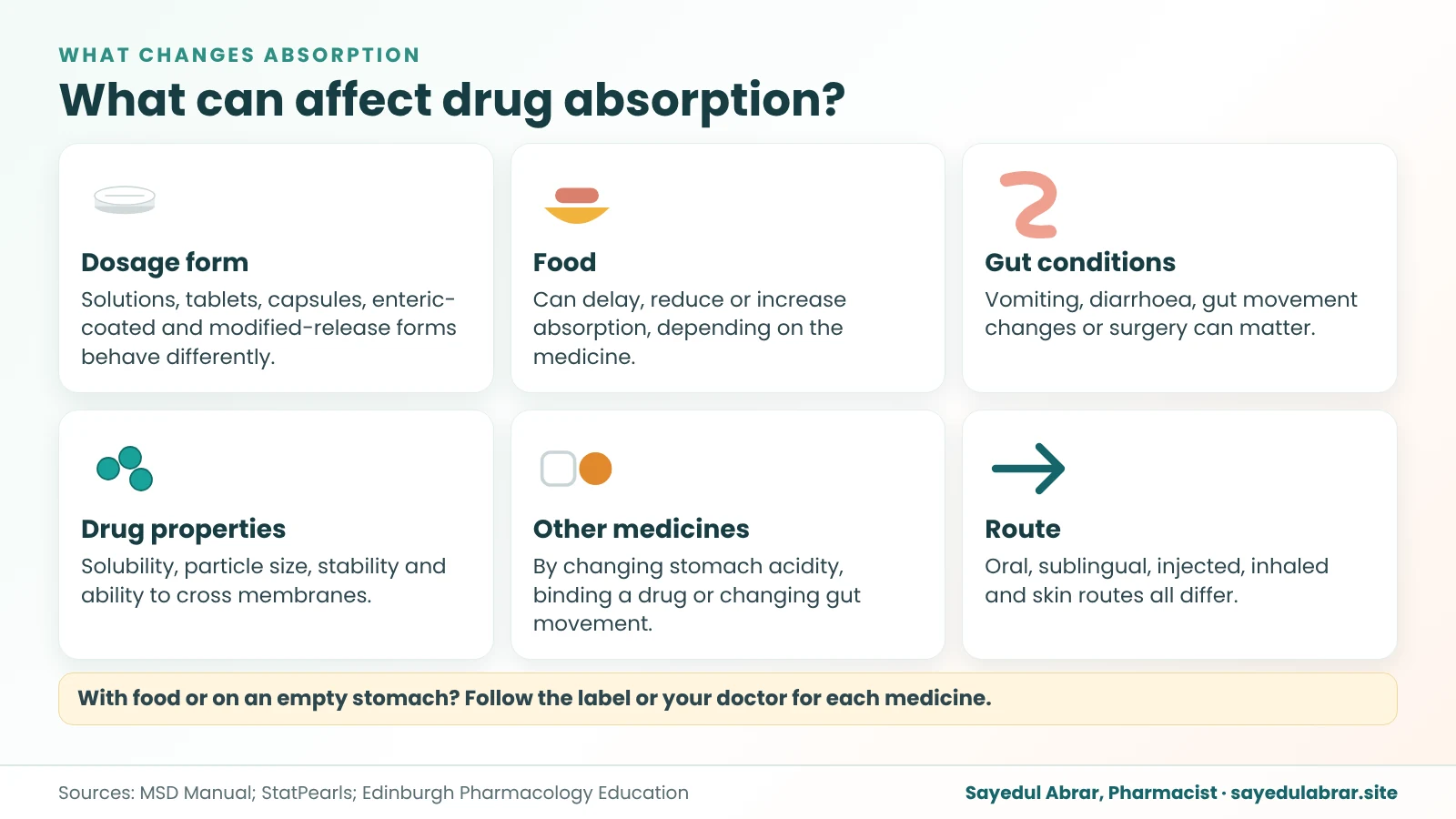
- Dosage form: A solution, ordinary tablet, capsule, enteric-coated tablet and modified-release product can behave differently.
- Food: Food may delay, reduce or sometimes increase the absorption of particular medicines. The effect is medicine-specific.
- Gastrointestinal conditions: Vomiting, diarrhoea, changes in gut movement, surgery or certain diseases may affect absorption.
- Drug properties: Solubility, particle size, stability and ability to cross membranes can influence absorption.
- Other medicines: Some medicines interact by changing stomach acidity, binding another drug or altering gut movement.
- Route of administration: Oral, inhaled, topical, sublingual, intramuscular and intravenous routes have different absorption patterns.
7. Do all routes need an absorption step?
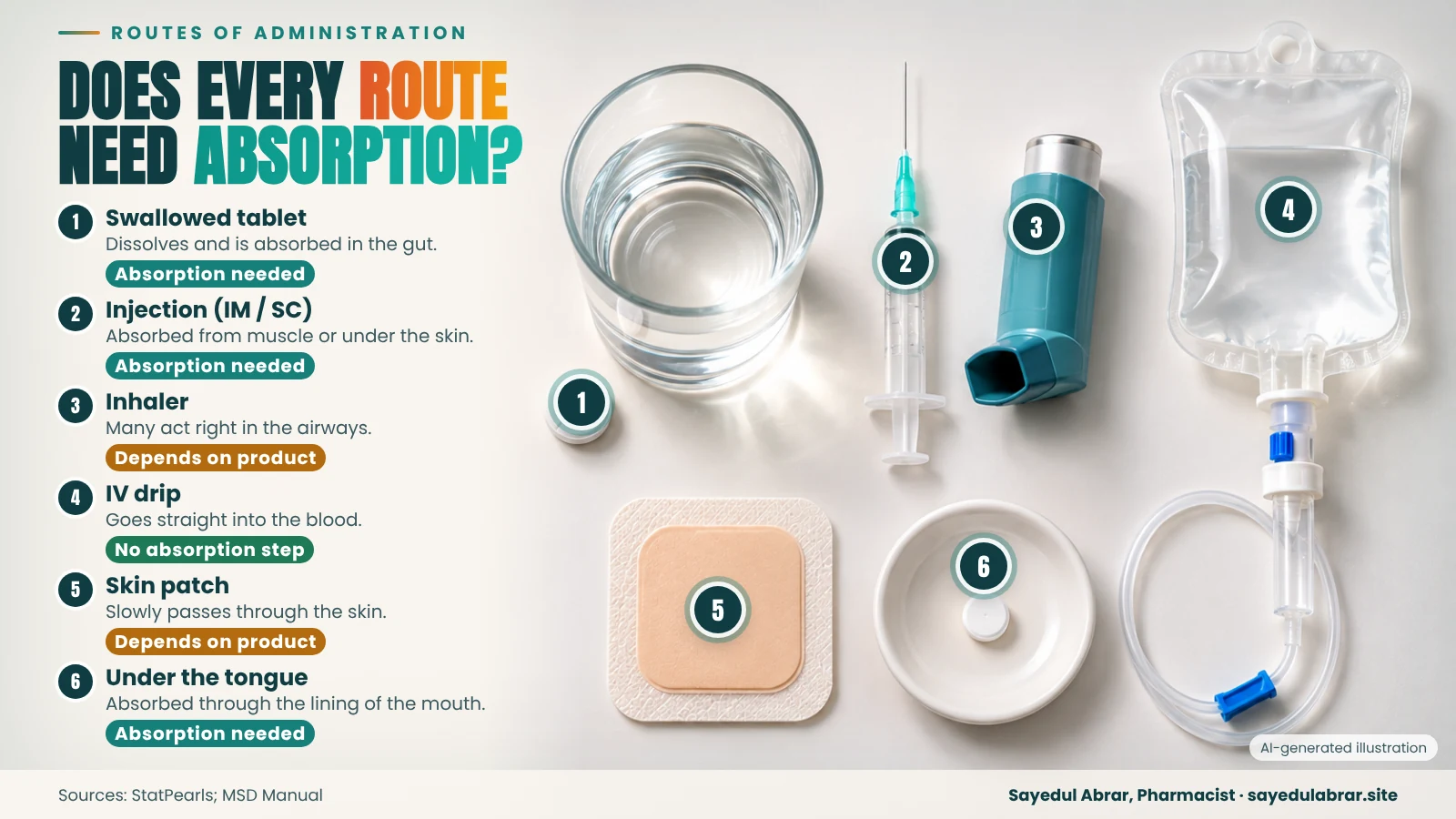
Not in the same way. An intravenous medicine enters the bloodstream directly, so it does not need to be absorbed from another site first. Intramuscular and subcutaneous injections must move from the injection site into the circulation. Inhaled medicines are deposited in the respiratory tract, while topical medicines are intended to act on or pass through the skin depending on the product.
Medicines placed under the tongue (sublingual) are absorbed through the lining of the mouth.
8. A simple example from everyday medicine use
Imagine taking a standard oral pain-relief tablet. The tablet first breaks apart and the active ingredient dissolves in gastrointestinal fluid. The dissolved drug then crosses the gut lining and enters the blood. It can travel to tissues where it produces its effect. The body later metabolises and eliminates the drug.
This is a simplified explanation. The exact timing and amount absorbed vary by medicine, formulation and person. Never crush, split or open a medicine unless its product instructions or a healthcare professional say it is appropriate.
Key takeaways
- Absorption means movement of a drug from its administration site into the bloodstream.
- Many oral tablets must disintegrate and dissolve before the drug can cross the gut wall.
- The small intestine provides a large surface area through villi and microvilli.
- Bioavailability is the rate and extent that active drug reaches systemic circulation.
- Food, formulation, gut conditions, drug properties and route can affect absorption.
Frequently asked questions
How long does a tablet take to absorb?
There is no single time for all tablets. It depends on the medicine, formulation, food, gastrointestinal conditions and the person taking it.
Are absorption and dissolution the same?
No. Dissolution means the drug dissolves in fluid. Absorption means the drug moves from its administration site into the bloodstream.
Why are many medicines absorbed in the small intestine?
The small intestine has a large surface area and a rich blood supply, which support absorption of many medicines.
Does food always reduce medicine absorption?
No. Food can reduce, delay, increase or have little effect on absorption depending on the medicine. Follow the instructions for the specific product.
What is first-pass metabolism?
It is the metabolism of a drug in the gut wall or liver after absorption from the gastrointestinal tract but before it reaches the general circulation.
What is passive diffusion?
It is the most common way medicines cross cell membranes. Molecules move from an area of higher concentration to an area of lower concentration without using energy.
Why does a medicine given into a vein work differently from a tablet?
An intravenous (IV) medicine goes straight into the bloodstream, so its bioavailability is 100% and there is no absorption or first-pass step. A tablet must dissolve, be absorbed and pass the liver first.
Continue learning: How do medicines work in the body? connects absorption with distribution, metabolism, excretion and the difference between pharmacokinetics and pharmacodynamics.
References and further reading
- Alagga AA, Pellegrini MV, Gupta V. Drug Absorption. StatPearls (NCBI Bookshelf), updated 27 February 2024. www.ncbi.nlm.nih.gov — mechanisms of absorption, small intestine, bioavailability.
- First-Pass Effect. StatPearls (NCBI Bookshelf). www.ncbi.nlm.nih.gov — first-pass metabolism and routes that bypass it.
- Pharmacokinetics. StatPearls (NCBI Bookshelf). www.ncbi.nlm.nih.gov — absorption within pharmacokinetics.
- MSD Manual Professional Edition. Drug Absorption (reviewed August 2026). www.msdmanuals.com — drugs must be in solution, passive diffusion, transporters, routes.
- Merck Manual Professional Edition. Overview of Pharmacokinetics. www.merckmanuals.com — general overview.
Editorial note: This article gives a simplified introduction. Absorption characteristics should be checked in the approved product information for each medicine.

Sayedul Abrar
A Grade Pharmacist · Registration Code: A-22040
Product Executive, Product Management Department (PMD) · Opsonin Pharma Ltd.