Sayedul Abrar
Quick answer: when to take a PPI
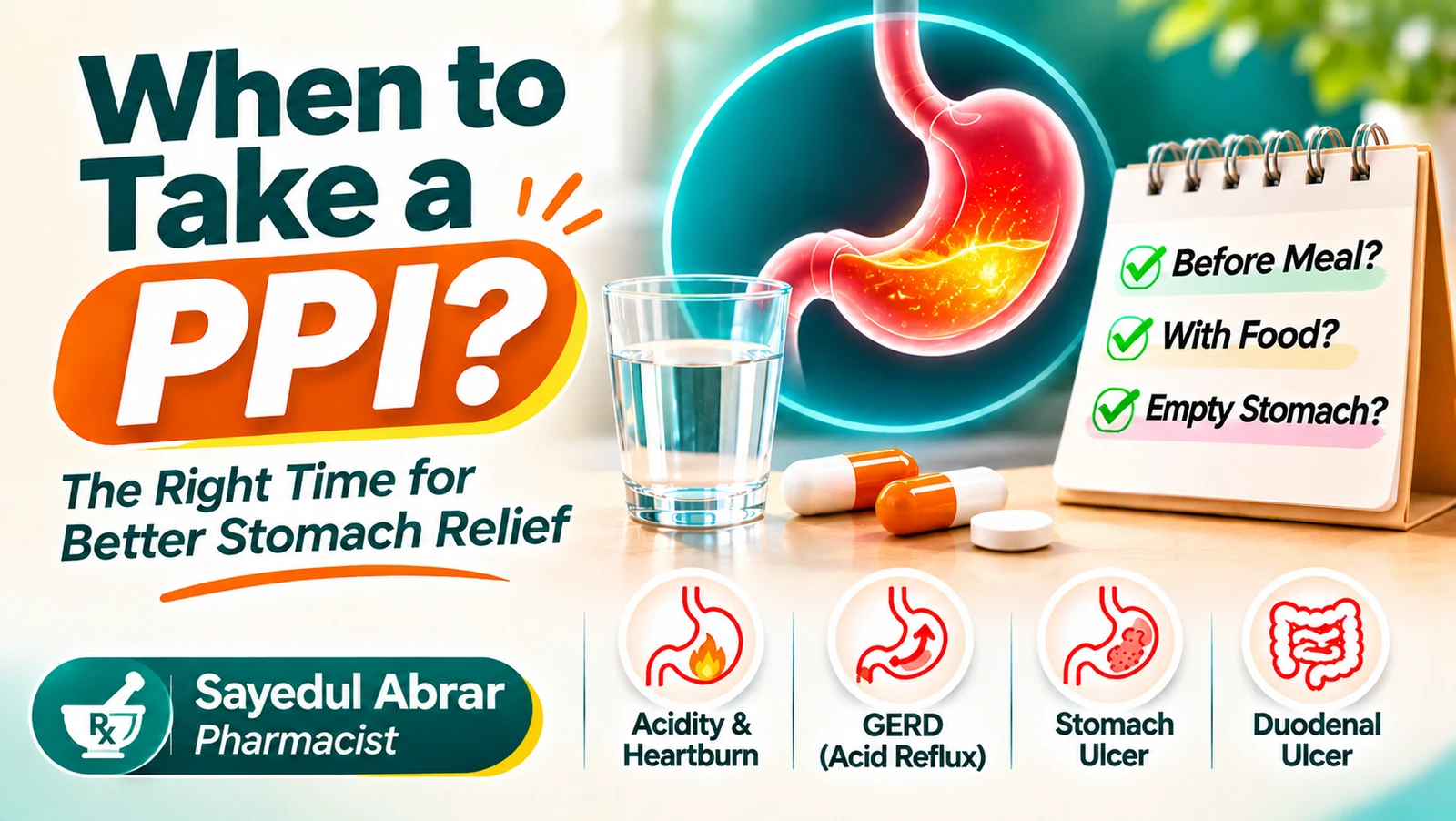
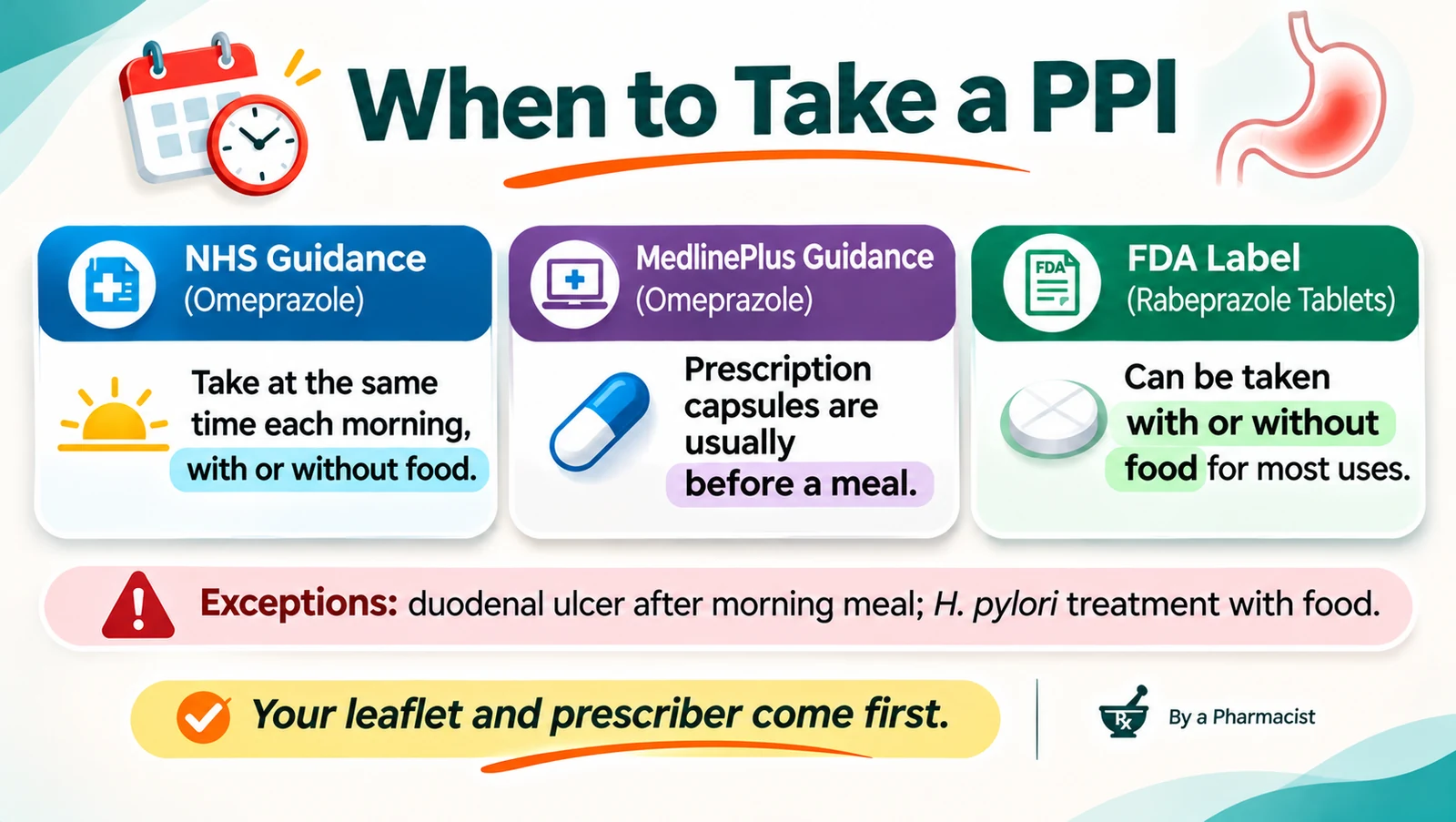
Rabeprazole tablets can be taken with or without food for most uses, according to the FDA label. Omeprazole advice varies: the NHS says morning, with or without food, while MedlinePlus says prescription capsules are usually taken before a meal. Swallow tablets whole, never chew or crush them, and follow your prescriber and leaflet.
- Timing: pick one time and keep it. The NHS says morning for once-a-day omeprazole.
- Rabeprazole tablets: with or without food for most uses (FDA label). Exceptions: duodenal ulcer, after the morning meal; H. pylori therapy, with food.
- Omeprazole: NHS says with or without food; MedlinePlus says prescription capsules are usually taken before a meal.
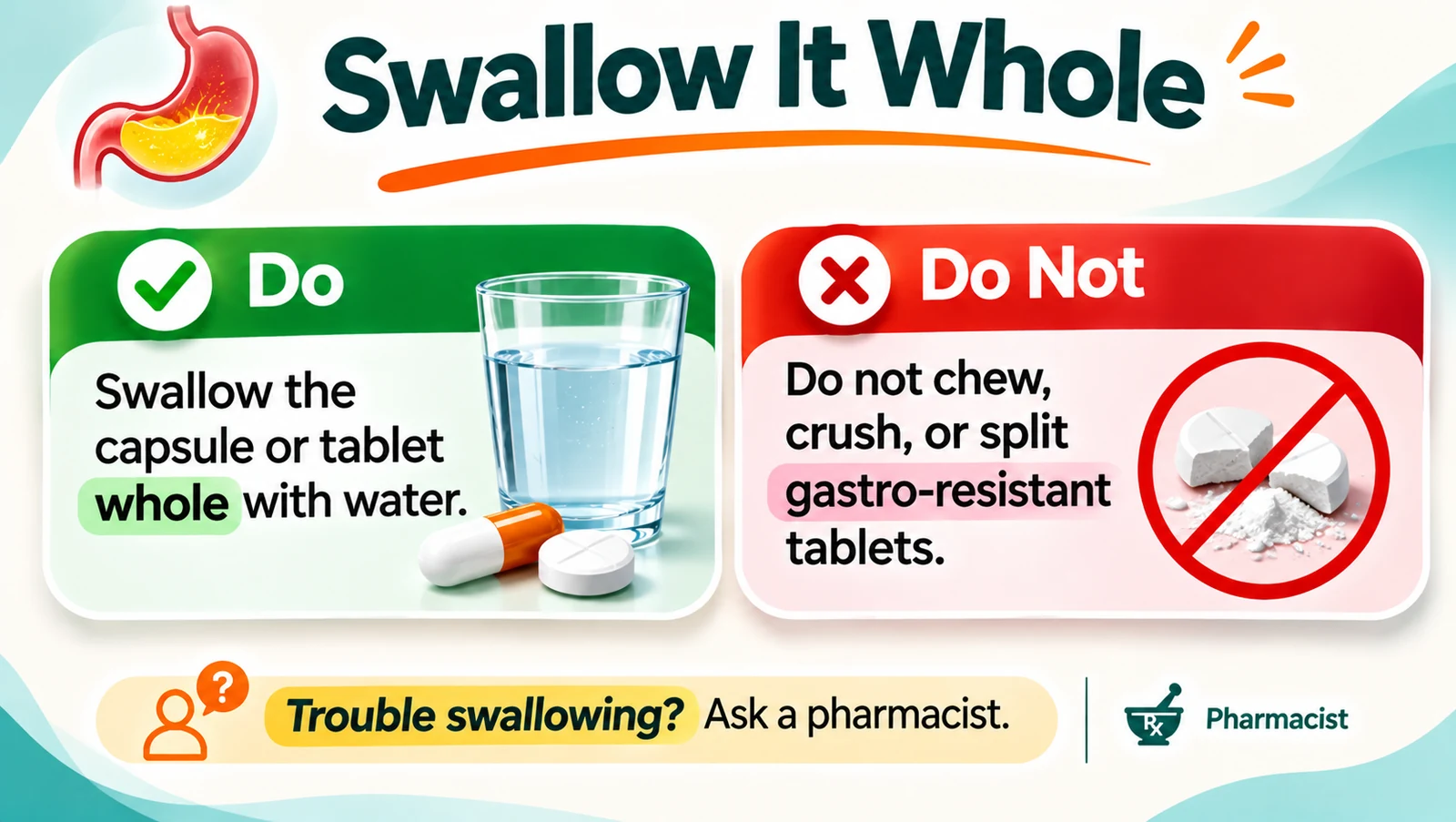
- Swallow whole with water. Do not chew or crush enteric coated or gastro-resistant tablets.
- Do not self-treat for long: non-prescription packs are for 2 weeks (NHS) or 14 days (MedlinePlus).
What is a PPI?
PPI stands for proton pump inhibitor. It is a type of medicine that reduces stomach acid. Omeprazole, lansoprazole and rabeprazole are examples. According to the NHS, omeprazole is used to treat or prevent stomach ulcers, heartburn and gastro-oesophageal reflux disease (GORD), and, alongside antibiotics, Helicobacter pylori infection. If you want to understand the symptoms first, read my article on heartburn, acid reflux and GERD.
How does a PPI work, and how fast?
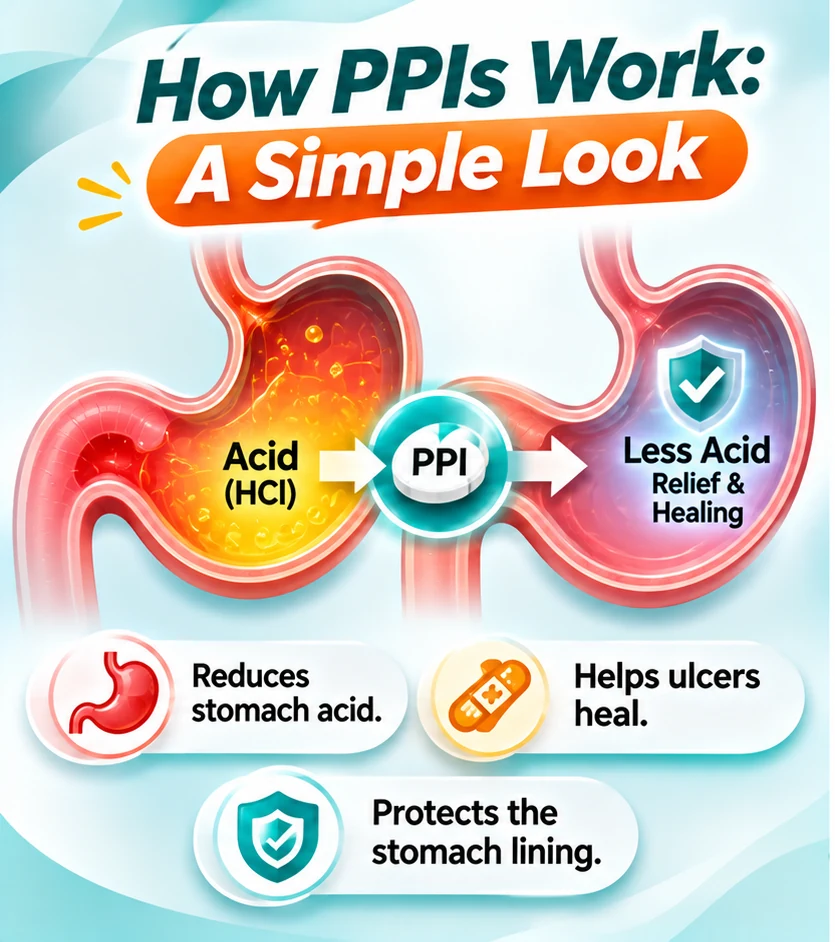
A PPI reduces the amount of acid your stomach makes, which is why it is used for ulcers, heartburn and reflux (NHS). For rabeprazole, the FDA label says the acid-reducing effect begins within one hour of taking a 20 mg tablet. That describes the effect on acid, so do not expect every symptom to vanish within an hour. The same label adds a useful warning: feeling better on treatment does not rule out a more serious stomach problem, which is one more reason to see a doctor if symptoms keep returning.
A common story (illustrative, fictional)
Rafi, 34, buys a gas medicine whenever his chest burns. Some days he takes it in the morning, some days at night. When the tablet is hard to swallow he chews it. After three months he is still buying strips without a check-up. A pharmacist would ask him to read the leaflet, keep a fixed time, swallow the tablet whole and see a doctor, because heartburn lasting three months or more is one of the reasons MedlinePlus gives for calling a doctor. This is an example, not a real patient.
When should you take a PPI?
This is the part where trusted sources do not say exactly the same thing, and that is normal. Products, strengths and conditions differ. The table shows what each source states.
| Source | Medicine | What it says about timing |
|---|---|---|
| NHS | Omeprazole | Same time each morning if once a day, or morning and evening if twice a day. With or without food. |
| MedlinePlus | Omeprazole (prescription capsules) | Usually once a day before a meal. |
| MedlinePlus | Omeprazole (non-prescription tablets) | Once a day in the morning, at least 1 hour before eating, for 14 days in a row. |
| FDA label (2023) | Rabeprazole delayed-release tablets | Most uses: with or without food, “without regard to timing of meals”. Duodenal ulcer: after the morning meal. H. pylori triple therapy: with food, twice daily. |
| Mayo Clinic | Rabeprazole tablets | With or without food. Swallow whole. |
| UK patient leaflet (eMC) | Rabeprazole 20 mg tablets | Mostly once a day. The section does not specify morning or food. For H. pylori, twice a day, normally for 7 days. |
The honest answer is therefore this: if your label says before a meal, follow that. If your product allows food, it is fine. Either way, take it at a consistent time.
Can rabeprazole be taken with or without food, at any time?
For the tablet, mostly yes. The FDA label for rabeprazole delayed-release tablets says: “For all other indications ACIPHEX delayed-release tablets can be taken with or without food.” The two exceptions it names are duodenal ulcer (after the morning meal) and H. pylori eradication (with food, together with the two antibiotics). On food, the label explains that a high-fat meal may delay absorption by up to 4 hours or longer, but the peak level and the total amount absorbed are not significantly altered, so the tablets may be taken without regard to timing of meals.
The label also says a significant portion of rabeprazole is broken down by a non-enzymatic reduction in the body, besides CYP3A and CYP2C19. This is simply why the label does not tie it to one strict clock time. Even so, a consistent daily time is easier to remember. The label does not say anything about acid control being better or worse at a particular time, so I will not claim that.
Example: Finix tablet, Finix MUPS and Finix 10 sprinkle
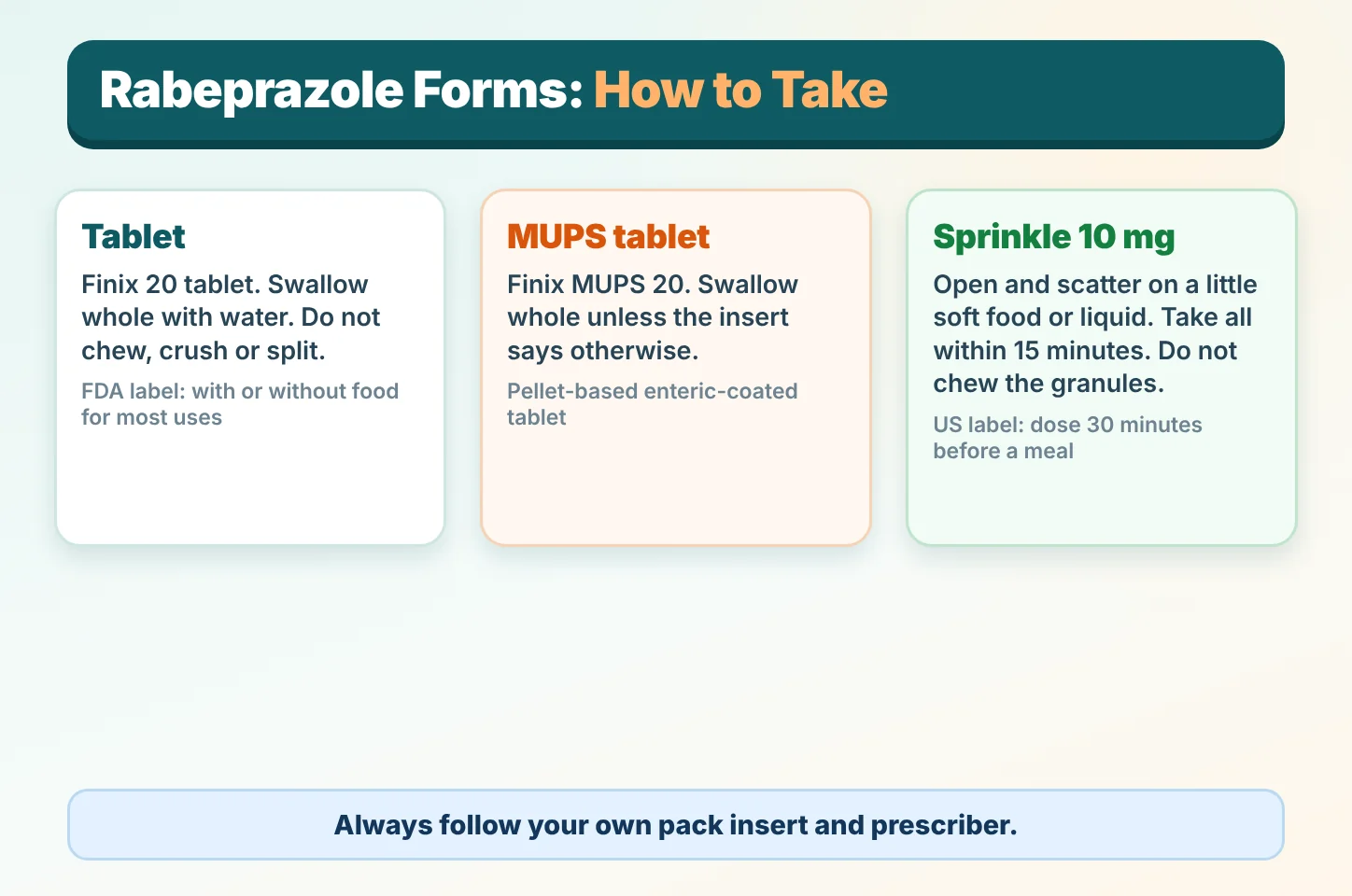
In Bangladesh, rabeprazole is sold under many brand names. Finix, which I use here as a worked example, comes in three forms, and each one is taken a little differently. These are product examples to explain the dosage forms, not an advertisement or a replacement for your doctor’s advice.
- Finix 20 tablet: an enteric-coated rabeprazole tablet. Swallow it whole with water; do not chew, crush or split it. For most uses it can be taken with or without food.
- Finix MUPS 20: a 20 mg Multiple-Unit Pellet System tablet. Instead of one solid core, the dose is carried in many small enteric-coated pellets inside one tablet. Swallow it whole unless the insert says otherwise.
- Finix 10 sprinkle capsule: a 10 mg delayed-release capsule that is opened instead of swallowed whole. Scatter the contents on a small amount of soft food (for example applesauce or yogurt) or liquid at or below room temperature, take the whole dose within 15 minutes and do not chew the granules. This form can help when swallowing a whole tablet is difficult, for example in young children (the US label covers ages 1 to 11 years with GERD).
One detail to watch: the US prescribing information for the sprinkle capsule says to take the dose 30 minutes before a meal, and the 15 minutes is the time limit after mixing with soft food or liquid. If the insert in your own pack states something different, follow your insert.
How to swallow it
The NHS says to swallow omeprazole with water and not to chew or crush capsules or tablets labelled enteric coated or gastro-resistant. The UK rabeprazole leaflet is blunt: the tablet must be swallowed whole, not crushed or chewed. If swallowing is hard, the NHS suggests asking a pharmacist. MedlinePlus describes opening omeprazole capsules onto applesauce, and the NHS notes some tablets can be dissolved in water. Those are product-specific, so only do it if your own leaflet says so.
Common mistakes to avoid
- Chewing or crushing a gastro-resistant tablet.
- Random timing, some days morning and some days night.
- Doubling a missed dose to catch up.
- Running non-prescription packs for months instead of the 2 weeks or 14 days stated by the NHS and MedlinePlus.
- Ignoring warning signs such as trouble swallowing, black stools or weight loss.
- Not mentioning other medicines and supplements.
- Drinking alcohol: the NHS says it is best not to, because alcohol can raise stomach acid and worsen symptoms.
How long can you take it?
The NHS says some people need omeprazole for only a few days, others for weeks, months or years. It also says the chance of serious side effects can be higher after a year or more. These are mostly rare and include low vitamin B12, weakened bones that may break more easily, a severe allergic reaction, and a type of lupus causing rashes and joint pain. MedlinePlus similarly says PPIs may raise the risk of fractures of the wrists, hips or spine, with the highest risk at high doses or when used for a year or longer. If you are on a PPI long term, ask your doctor to review whether you still need it. Do not stop a prescribed PPI on your own.
Medicines to mention to your pharmacist
| Medicine | What the source says | Source |
|---|---|---|
| Warfarin, clopidogrel | May not mix well with omeprazole | NHS |
| Digoxin, diazepam, phenytoin | May not mix well with omeprazole | NHS |
| Lansoprazole, famotidine | Other acid-reducing medicines that may not mix well with omeprazole | NHS |
| St John’s wort, iron supplements | Tell your doctor and pharmacist if you take them | MedlinePlus; NHS lists St John’s wort |
| Nelfinavir, atazanavir (HIV medicines) | May not mix well with omeprazole. The rabeprazole leaflet says atazanavir should not be used together with rabeprazole | NHS; UK leaflet |
| Ketoconazole, itraconazole | Rabeprazole may lower the amount of these medicines in your blood | UK leaflet |
| High-dose methotrexate | The doctor may temporarily stop rabeprazole | UK leaflet |
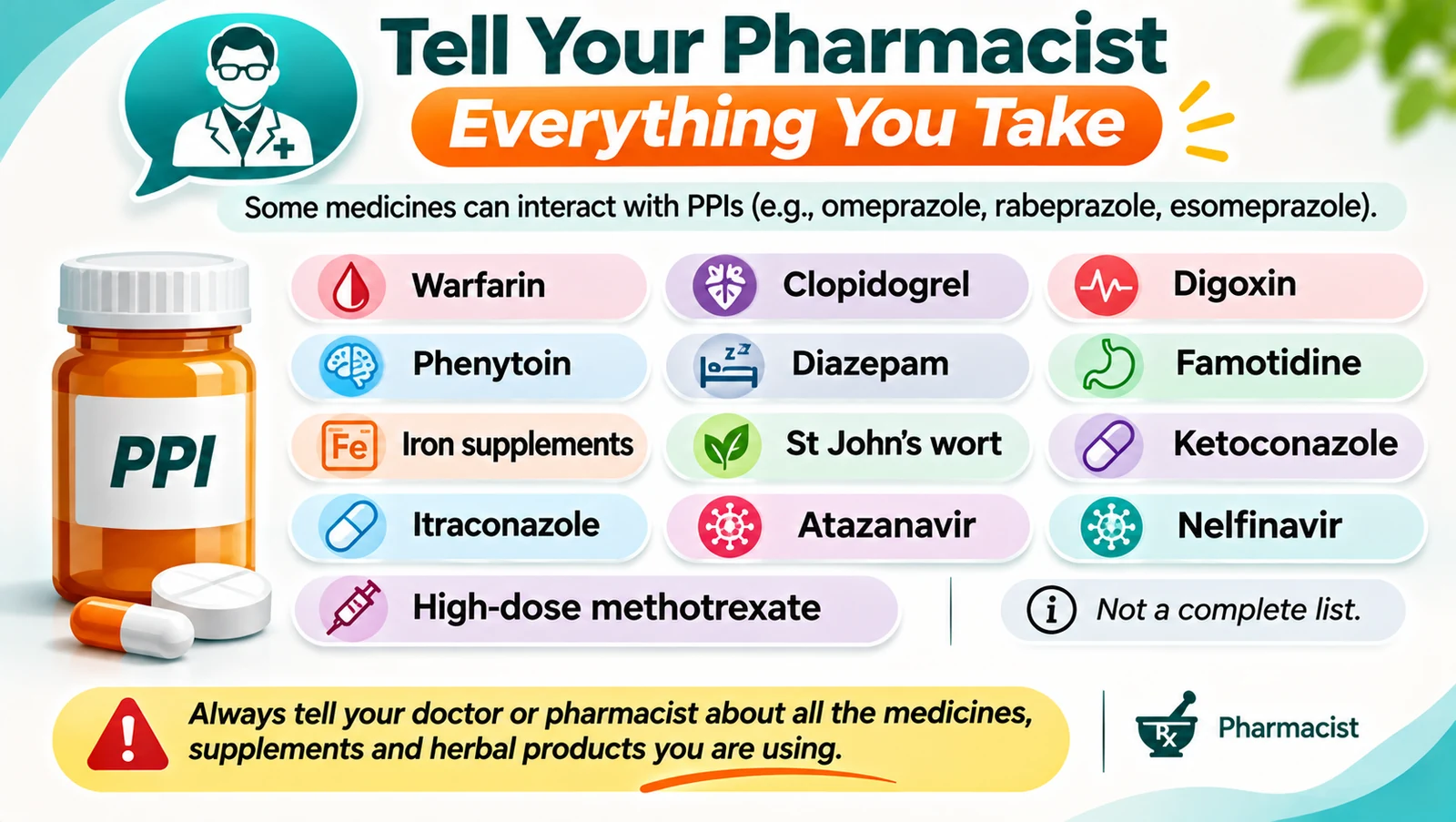
This is not a full list, and different PPIs have different interactions. I also covered one example in my article on iron tablets.
What are the common side effects?
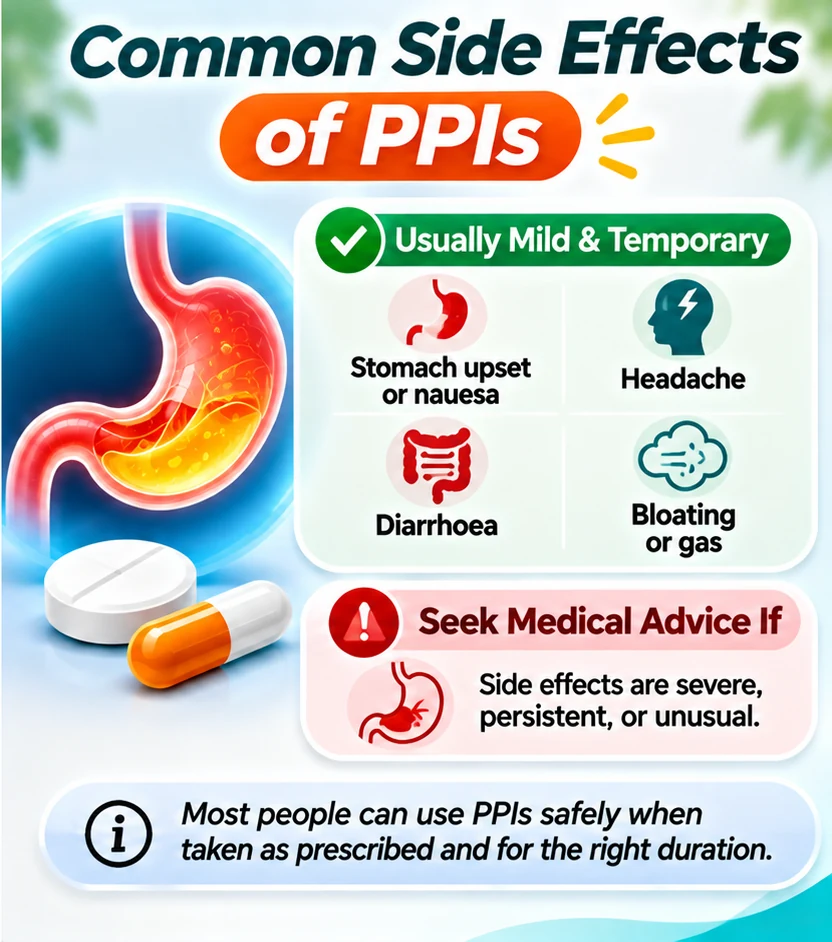
The NHS lists these as common side effects of omeprazole: headache, stomach pain, feeling sick or being sick, constipation or diarrhoea, and passing wind more than usual. It advises speaking to a pharmacist or doctor if side effects bother you or do not go away, and to keep taking the medicine unless you are told not to. Serious side effects are mostly rare. The NHS says to call NHS 111 (in the UK) if you think you may be having them. Where you live, contact your doctor or pharmacist.
What if I miss a dose, or take too much?
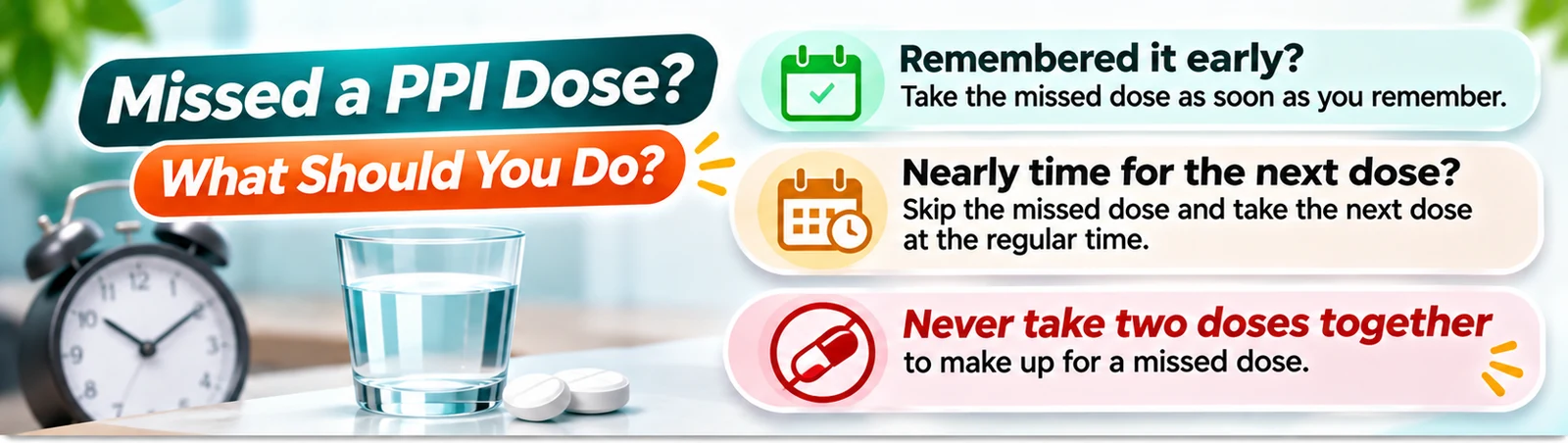
The NHS and MedlinePlus agree: take a missed dose as soon as you remember, unless the next dose is nearly due, and never take two doses together. A UK rabeprazole leaflet adds that if you forget your medicine for more than 5 days, call your doctor before taking any more. The NHS says an extra dose is unlikely to cause problems, but advises getting medical advice if you take too much, and bringing the packet with you.
When to see a doctor
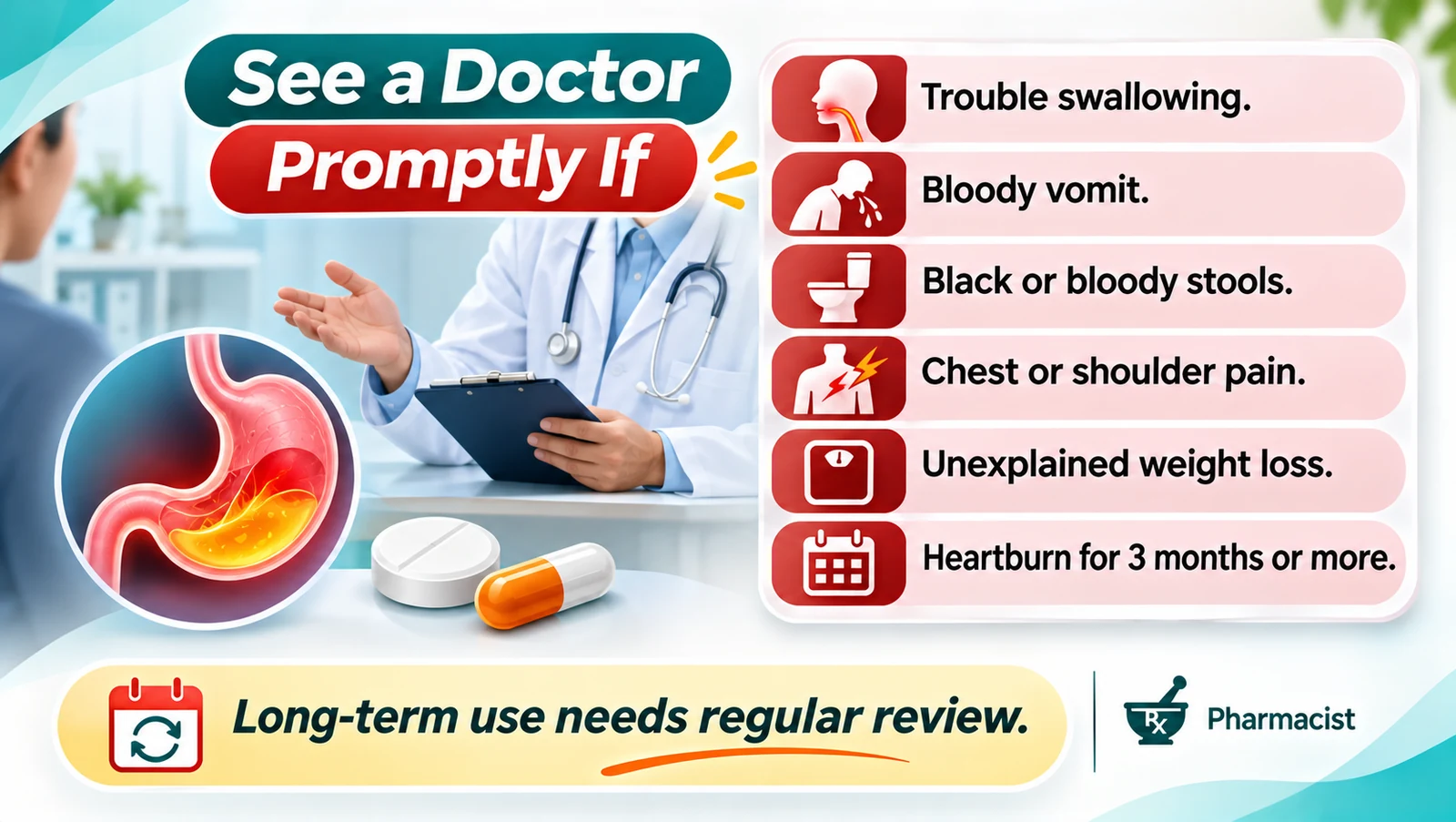
MedlinePlus lists these reasons to call a doctor if you are using non-prescription omeprazole for heartburn: heartburn lasting 3 months or longer, no improvement after 14 days, chest or shoulder pain, shortness of breath, unexplained weight loss, vomiting (especially bloody), stomach pain, trouble swallowing, or black or bloody stools. A UK rabeprazole leaflet says to stop and see a doctor straight away for severe watery or bloody diarrhoea with fever, abdominal pain or tenderness, and to seek care for sudden swelling of the face or difficulty breathing.
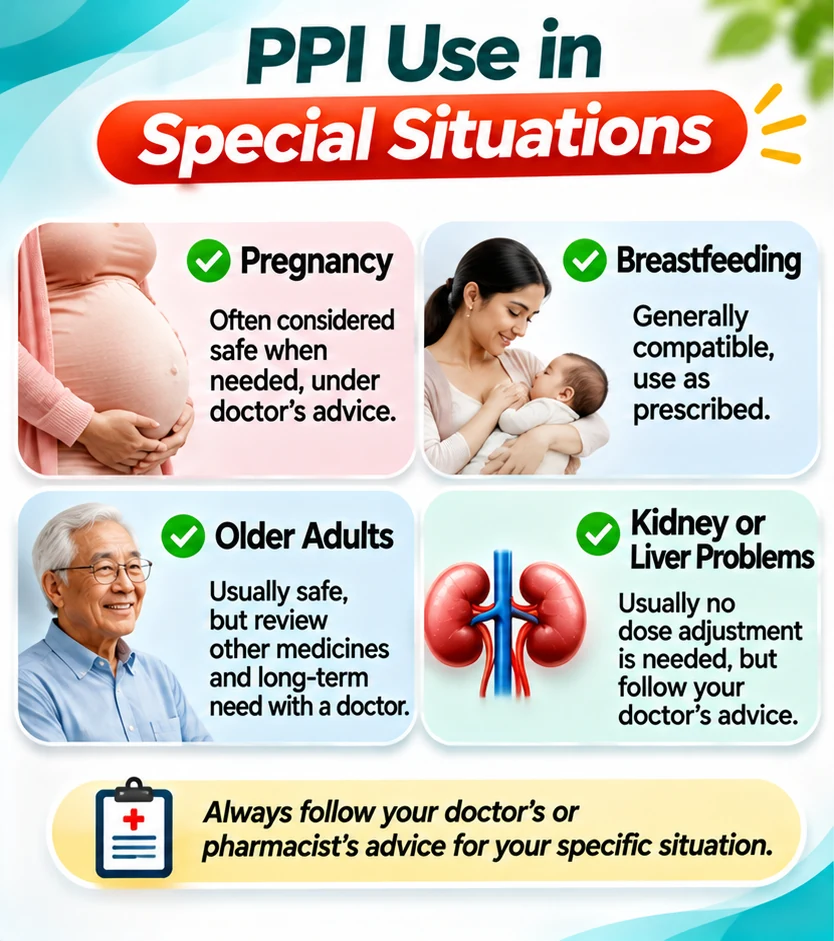
Pregnancy, breastfeeding, older adults, kidney or liver problems
The picture above is a general summary, and the details differ by medicine, so here is what the sources actually say. For omeprazole, the NHS says you can usually take it in pregnancy and while breastfeeding, but to check with a pharmacist or doctor first. For rabeprazole, the FDA label says there are no available human data in pregnant women and that lactation studies have not been conducted, so ask your doctor before using it. The same label reports no overall safety or effectiveness differences in older adults and no dose adjustment for mild to moderate liver impairment. The NHS notes that omeprazole may not be suitable if you have a kidney or liver condition. In every one of these situations, ask your doctor or pharmacist first.
Frequently asked questions
1. Can rabeprazole be taken with or without food, at any time of day?
For most uses, yes for the tablet. The FDA label for rabeprazole delayed-release tablets says they can be taken with or without food, and notes that food may delay absorption but does not significantly change the amount absorbed. Exceptions in that label: duodenal ulcer (after the morning meal) and H. pylori triple therapy (with food). Follow your doctor and your pack insert.
2. Can I take the Finix 10 mg sprinkle capsule with food?
The sprinkle capsule is opened and the granules are scattered on a small amount of soft food or liquid, then the whole dose is taken within 15 minutes without chewing. The US prescribing information for rabeprazole sprinkle capsules also says to take the dose 30 minutes before a meal. Check the insert in your own Finix pack, since local labels can differ.
3. Should I take omeprazole before or after food?
The NHS says you can take omeprazole with or without food. MedlinePlus says prescription omeprazole capsules are usually taken once a day before a meal. Because labels differ by product and condition, follow your prescriber and your leaflet.
4. Is it better to take a PPI in the morning or at night?
The NHS advises the same time each morning for once-a-day omeprazole, or morning and evening if twice a day. Choose the schedule your doctor gave you and keep it consistent.
5. Can I chew or crush a PPI tablet?
No for enteric coated or gastro-resistant tablets, according to the NHS. A UK rabeprazole leaflet also says the tablet must be swallowed whole, not crushed or chewed. If you struggle to swallow, ask a pharmacist.
6. How long can I use a PPI without a prescription?
The NHS says not to take omeprazole for longer than 2 weeks if you bought it without a prescription. MedlinePlus says not to use non-prescription omeprazole for more than 14 days, or more often than once every 4 months, without talking to a doctor. These are UK and US rules, so follow the label on your pack.
7. Can I take two acid-reducing medicines together?
Do not assume it is safe. The NHS lists lansoprazole and famotidine among medicines that may not mix well with omeprazole. Ask your pharmacist before combining them.
8. Can I take a PPI during pregnancy or while breastfeeding?
The NHS says you can usually take omeprazole in pregnancy and while breastfeeding, but to check with a pharmacist or doctor first. The FDA label for rabeprazole says there are no available human data in pregnant women and that lactation studies have not been conducted. Always ask your doctor first.
9. What should I do if I miss a dose?
Take it as soon as you remember, unless the next dose is nearly due. In that case skip the missed dose. Never take two doses together.
Key takeaway
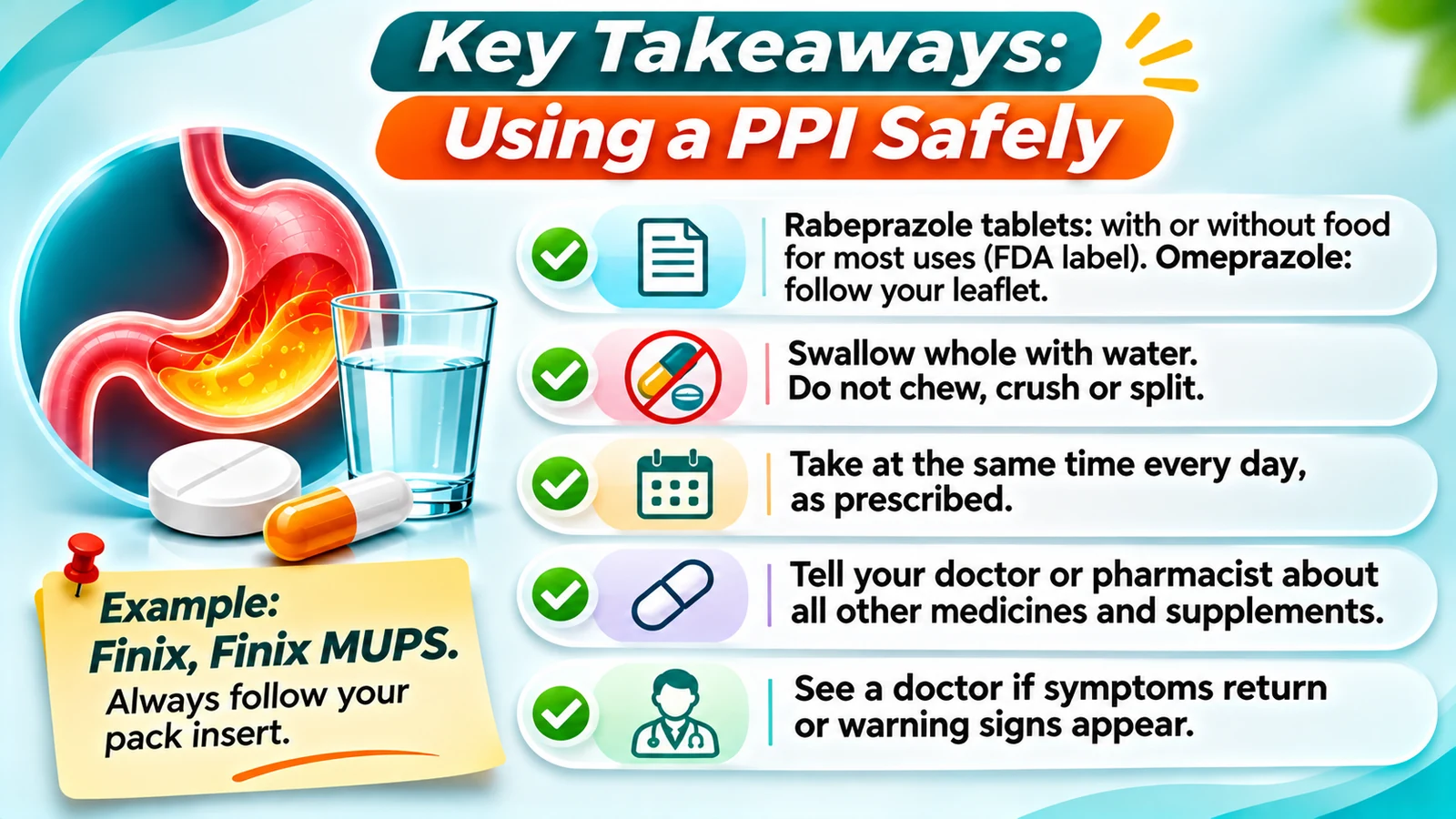
Rabeprazole tablets can be taken with or without food for most uses, but use the timing on your own label, take it at a consistent time, swallow tablets whole (open sprinkle capsules only as the insert says), share your other medicines and do not self-treat for long. If symptoms keep returning or warning signs appear, see a doctor.
References
- NHS: How and when to take omeprazole
- NHS: Common questions about omeprazole
- NHS: Omeprazole
- NHS: Side effects of omeprazole
- MedlinePlus: Omeprazole
- U.S. FDA: ACIPHEX (rabeprazole sodium) delayed-release tablets prescribing information, revised 07/2023
- Mayo Clinic: Rabeprazole (oral route), proper use
- Drugs.com: ACIPHEX Sprinkle prescribing information (text of the FDA-approved label)
- electronic medicines compendium (UK): Rabeprazole sodium 20 mg gastro-resistant tablets, patient information leaflet
- Finix product information page (rabeprazole sodium 10 mg sprinkle capsule, 20 mg capsule, 20 mg tablet)
- Finix MUPS 20 product information page (rabeprazole sodium 20 mg MUPS tablet)