 Sayedul Abrar
A medicine may pass release testing when manufactured and still change during storage. Moisture may enter a pack, an active ingredient may degrade, a tablet may dissolve differently, or a liquid may change physically. Stability studies assess whether the product continues to meet its quality specifications throughout the period printed on the pack.
1. What is medicine stability testing?
Stability testing is a planned programme that measures how an active pharmaceutical ingredient (API) or finished pharmaceutical product (FPP) changes with time. Temperature, relative humidity, light and other physical factors can influence quality. The formulation, excipients and container-closure system also matter: a product may absorb moisture, lose water or interact with packaging.
Two different time limits may be supported:
- API retest period: when an active ingredient should be retested against its specification before use, where a retest period is appropriate.
- Finished-product shelf life: how long the packaged medicine is expected to remain within approved quality limits when stored as labelled. This supports the expiry date.
Release testing asks whether a batch meets its specifications now. Stability testing asks whether it continues to meet them as time passes.
2. Long-term, accelerated and intermediate studies

Long-term studies store the product under the selected intended or justified condition and follow it over months and years. These real-time results are the main foundation for a proposed shelf life.
Accelerated studies use higher temperature and, where appropriate, humidity to reveal possible changes sooner. They provide supportive evidence and can help assess short-term shipping excursions. They do not convert six months in a chamber into a fixed number of years at room temperature.
Intermediate studies add another condition when the design calls for it—for example, when a product stored long-term at 25°C/60% RH shows significant change during accelerated testing.
| Study | Illustrative general condition | Purpose |
|---|---|---|
| Long-term | 25°C ± 2°C / 60% RH ± 5%, or 30°C ± 2°C / 65% RH ± 5% | Real-time quality profile |
| Accelerated | 40°C ± 2°C / 75% RH ± 5% | Supportive evidence under higher stress |
| Intermediate | 30°C ± 2°C / 65% RH ± 5% | Additional evaluation when triggered |
These are ICH Q1A(R2) general-case examples, not a universal protocol. If 30°C/65% RH is selected as the long-term condition, a separate intermediate arm at the same setting is not required under that framework. Refrigerated, frozen, semi-permeable, biological and other specialised products need product-specific designs.
3. What do laboratories test?
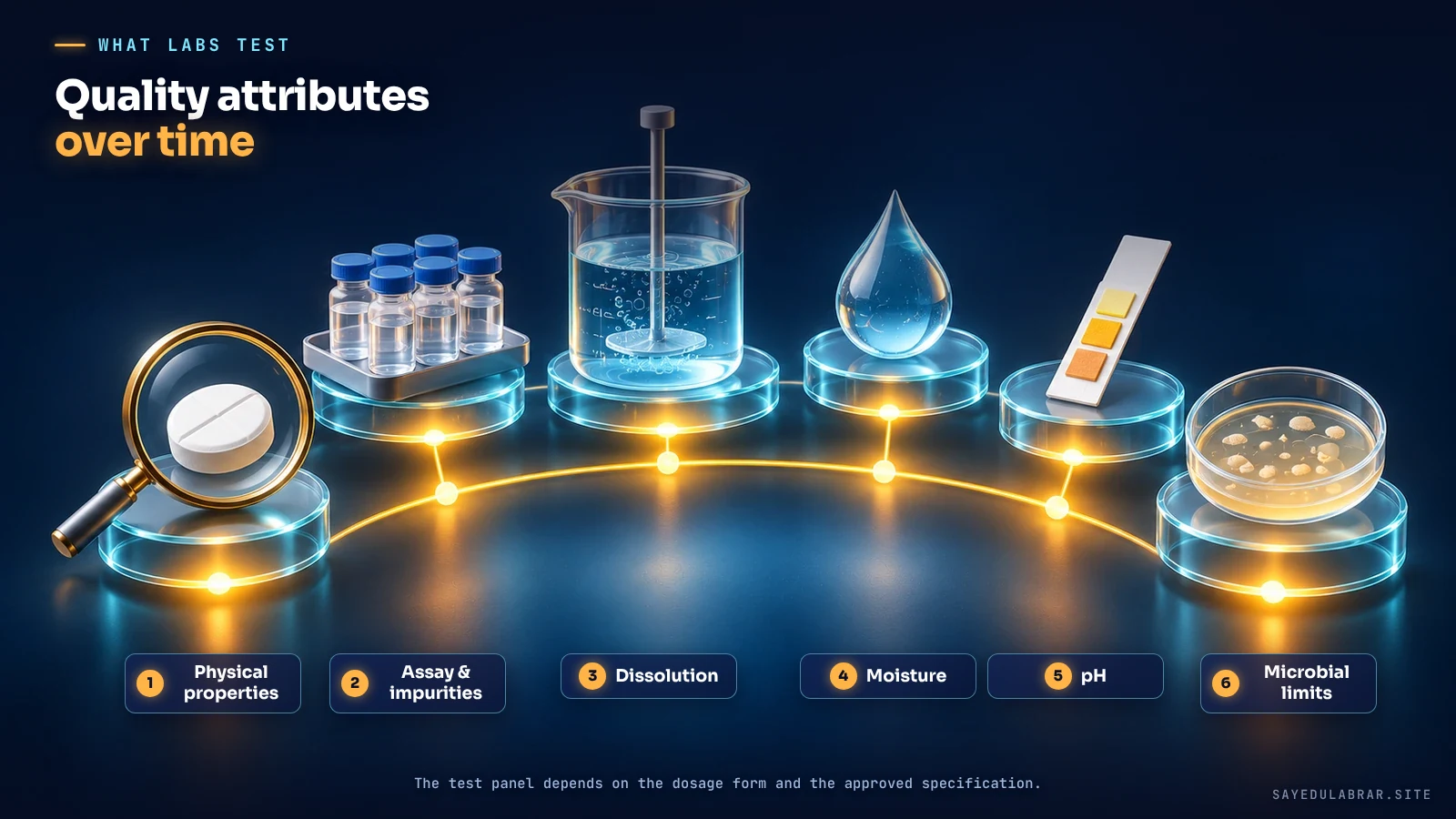
The test panel depends on the dosage form and its risks. It may include:
- Assay or potency: whether the required amount of active ingredient remains.
- Degradation products and impurities: whether breakdown products appear or increase beyond their limits.
- Dissolution or drug release: whether a tablet or capsule releases its medicine as expected.
- Physical properties: appearance, colour, moisture, hardness, caking or phase separation, as relevant.
- Other tests: pH, preservative content, microbial limits, sterility, particulate matter or device performance when applicable.
Methods must detect storage-related change. A validated stability-indicating method should distinguish the active ingredient from relevant degradation products. Not every test is needed for every product; the protocol follows its characteristics and approved specification.
4. Why packaging must be part of the study
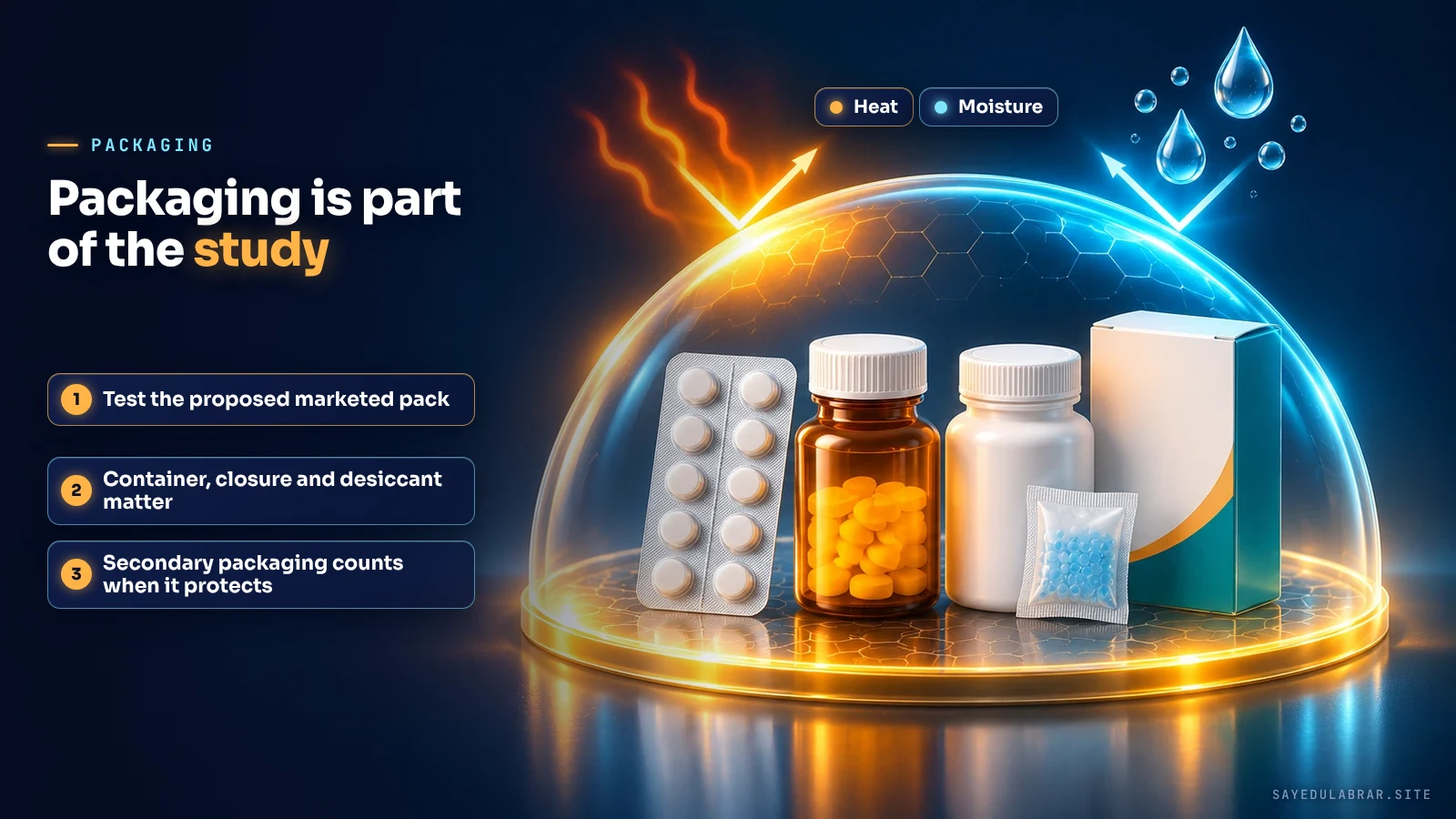
Packaging can limit or allow moisture, oxygen and light to reach a medicine. A change from a sealed blister to a bottle, or a change in bottle material, closure or desiccant, may alter the stability profile. Studies should therefore use the proposed marketed container-closure system or a scientifically justified equivalent. Secondary packaging matters when it provides additional protection.
5. How are batches and time points selected?
Formal studies use representative batches made by a process that reflects intended commercial production. ICH Q1A(R2) describes data from at least three primary batches in the general case. Finished-product batches should have the same formulation and proposed container-closure system. Bracketing or matrixing may reduce testing only when scientifically justified.
Testing happens at planned intervals. In the ICH general case, long-term testing for a product with a proposed shelf life of at least 12 months normally occurs every three months in year one, every six months in year two, and annually thereafter. A six-month accelerated study commonly includes 0, 3 and 6 months. If intermediate testing is needed, a 12-month study may include 0, 6, 9 and 12 months. The approved protocol sets the actual schedule.
6. Bangladesh: climate and regulatory context

Hot and humid conditions during storage, transport and distribution make temperature and moisture important considerations in Bangladesh. But a climatic-zone label or WHO table should not be mistaken for a current national regulatory instruction.
The WHO Member State stability-conditions table updated in March 2021 lists Bangladesh as [30°C/65% RH] with footnote 3. WHO explains that bracketed entries with this footnote were supplied by the International Federation of Pharmaceutical Manufacturers and Associations using climate references. They are not conditions confirmed to WHO through official communications from national medicines regulators. The table is useful context; it does not prove that 30°C/65% RH is a current DGDA-mandated condition for every medicine.
Requirements must be checked against the applicable DGDA product category, registration route and current instructions. A 2024 DGDA guideline for locally sourced medical products for public health priority disease says, within its scope, applicants should provide long-term studies on at least three commercial batch sizes, in the proposed marketing container-closure system and covering the full shelf life. The formula, API source, manufacturing site and packaging material should match the product intended for supply. This is a scoped guideline, not a universal summary of every registration route.
7. How does the evidence become an expiry date?
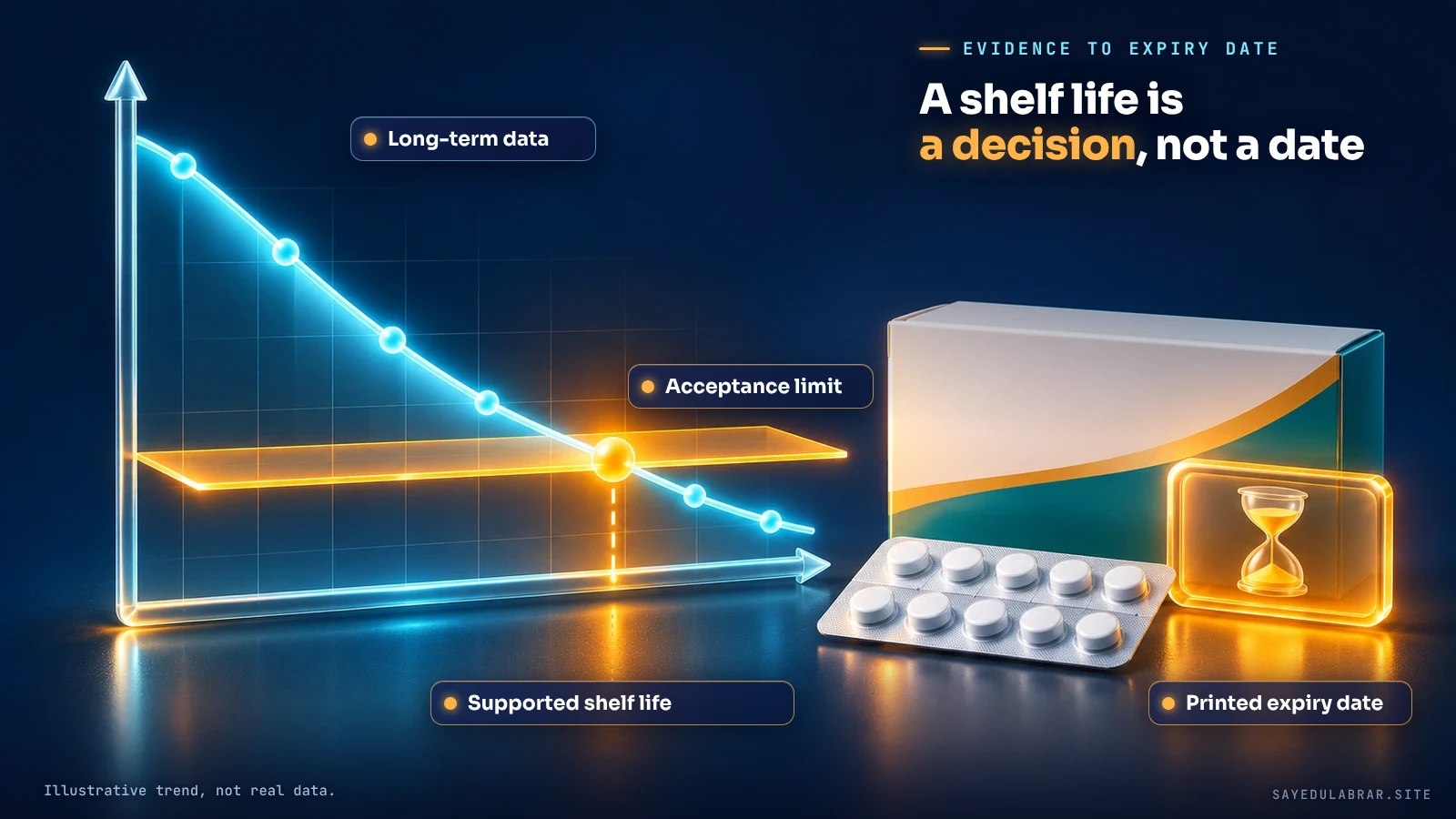
Scientists review results across batches, time points and relevant quality attributes. They consider the pattern of change, batch-to-batch variability, degradation products and whether results remain within acceptance criteria. Statistical analysis may be appropriate when an attribute changes with time. Extrapolation beyond observed long-term data needs scientific justification and supporting evidence.
Accelerated data support the assessment, but one accelerated study alone does not automatically establish a two- or three-year shelf life. Long-term real-time data, degradation behaviour, packaging, batch variability and the applicable regulatory framework all matter. The label's storage statement should match the conditions under which stability has been demonstrated.
After approval, an ongoing programme monitors marketed batches. WHO guidance describes monitoring throughout shelf life and, unless justified otherwise, inclusion of at least one batch per year for each strength and primary packaging type when that product is manufactured. Significant process or packaging changes, atypical trends or out-of-specification results may require investigation.
8. What should patients understand?

- Follow the storage instructions on the pack; do not assume every medicine belongs in a refrigerator.
- Keep tablets and capsules in their original packaging, especially when it protects them from moisture or light.
- Avoid hot cars, direct sunlight and damp places such as bathrooms.
- Do not use a medicine after its printed expiry date. If the pack is damaged or wet, ask a pharmacist.
- Do not judge quality only by colour, smell or appearance; some changes are not visible.
The expiry date is meaningful when the medicine has been stored as directed and the pack remains suitable. Stability testing connects laboratory evidence with the storage advice on the label.
9. Key takeaways

- Stability testing follows medicine quality over time under defined temperature, humidity, light and packaging conditions.
- Long-term data are the main basis for a finished medicine's shelf life; accelerated data support the assessment.
- Studies should use the proposed marketed container-closure system or a justified equivalent.
- Representative batches and planned time points show whether quality stays within specification.
- Shelf life is a decision from the whole data package. Store the medicine as the pack says.
Frequently asked questions
What is the difference between long-term and accelerated stability testing?
Long-term studies follow the product under the selected storage condition. Accelerated studies use higher temperature and, where appropriate, humidity to reveal changes sooner. They support, but do not replace, real-time evidence.
Can six months of accelerated testing prove a two-year expiry date?
No. Six months at an accelerated condition is not a mathematical substitute for two years of real-time storage. Shelf life uses long-term data, degradation behaviour, batch variability and packaging.
Why are three batches commonly studied?
Representative batches help show whether the stability pattern is consistent and future batches are likely to remain within specification. Exact requirements depend on the product and guidance.
Does Bangladesh require 30°C/65% RH for every medicine?
This article does not make that claim. WHO's 2021 table lists Bangladesh [30°C/65% RH] with footnote 3, an IFPMA-derived climate estimate rather than a condition formally confirmed by the national regulator. Check current DGDA requirements.
Why must the marketed packaging be used?
Packaging changes how much moisture, oxygen or light reaches a medicine. A study in the proposed container-closure system supports the quality claim for the supplied product.
What happens if a stability sample fails a test?
The result needs documented investigation. The manufacturer reviews the method, sample, chamber history, batch and packaging, assesses impact and follows applicable procedures. Repeating a test until it passes is not a substitute.
Is an API retest period the same as a finished medicine expiry date?
No. An API may be retested before use when a retest period applies. A finished medicine's shelf life supports its expiry date; it should not be used after that date.
For the wider industry context, read What is the pharmaceutical industry? to understand where stability testing fits within pharmaceutical manufacturing and quality systems.
References and further reading
- World Health Organization. TRS 1010, Annex 10: Stability testing of active pharmaceutical ingredients and finished pharmaceutical products. 2018.
- International Council for Harmonisation. ICH Q1A(R2): Stability Testing of New Drug Substances and Products. Step 5, 2003.
- World Health Organization. Stability conditions for WHO Member States by Region. Updated March 2021.
- Directorate General of Drug Administration, Bangladesh. Guideline for quality assurance of locally sourced medical products for public health priority disease. Published 30 September 2024.
- European Medicines Agency. ICH Q1 consolidated guideline status page. The consolidated text is listed as a Step 2b draft; consultation closed in July 2025.
Educational note: This article explains stability concepts and selected public guidance. It is not a regulatory submission checklist or a substitute for current DGDA instructions, an approved dossier or a validated stability protocol.

Sayedul Abrar
Pharmacist · A Grade Pharmacist (Registration Code A-22040)
Product Executive, Product Management Department · Opsonin Pharma Ltd.
Related reading: Quality Assurance vs Quality Control · Good Manufacturing Practices (GMP) · Active Pharmaceutical Ingredient (API) · Expiry Date vs Manufacturing Date