 Sayedul Abrar
1. Three simple words
- Onset of action: the time when the medicine first begins to take effect.
- Peak: the time when the medicine reaches its highest concentration in the body. Scientists call the highest level Cmax and the time it happens Tmax.
- Duration of action: the length of time the medicine produces its desired effect.
2. Reading the concentration–time curve
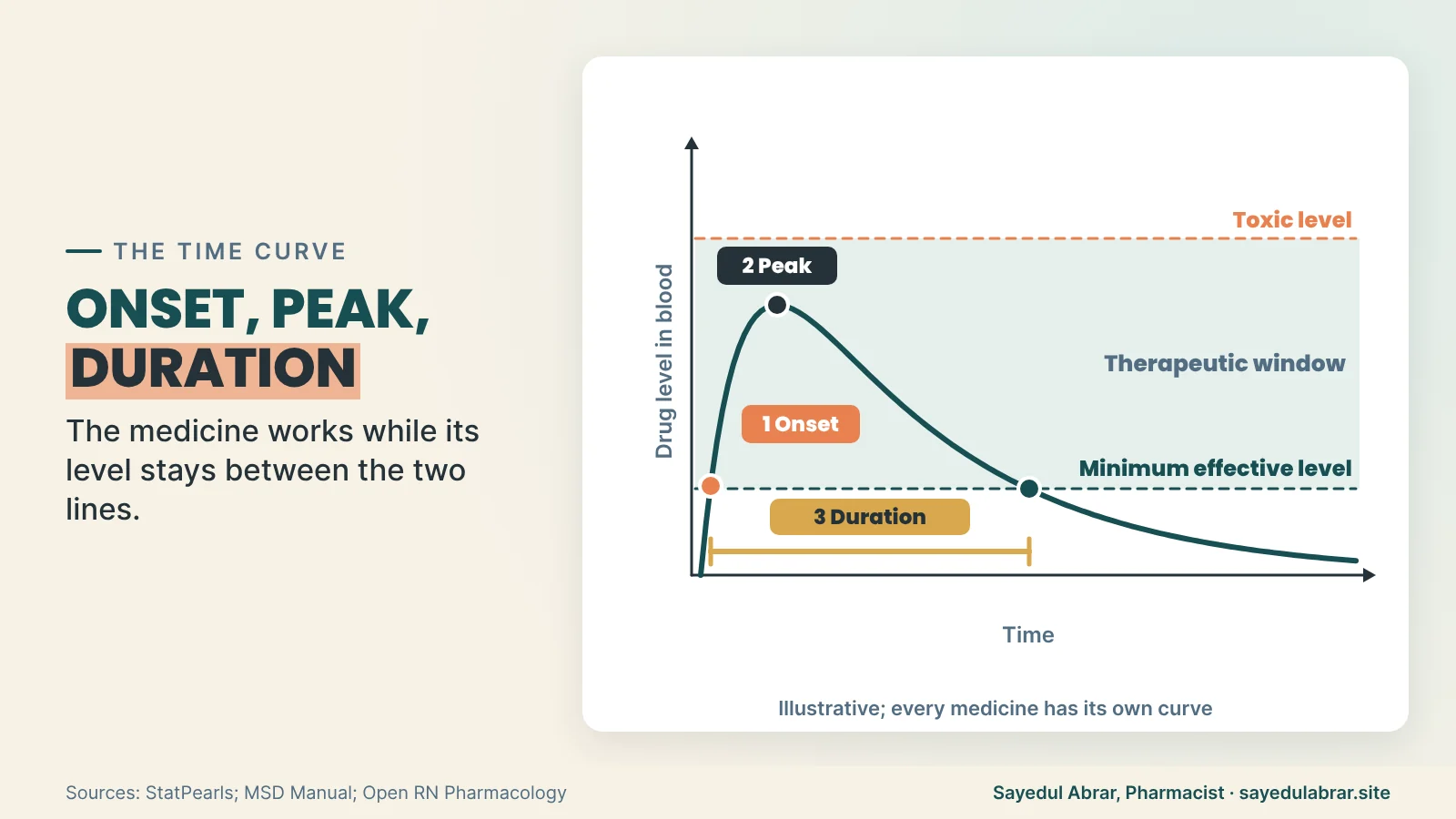
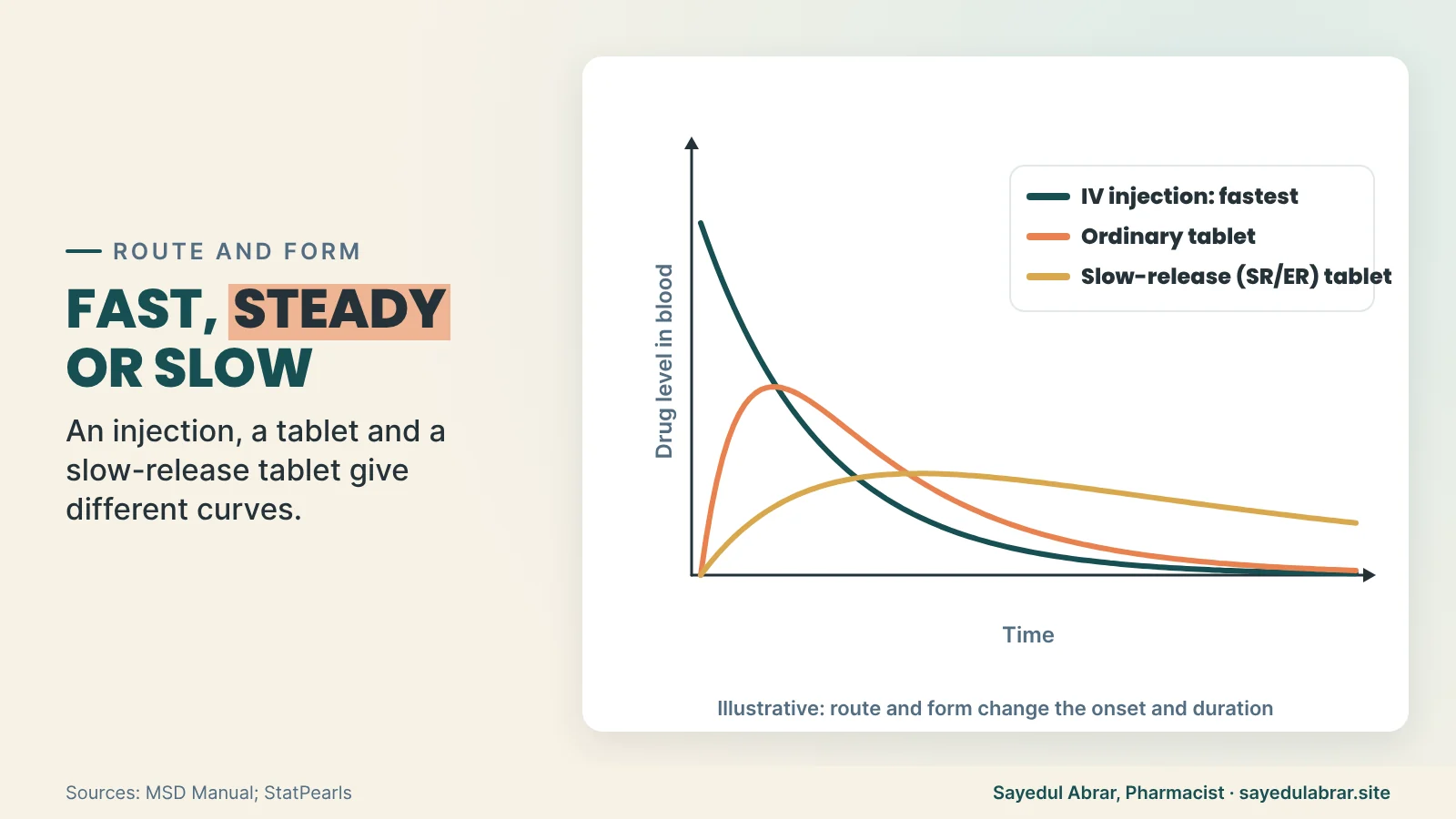
If you measure the drug level in the blood after a tablet and plot it against time, you get a curve. It rises as the drug is absorbed, reaches a peak, and then falls as the body removes the drug (see Drug Half-Life).
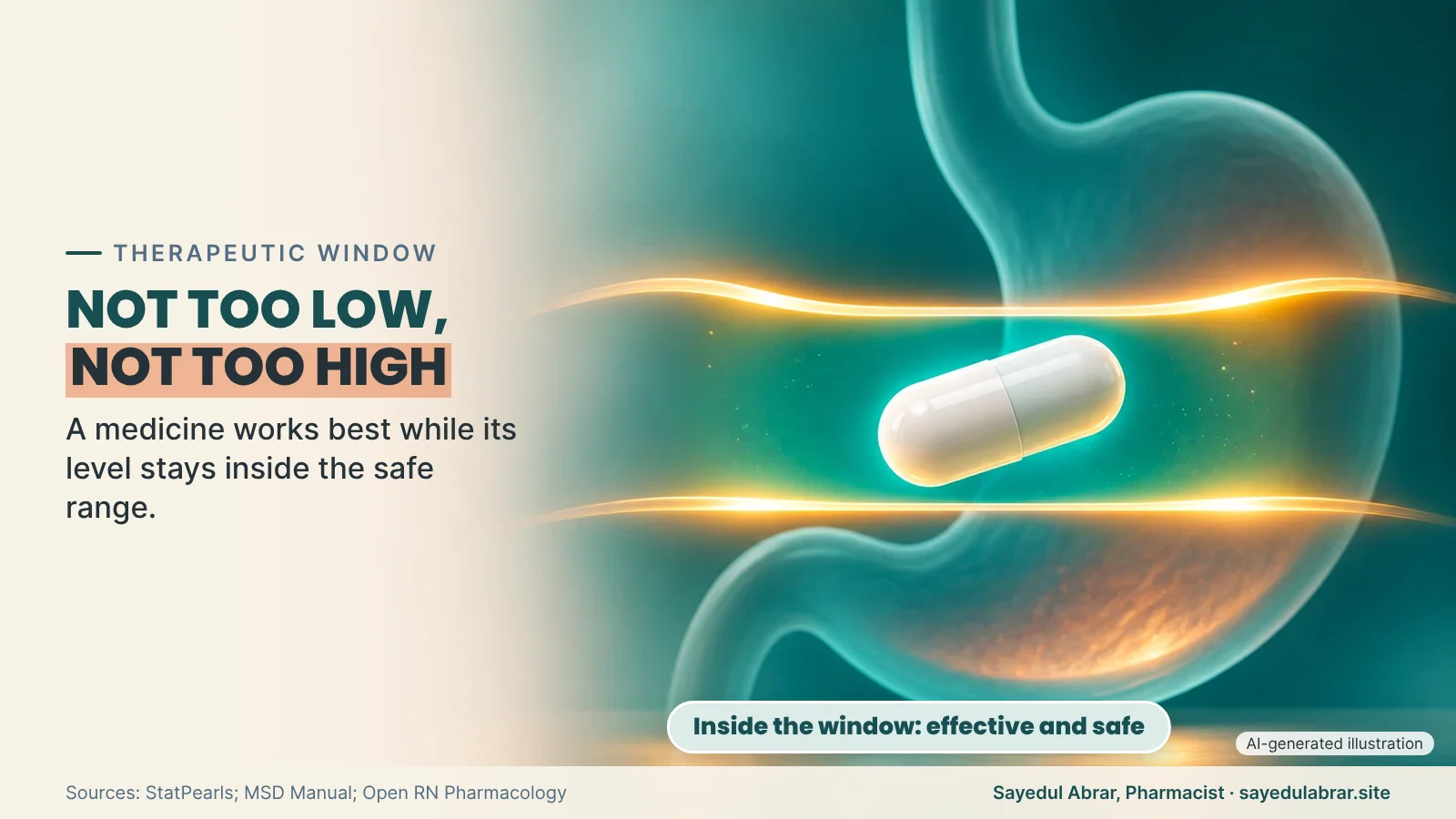
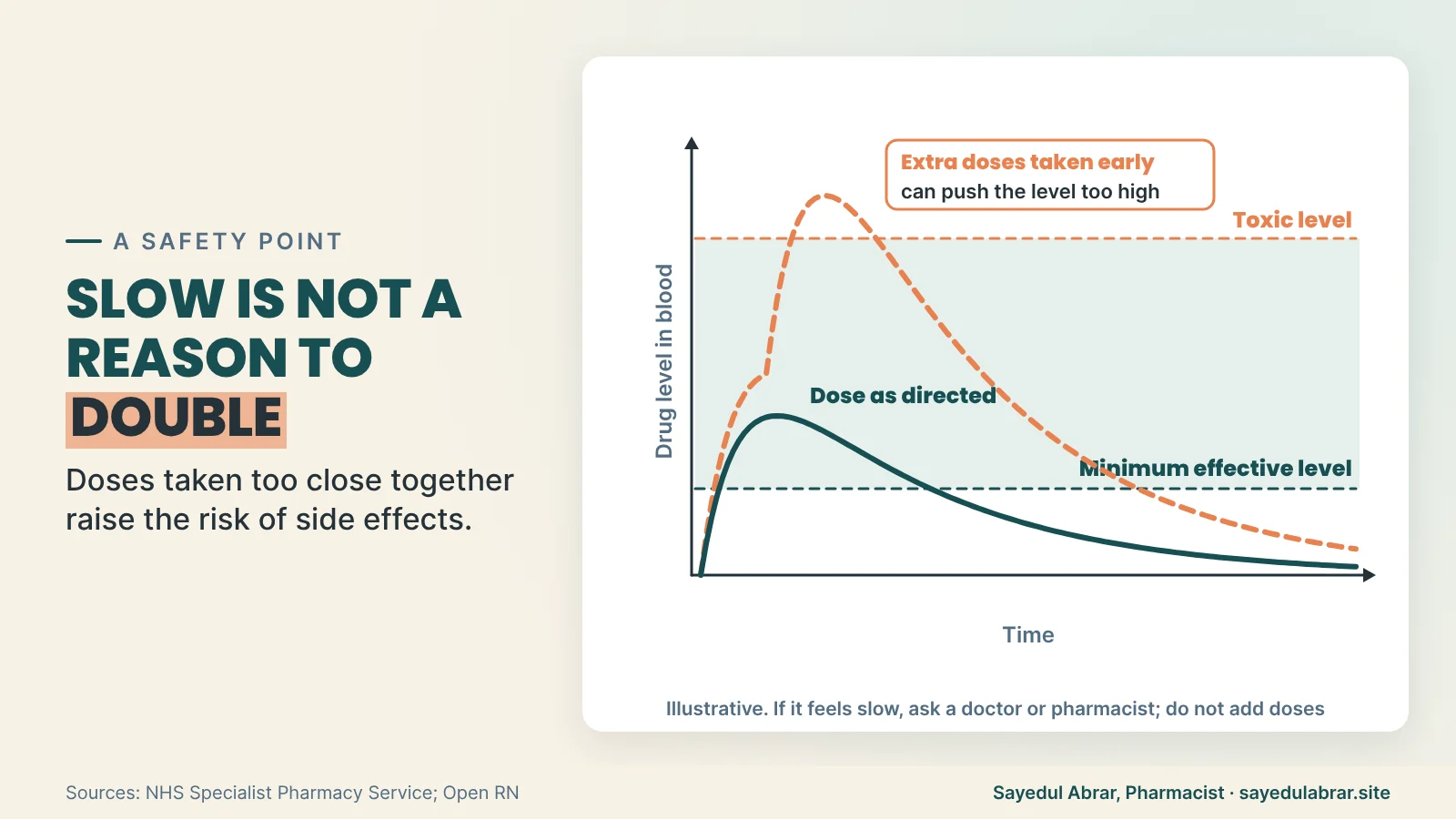
Two lines help explain the curve. Below the minimum effective level, the medicine is not doing enough. Above the toxic level, harmful effects become more likely. The space between them is the therapeutic window. Onset is roughly where the curve crosses into the window; duration is the time it stays there.
3. Narrow and wide windows
Some medicines have a wide gap between the effective level and the toxic level. Others have a narrow gap, so a small change in the level matters. Pharmacists use the therapeutic index to describe this safety margin. StatPearls names warfarin, lithium and theophylline as examples of medicines with a narrow therapeutic index; they need close monitoring by the treating team.
4. Why some medicines act in minutes and others in weeks
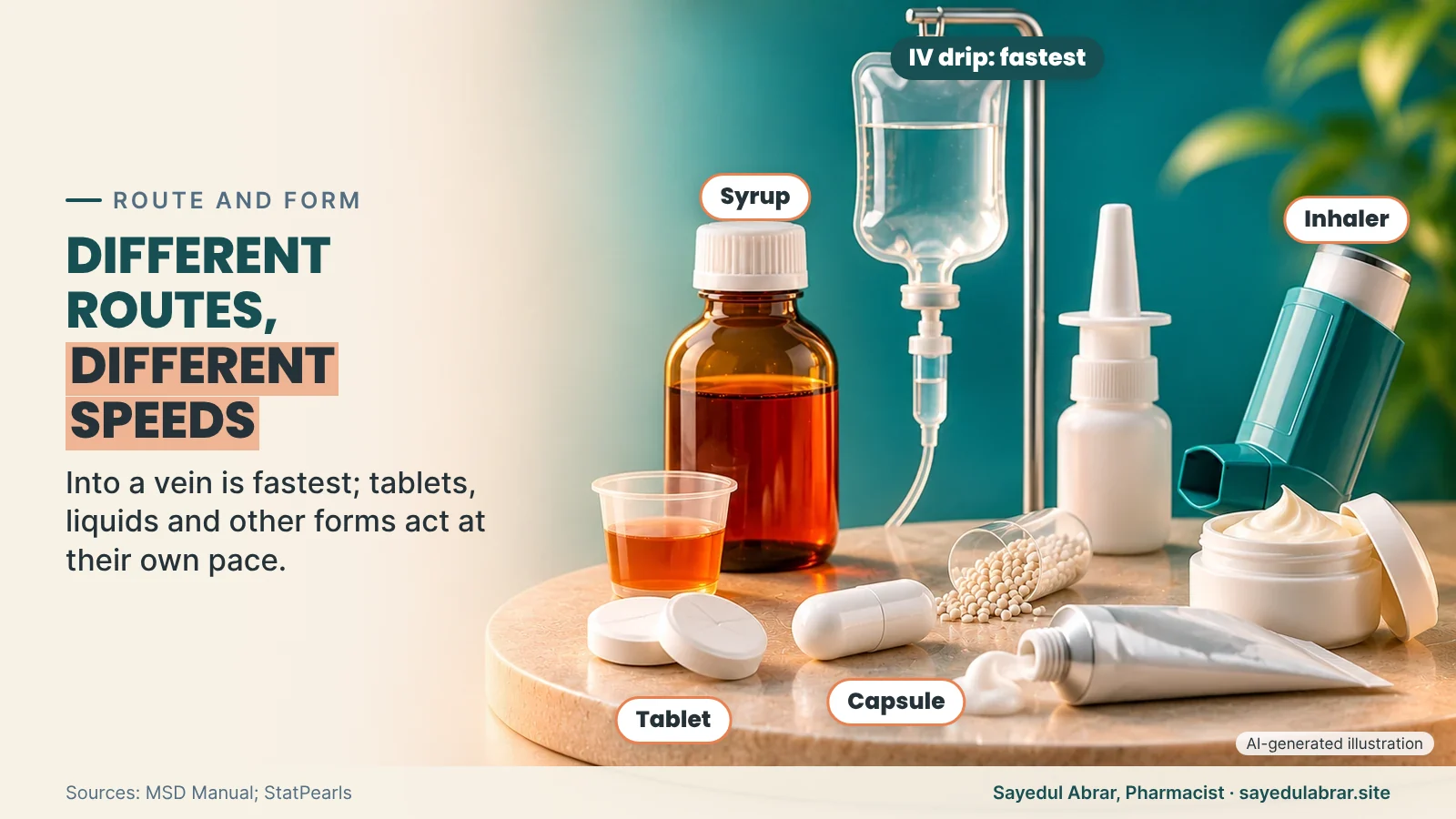
Route matters. A medicine given into a vein is delivered straight into the blood and acts faster than by other routes (MSD Manual). A medicine placed under the tongue can also act quickly; StatPearls describes sublingual nitroglycerin acting in about 2 minutes, with a short duration.
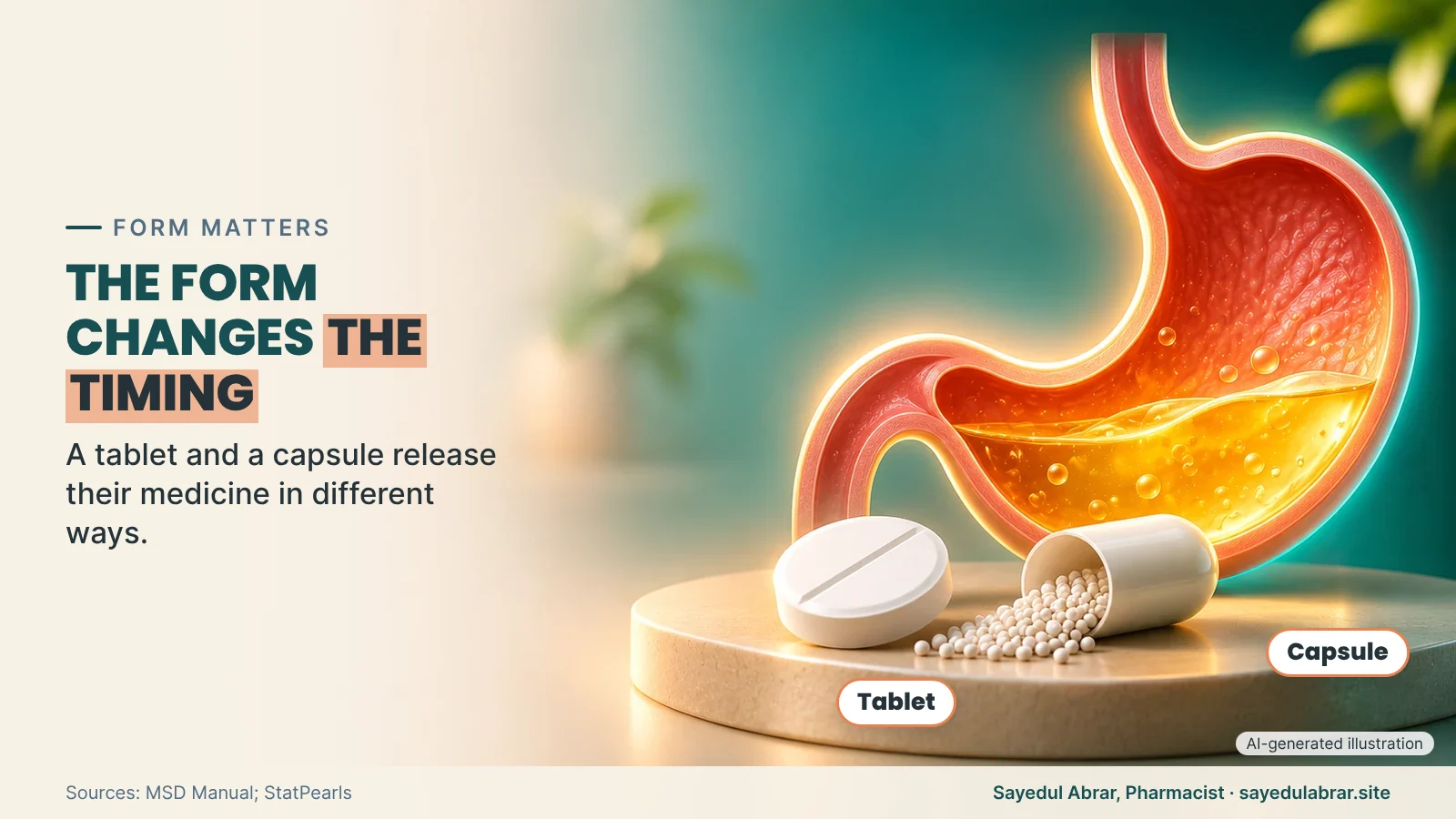
Form matters. Slow-release (SR, ER or CR) tablets are designed to release the drug over a longer time, reduce how often you take it, and limit ups and downs in the blood level. The trade-off is that they are not meant for a quick effect.
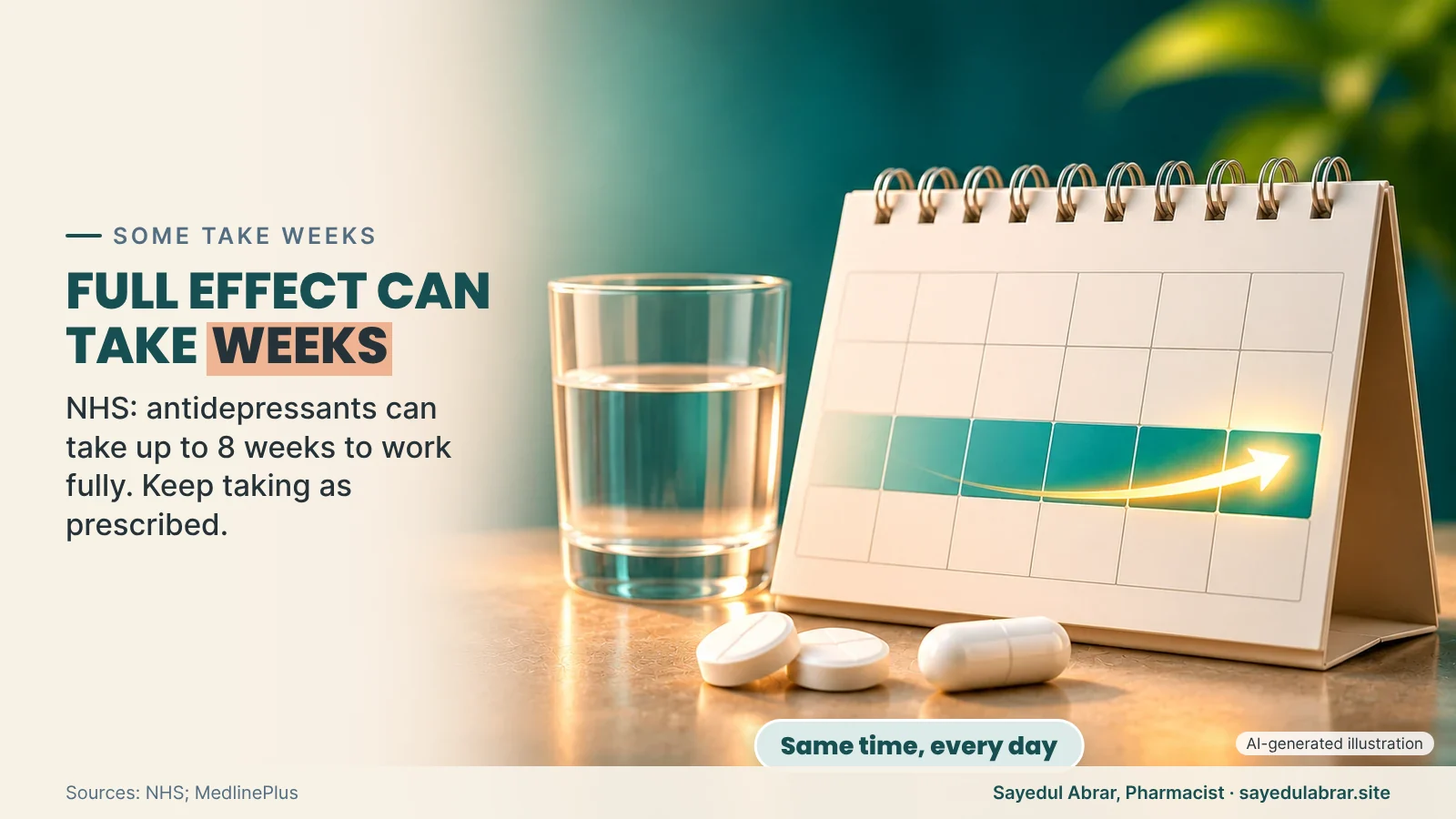
The medicine's job matters. Some medicines work only after the body slowly adapts. The NHS says antidepressants usually take 1 to 2 weeks to start having an effect and can take up to 8 weeks to work fully. A slow start does not always mean the medicine is not working.
5. Why you should not double a dose when it feels slow
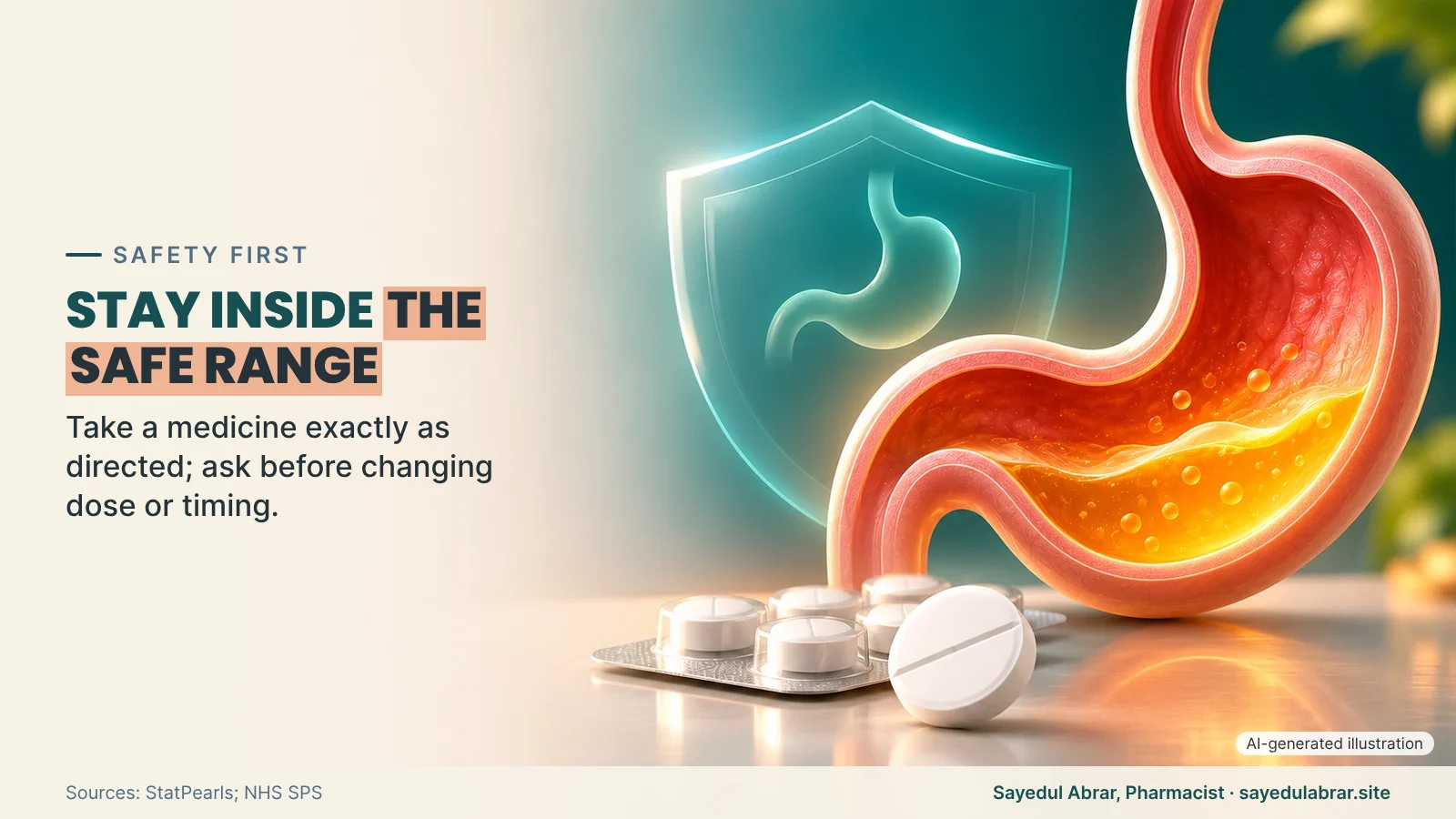
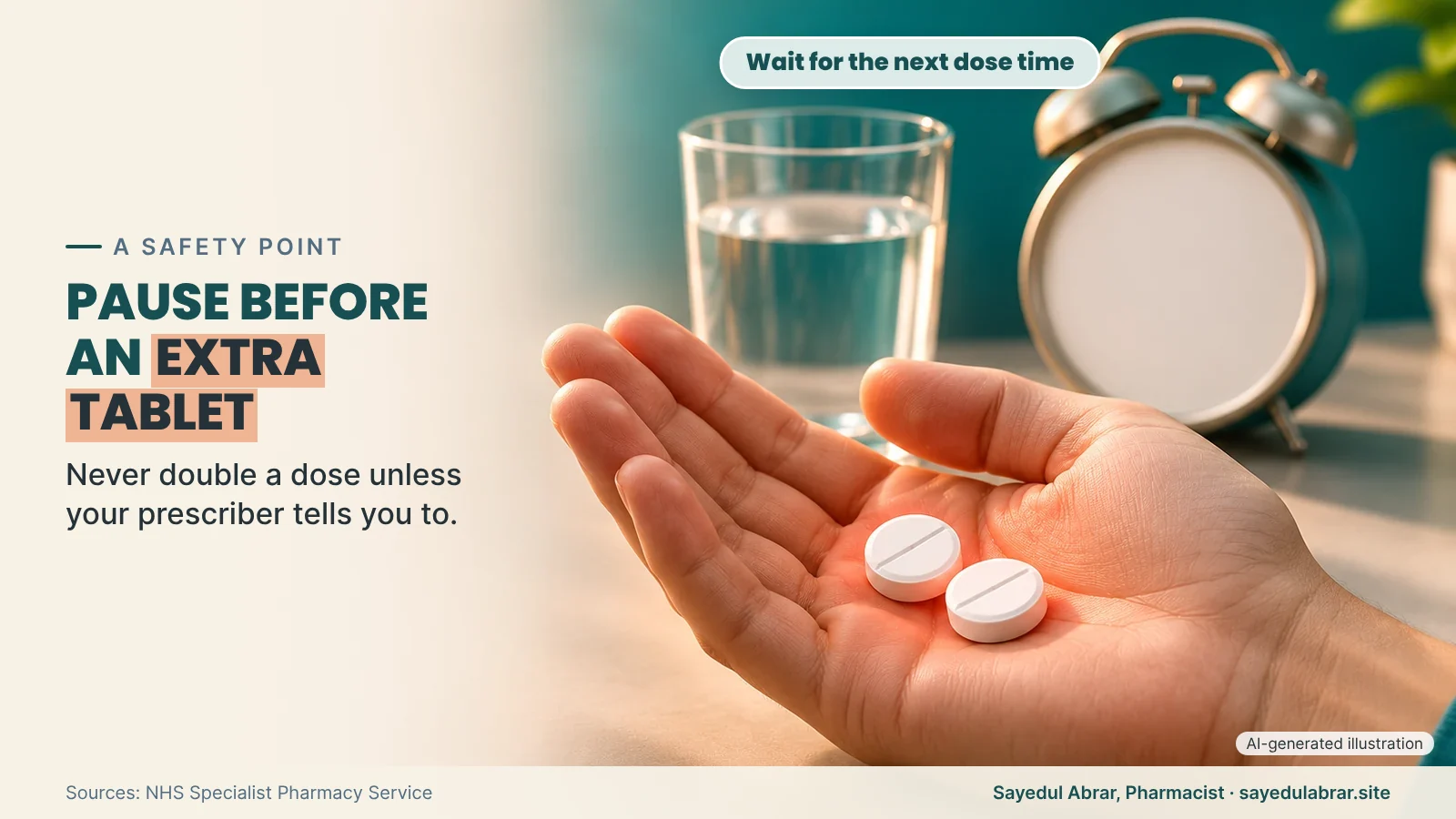
If a medicine seems slow, it is tempting to take another tablet. This can push the level above the window. The NHS Specialist Pharmacy Service advises: never take a double dose to make up for a forgotten dose unless a prescriber has told you to, because doses taken too close together can increase the risk of side effects.
If a medicine does not seem to work, or wears off too early, talk to your doctor or pharmacist. They may change the timing, the form or the medicine itself.
6. Key takeaways
Onset, peak and duration describe the timing of a medicine's effect. They depend on the route, the form, the half-life and the way the medicine works.
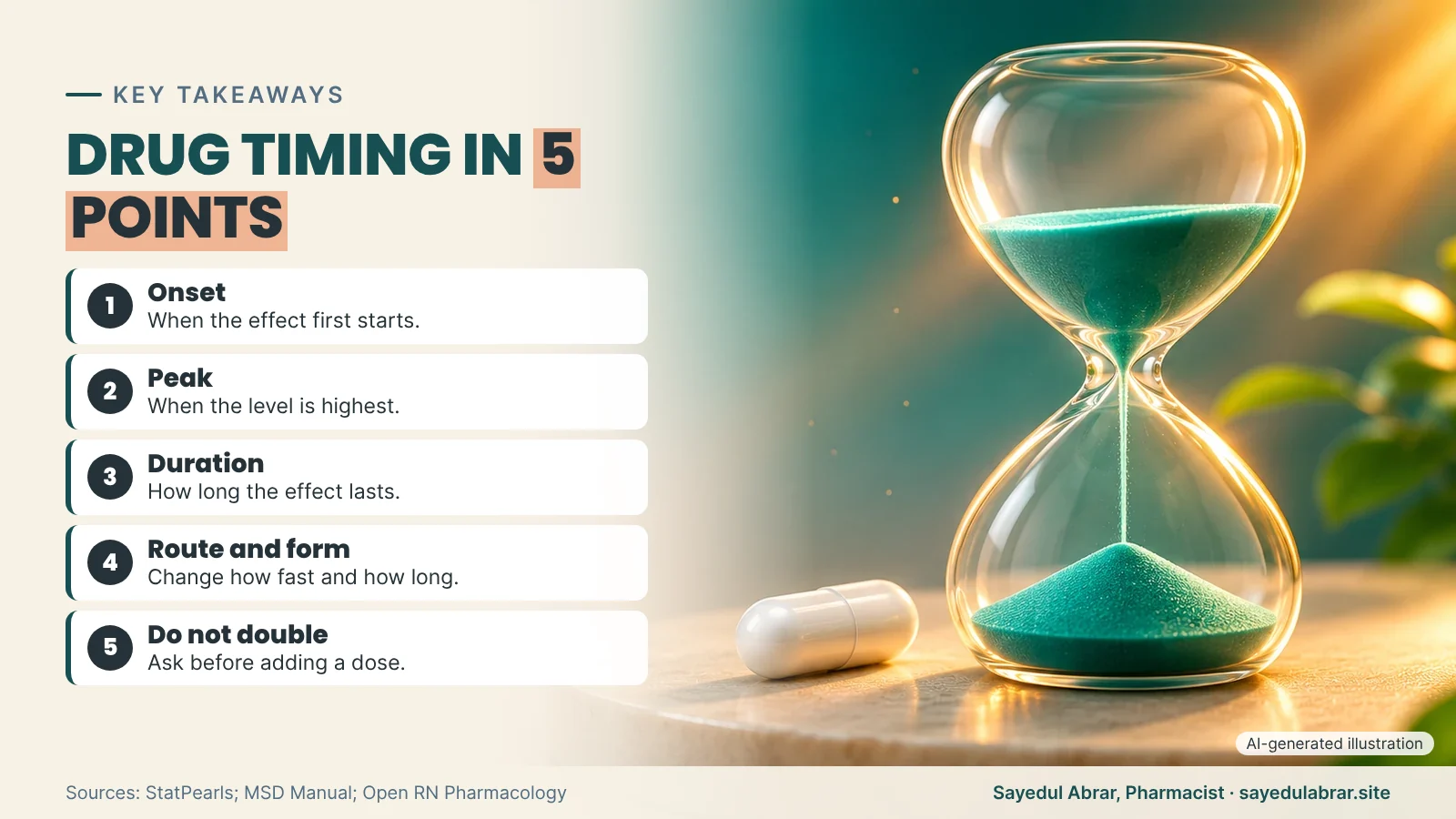
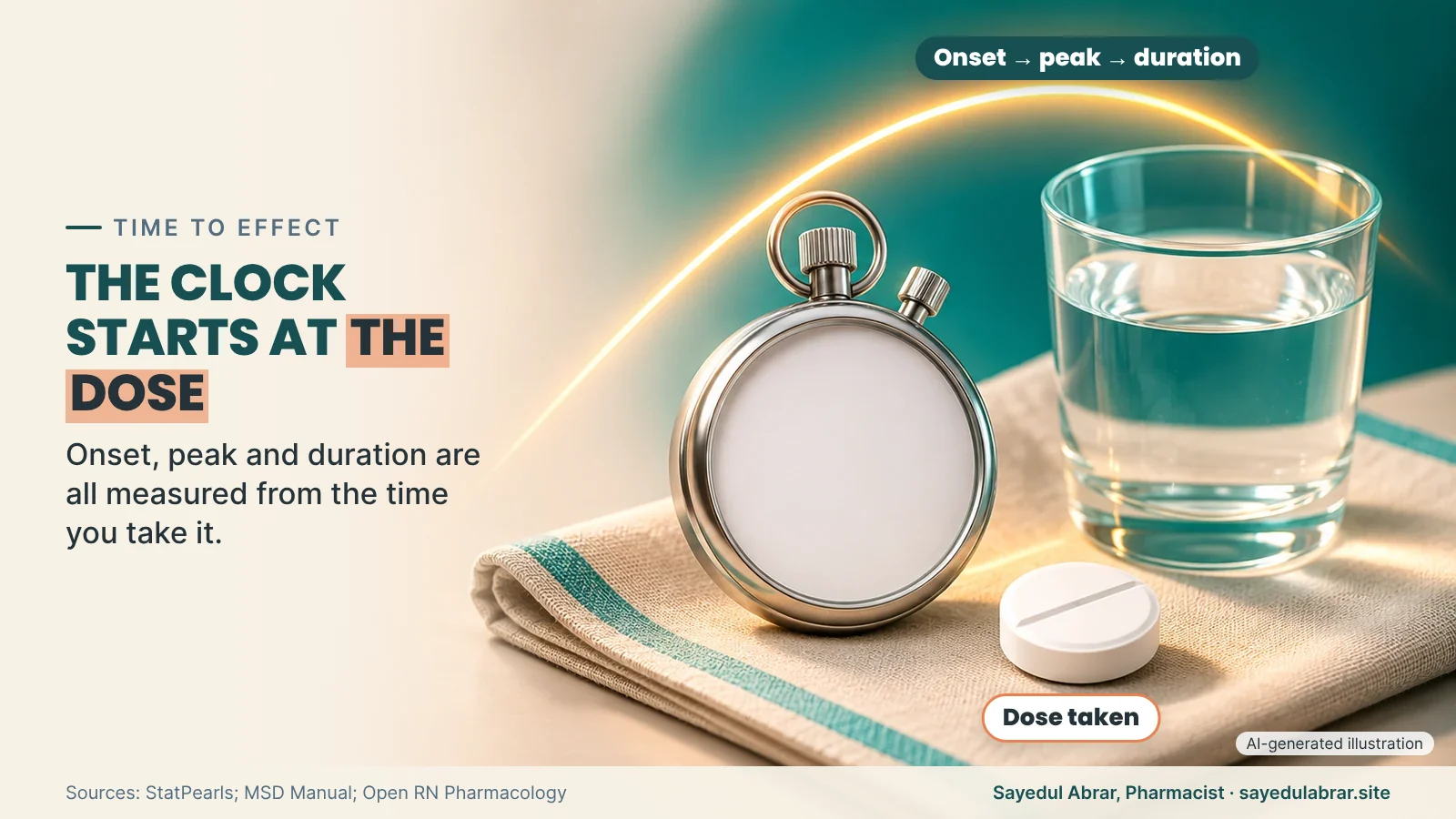
- Onset is when a medicine starts to work; peak is when its level is highest; duration is how long it works.
- A medicine helps while its level stays inside the therapeutic window.
- IV and under-the-tongue routes act fast; slow-release tablets act longer.
- Some medicines, such as antidepressants, need weeks for full effect.
- Never double a dose because it feels slow; ask your doctor or pharmacist.
Frequently asked questions
What is the difference between onset and peak?
Onset is when the medicine first starts to work. Peak is later, when the medicine reaches its highest level in the body.
What is the therapeutic window?
It is the range of drug levels between the minimum effective level and the level where toxic effects become likely. The medicine works best and safest inside this range.
Why does my medicine take so long to work?
It can depend on the route, the dosage form, how long the medicine takes to build up, and how it works. Some medicines, like antidepressants, can take several weeks for their full effect. Ask your pharmacist what to expect.
Can I take an extra tablet if the first one has not worked yet?
Do not take an extra dose on your own. Doses taken too close together can raise the risk of side effects. Follow the label or ask your doctor or pharmacist.
Does a slow-release tablet work faster if I crush it?
Do not crush or chew slow-release tablets unless the leaflet or your pharmacist says it is safe. Crushing can release the whole dose at once.
Related reading
- Drug Half-Life: How Long Does a Medicine Stay in the Body?
- Bioavailability: How Much Medicine Reaches the Bloodstream?
- Drug Absorption: How Does Medicine Enter the Bloodstream?
- How Do Medicines Work Inside the Human Body?
References and further reading
- Open RN. Nursing Pharmacology, 1.9 Examining Effect (onset, peak and duration). opentextbc.ca
- Open RN. Nursing Pharmacology, 1.10 Medication Safety (therapeutic window). opentextbooks.uregina.ca
- StatPearls. ED50 (therapeutic index). statpearls.com
- StatPearls. Drug Bioavailability. NCBI Bookshelf. ncbi.nlm.nih.gov
- MSD Manual Consumer Version. Drug Administration. msdmanuals.com
- MSD Manual Professional Edition. Drug Absorption. msdmanuals.com
- NHS. Antidepressants. nhs.uk
- NHS Specialist Pharmacy Service. Advising on missed or delayed doses of medicines. sps.nhs.uk

Sayedul Abrar
A Grade Pharmacist · Registration Code: A-22040
Product Executive, Product Management Department (PMD) · Opsonin Pharma Ltd.