 Sayedul Abrar
1. What does bioavailability mean?
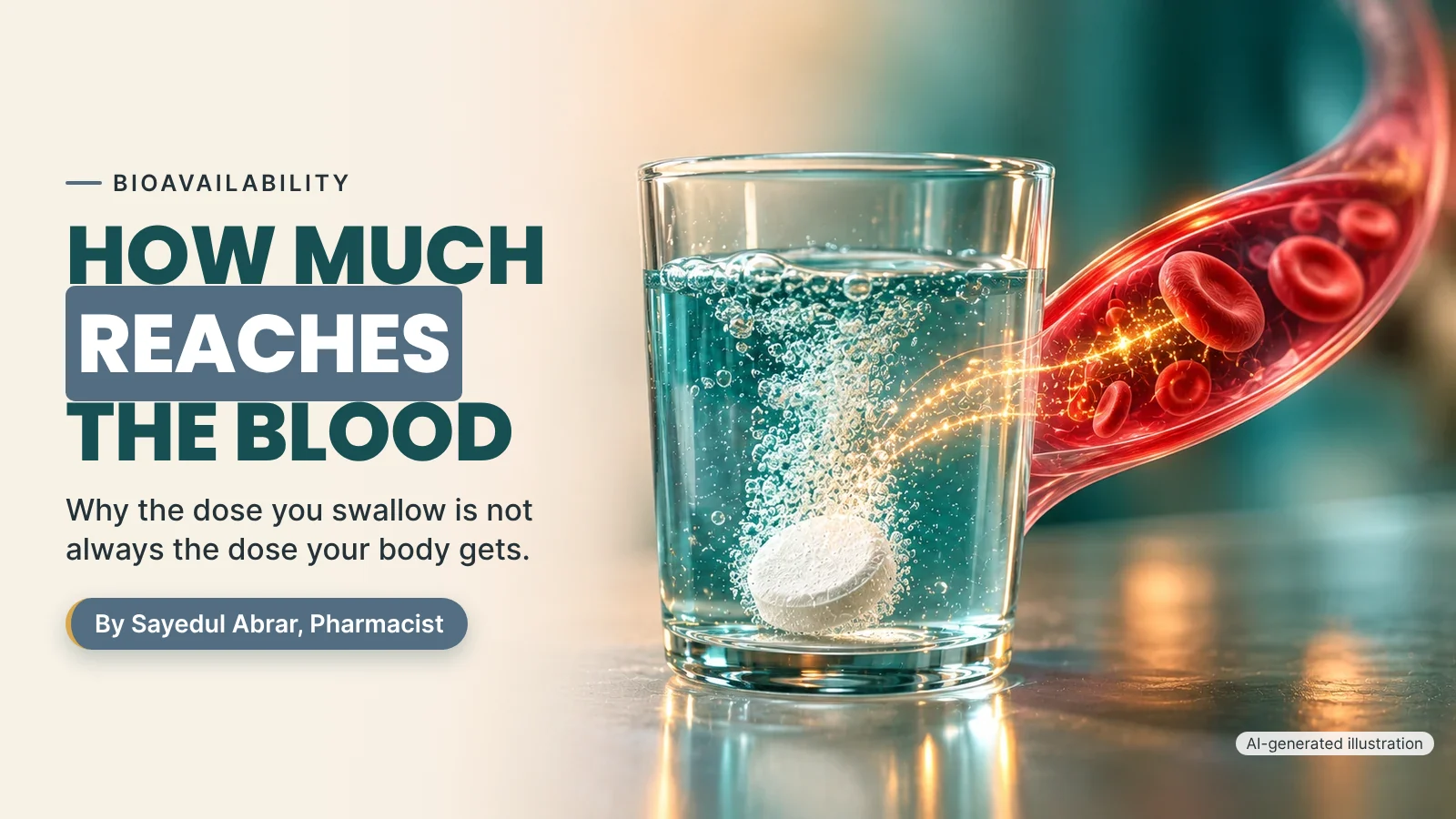
Bioavailability is the fraction of an administered dose of unchanged medicine that reaches the bloodstream (systemic circulation). It is usually written as a percentage, or as F.
The MSD Manual adds a second part: the rate. Bioavailability is about both how much of the active drug gets in and how fast it gets there.
If you read our article on Drug Absorption, think of it this way: absorption is the journey, bioavailability is the share that arrives.
2. The percentage idea: IV is 100%
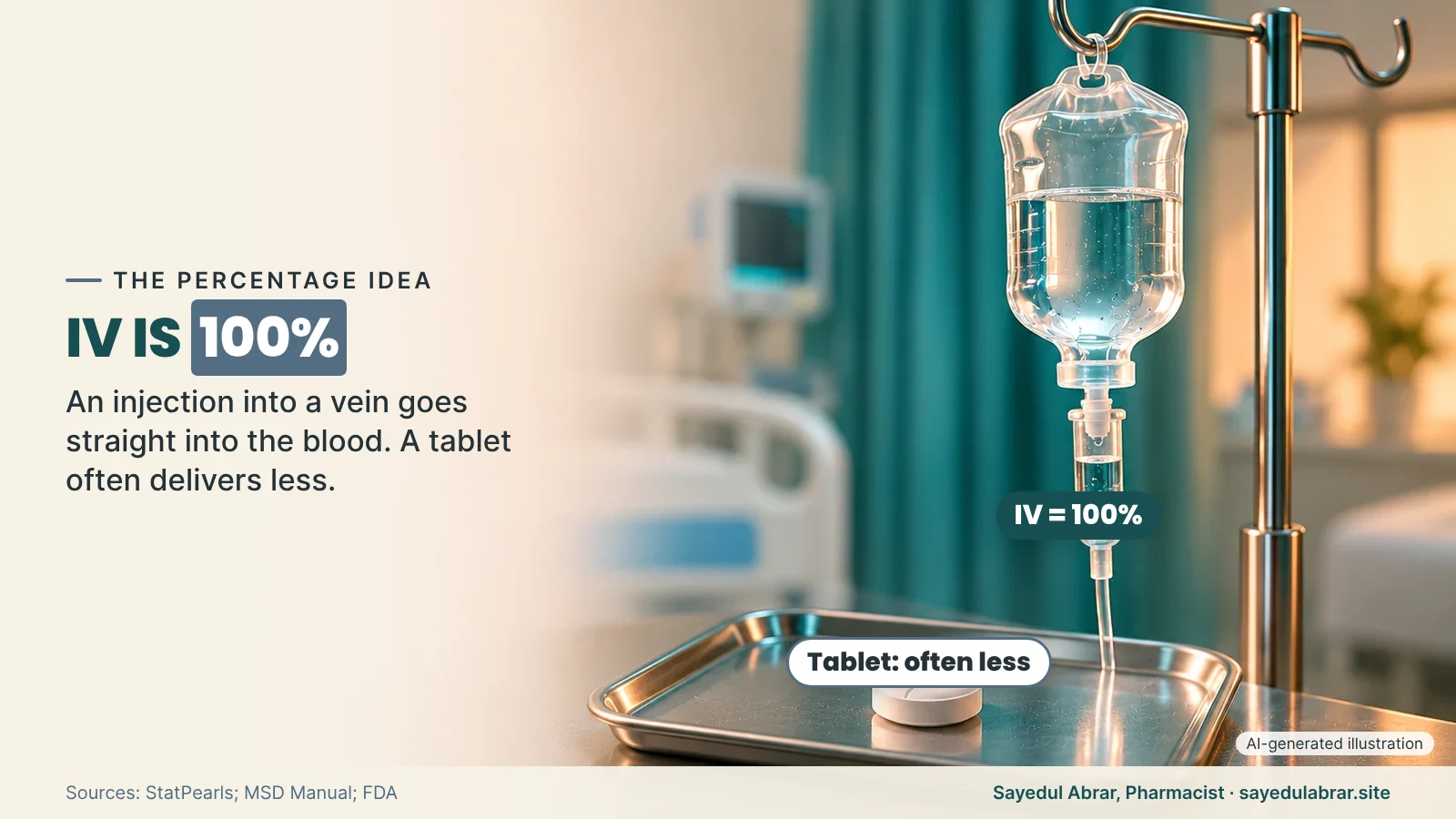
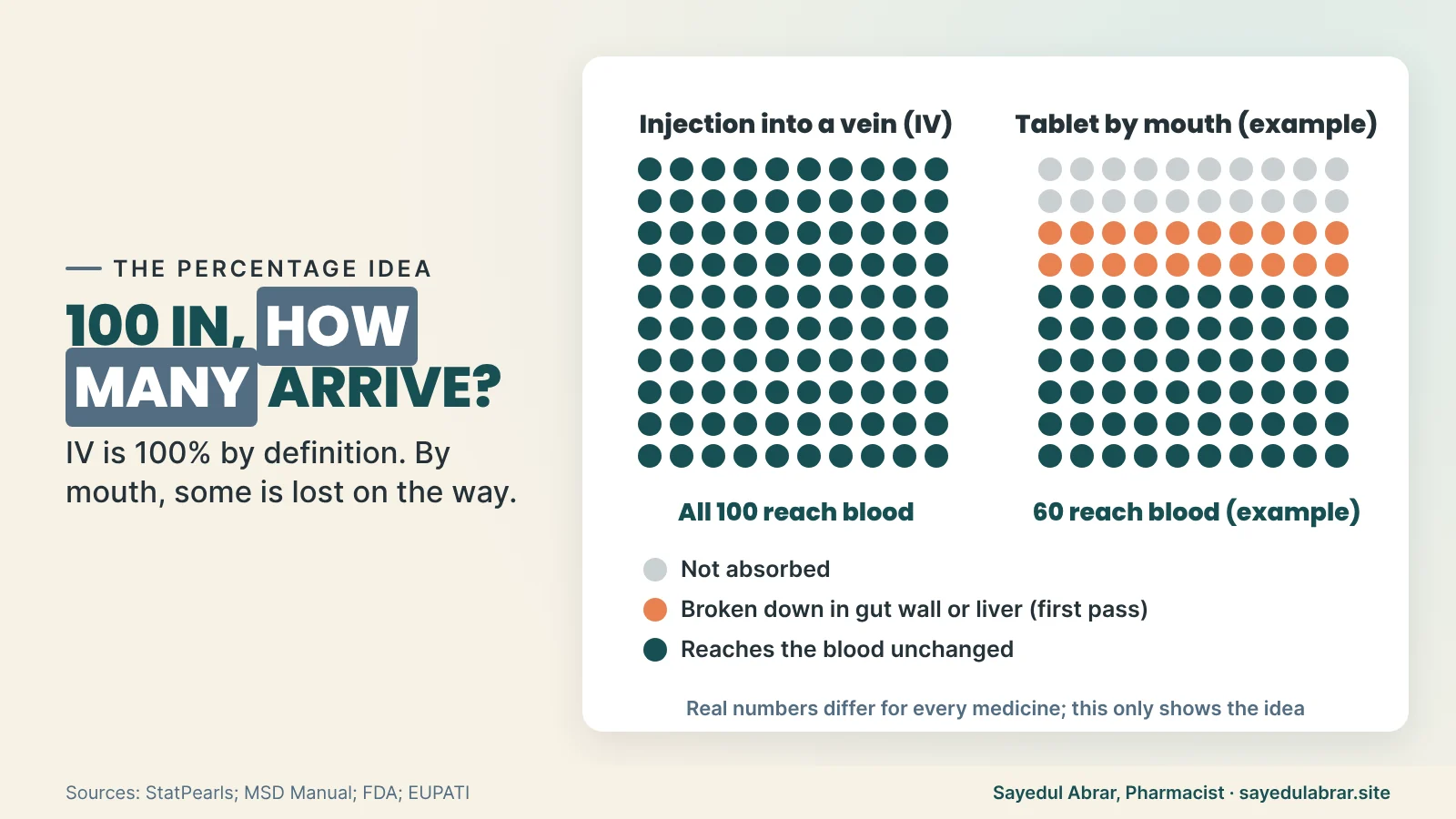
When a medicine is injected straight into a vein, all of it is already in the blood. So IV bioavailability is defined as 100%. Every other route is compared with that.
By mouth, the picture changes. Some of the dose may pass through the gut without being absorbed. Some may be broken down in the gut wall or liver before it reaches the general circulation. What is left reaches the blood unchanged.
3. First-pass effect in one paragraph
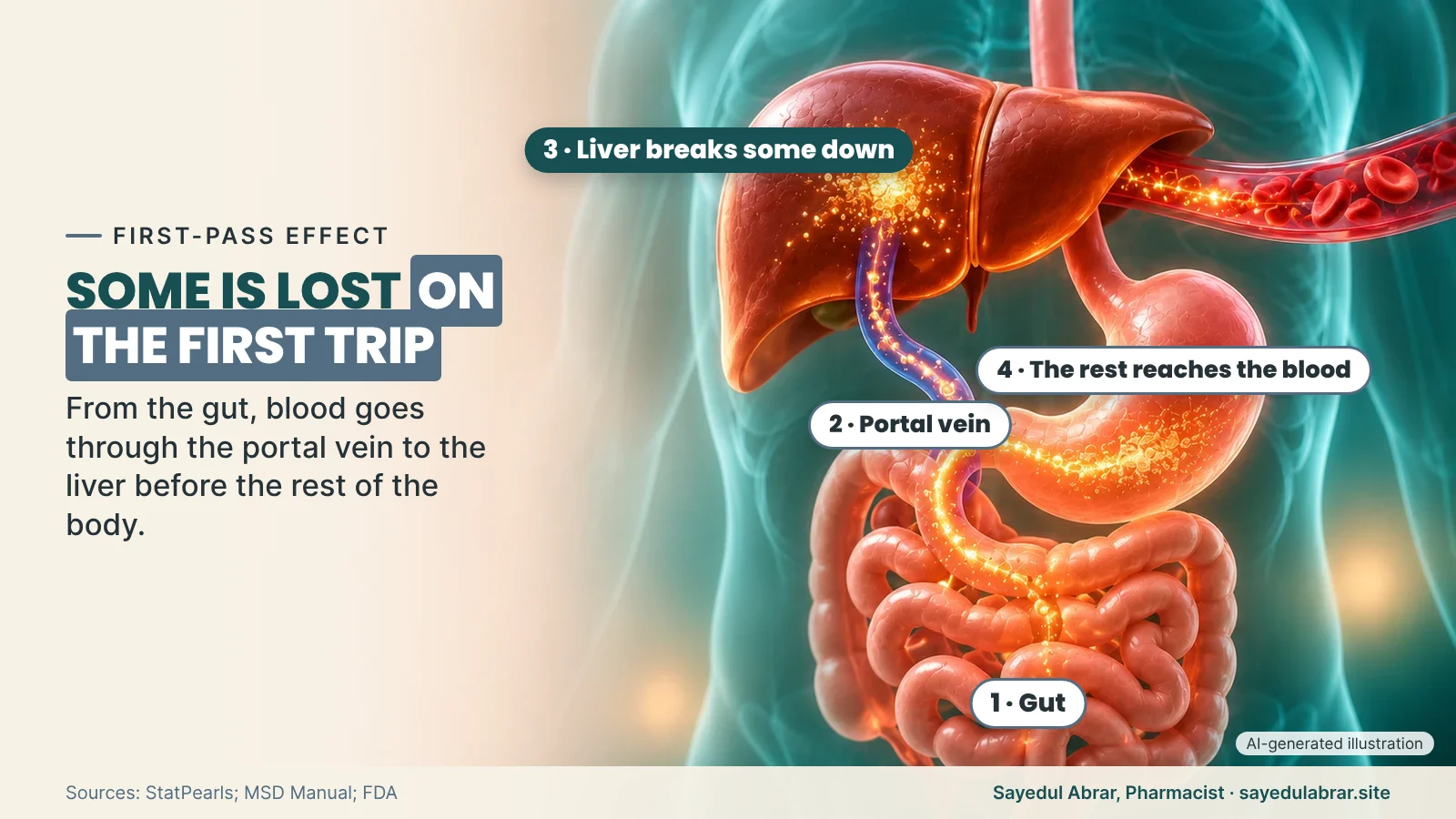
After absorption from the gut, blood travels through the portal vein to the liver before it reaches the rest of the body. Enzymes in the gut wall and liver can break down part of the dose on this first trip. This is called first-pass metabolism, and it can lower oral bioavailability a lot for some medicines. Medicines placed under the tongue, such as sublingual nitroglycerin, avoid this first trip. The full story is in Drug Metabolism.
4. What else changes bioavailability?
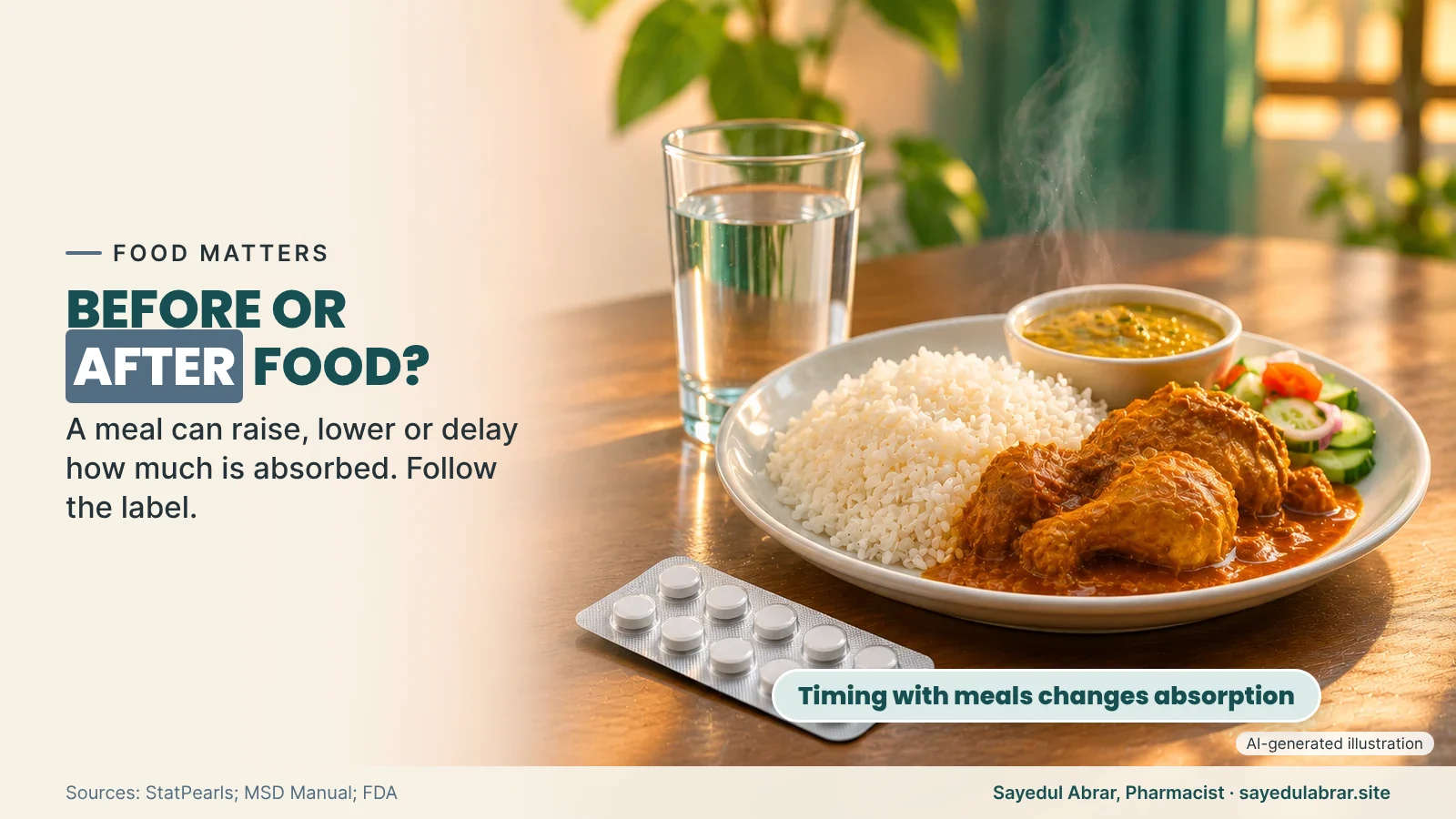
- Food and stomach contents: an empty stomach or a high-fat meal can change how much and how fast a drug is absorbed. That is why some medicines are taken before food and others after. (See When to take a PPI.)
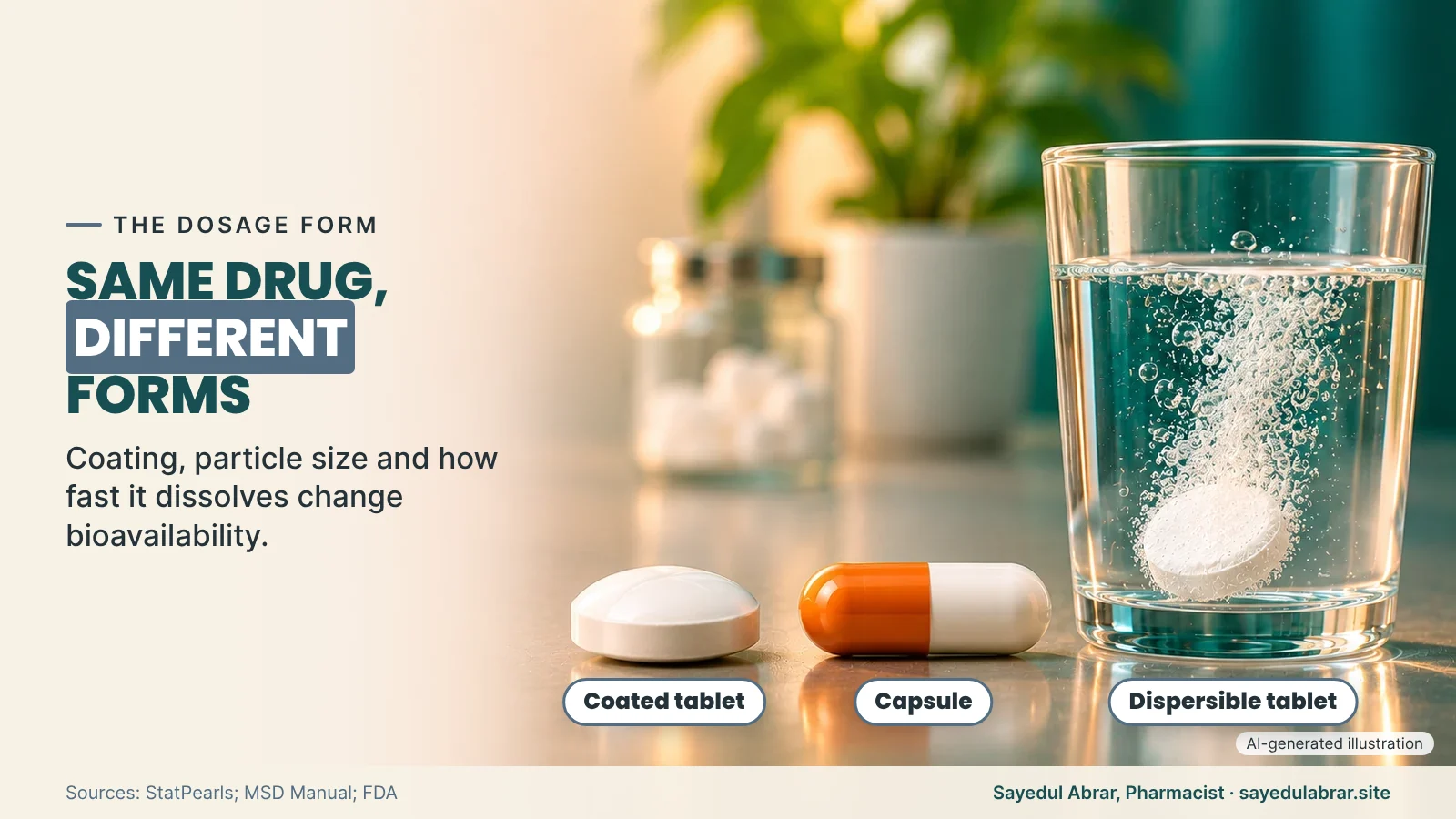
- The dosage form: the MSD Manual says bioavailability is largely decided by the properties of the dosage form, for example coating, particle size and how fast the tablet dissolves.
- Time in the gut: if a drug moves through too quickly, there may not be enough time to absorb it.
- Stomach acid and enzymes: some drugs are partly destroyed before absorption.
- Other medicines and foods: for example, tetracycline can bind to metal ions such as calcium or iron in the gut. The FDA warns that grapefruit juice can block a gut enzyme (CYP3A4) and raise the blood level of some medicines, while it can lower the level of others.
- The person: age, gut surgery, gut disease and genes can all play a part.
5. How is it measured? AUC, Cmax and Tmax
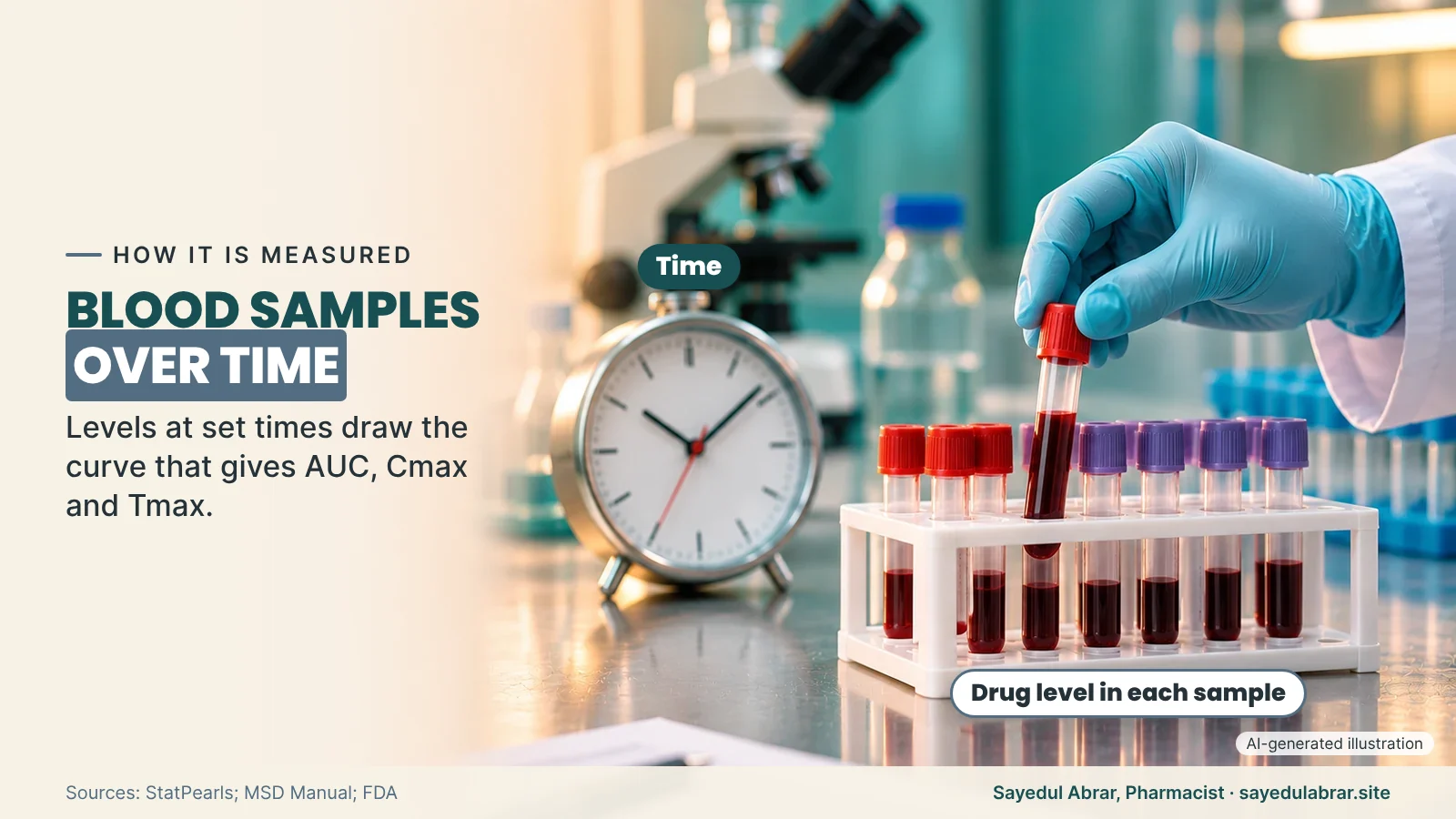
Researchers take blood samples over time and draw a concentration–time curve. Three numbers come from it:
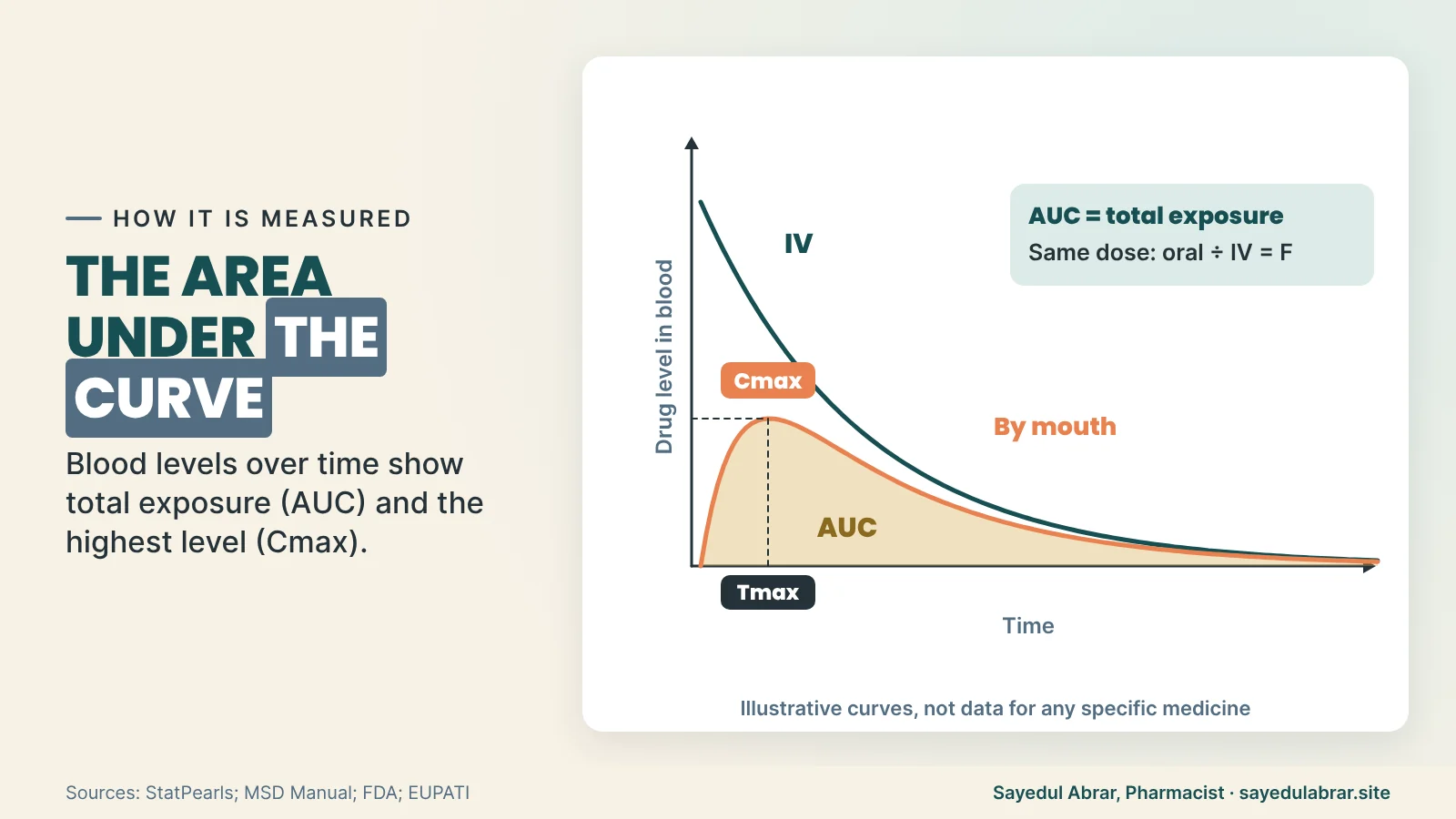
- AUC (area under the curve): the total exposure the body receives.
- Cmax: the highest concentration reached.
- Tmax: the time when that highest concentration is reached.
To find oral bioavailability, the AUC after a dose by mouth is compared with the AUC after the same dose given IV.
6. Bioequivalence and generic medicines
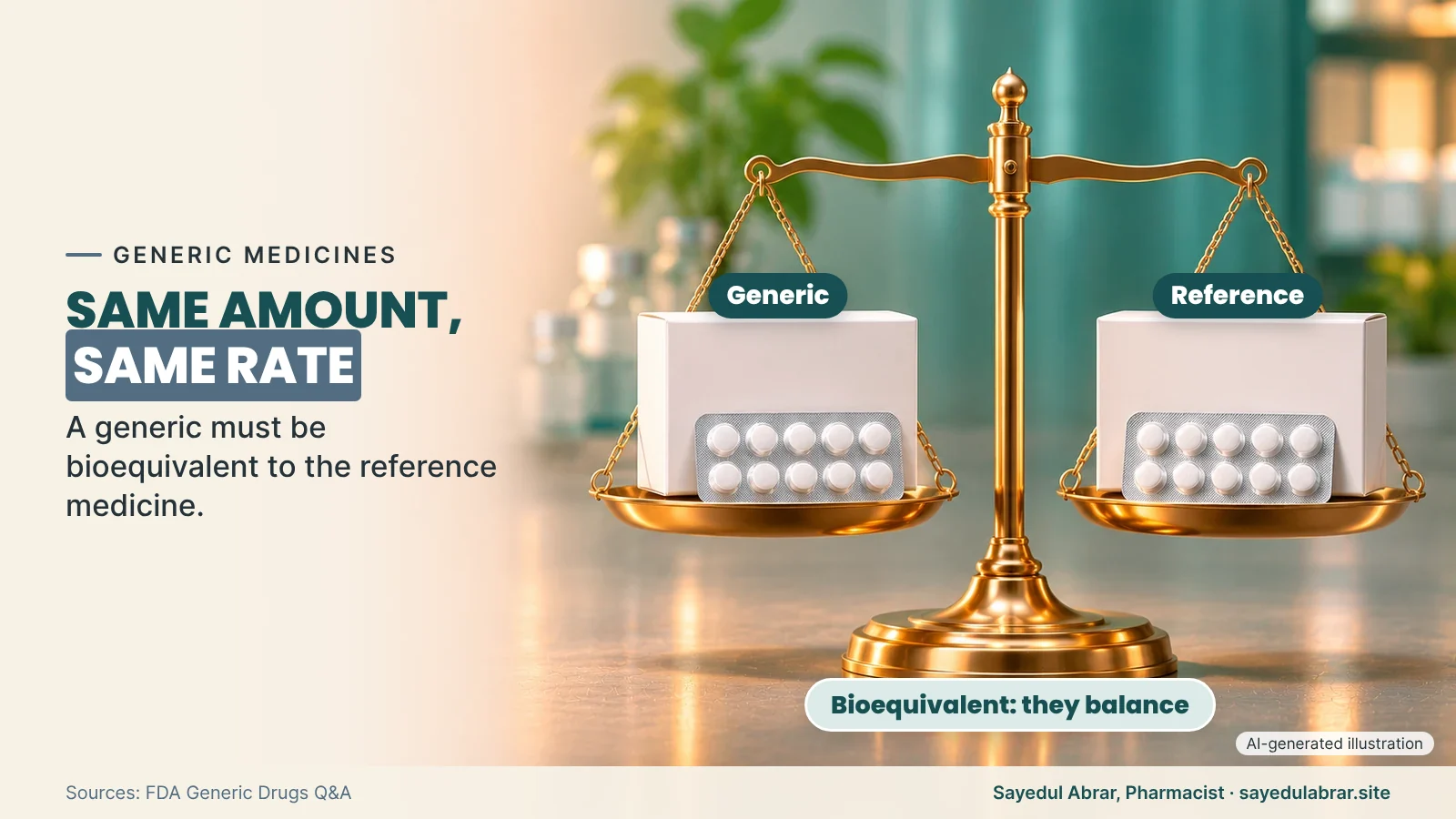
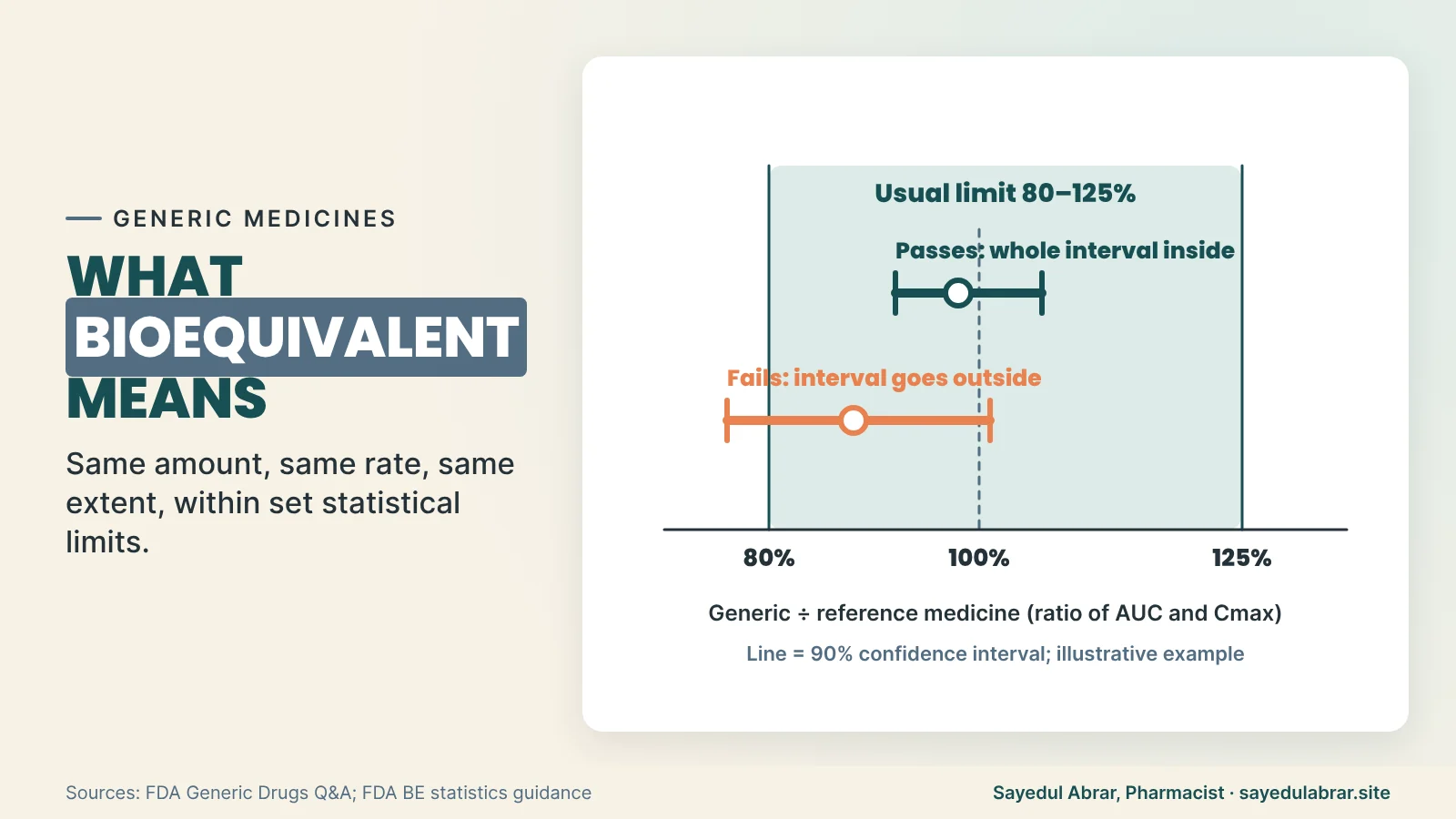
A generic medicine contains the same active ingredient as the original (reference) product. According to the U.S. FDA, it must have the same strength, dosage form and route, and it must be bioequivalent: it delivers the same amount of active ingredient at the same rate and to the same extent.
In bioequivalence studies, the generic and the reference are compared using AUC and Cmax. FDA guidance asks that the 90% confidence interval for the ratio of the two products' averages falls within set limits, usually 80–125%. This does not mean a generic can contain 20% less medicine; it is a statistical test on the whole interval.
Learn more about names on the pack in Generic Name vs Brand Name.
7. Why doses differ by route
Because oral bioavailability is often below 100%, the dose of the same medicine can be different for a tablet and an injection. A switch between forms, or between products, should always be decided by a doctor or pharmacist, never on your own.
8. Key takeaways
Bioavailability is about how much medicine actually reaches your blood. It explains food instructions, route-based doses and why generics must be tested for bioequivalence.
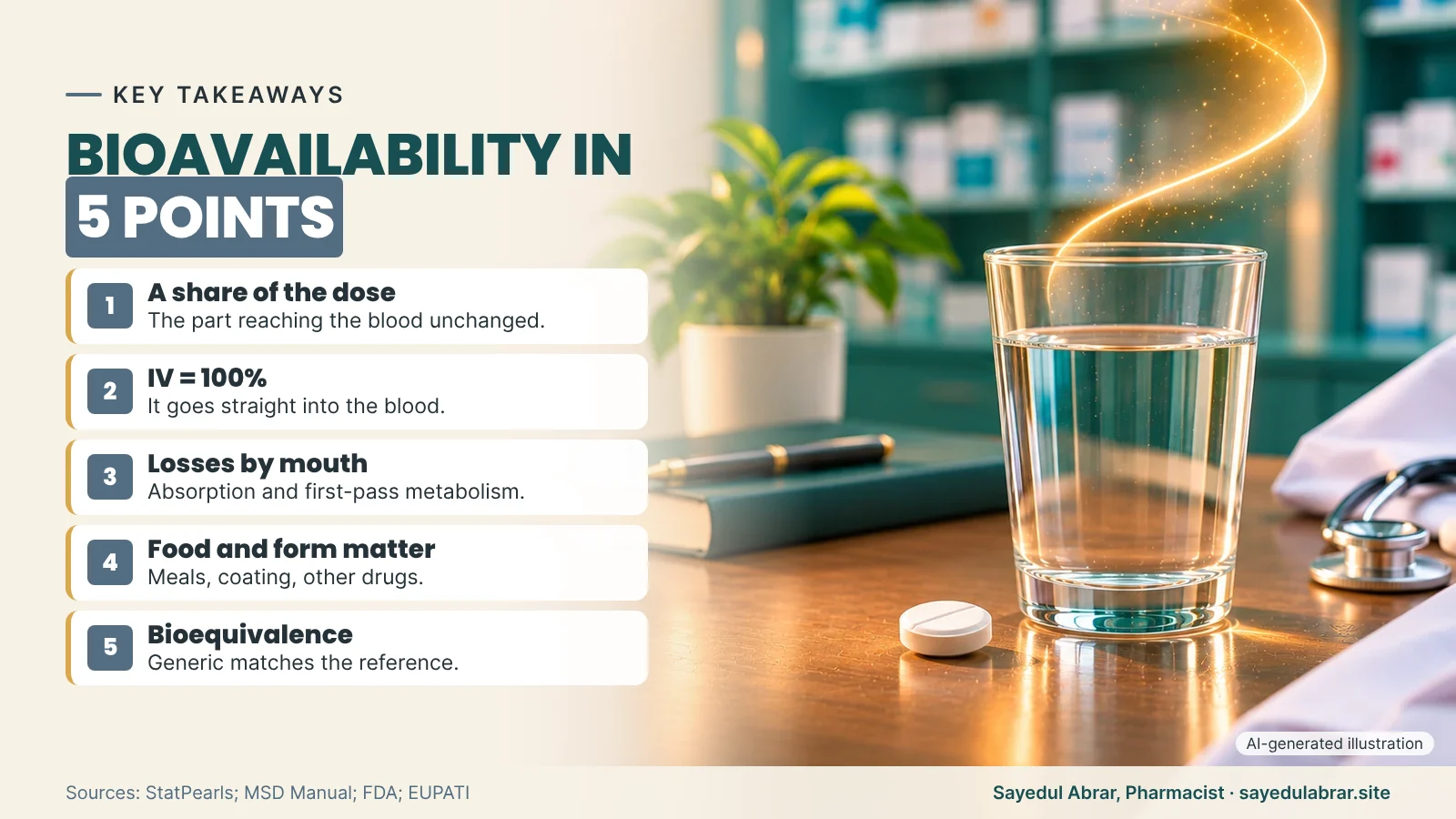
- Bioavailability is the share of a dose that reaches the blood unchanged.
- An IV dose is 100% bioavailable by definition.
- By mouth, poor absorption and first-pass metabolism can lower it.
- Food, the dosage form and other medicines can change it, so follow the label instructions.
- Generic medicines must show bioequivalence to the reference product.
Frequently asked questions
What does bioavailability mean in simple terms?
It is the percentage of a dose that reaches your bloodstream unchanged. If 60 out of 100 parts reach the blood, bioavailability is 60%.
Why is IV bioavailability 100%?
An IV injection puts the whole dose straight into the blood, so nothing is lost to absorption or first-pass metabolism. Other routes are compared with it.
What is the difference between bioavailability and bioequivalence?
Bioavailability describes how much of one product reaches the blood and how fast. Bioequivalence compares two products with the same active ingredient and checks that they deliver it at the same rate and extent, within set statistical limits.
Does food change bioavailability?
For some medicines, yes. Food can increase, decrease or delay absorption. Follow the instructions on your prescription or leaflet about taking a medicine before or after food.
Are generic medicines as effective as the original?
In the U.S., the FDA requires approved generics to be bioequivalent to the reference product, with the same active ingredient, strength, dosage form and route. If you have a concern about switching products, ask your pharmacist.
Related reading
- Drug Absorption: How Does Medicine Enter the Bloodstream?
- Generic Name vs Brand Name
- Drug Metabolism: How Does the Body Process Medicines?
- Drug Half-Life: How Long Does a Medicine Stay in the Body?
References and further reading
- StatPearls. Drug Bioavailability. NCBI Bookshelf. ncbi.nlm.nih.gov
- MSD Manual Professional Edition. Drug Bioavailability. msdmanuals.com
- EUPATI Toolbox. Bioavailability and bioequivalence. toolbox.eupati.eu
- U.S. FDA. Generic Drugs: Questions & Answers. fda.gov
- U.S. FDA. Generic Drug Facts. fda.gov
- U.S. FDA. Guidance for Industry: Statistical Approaches to Establishing Bioequivalence (2001). fda.gov
- U.S. FDA. Grapefruit Juice and Some Drugs Don't Mix. fda.gov

Sayedul Abrar
A Grade Pharmacist · Registration Code: A-22040
Product Executive, Product Management Department (PMD) · Opsonin Pharma Ltd.