 Sayedul Abrar
1. What does half-life mean?
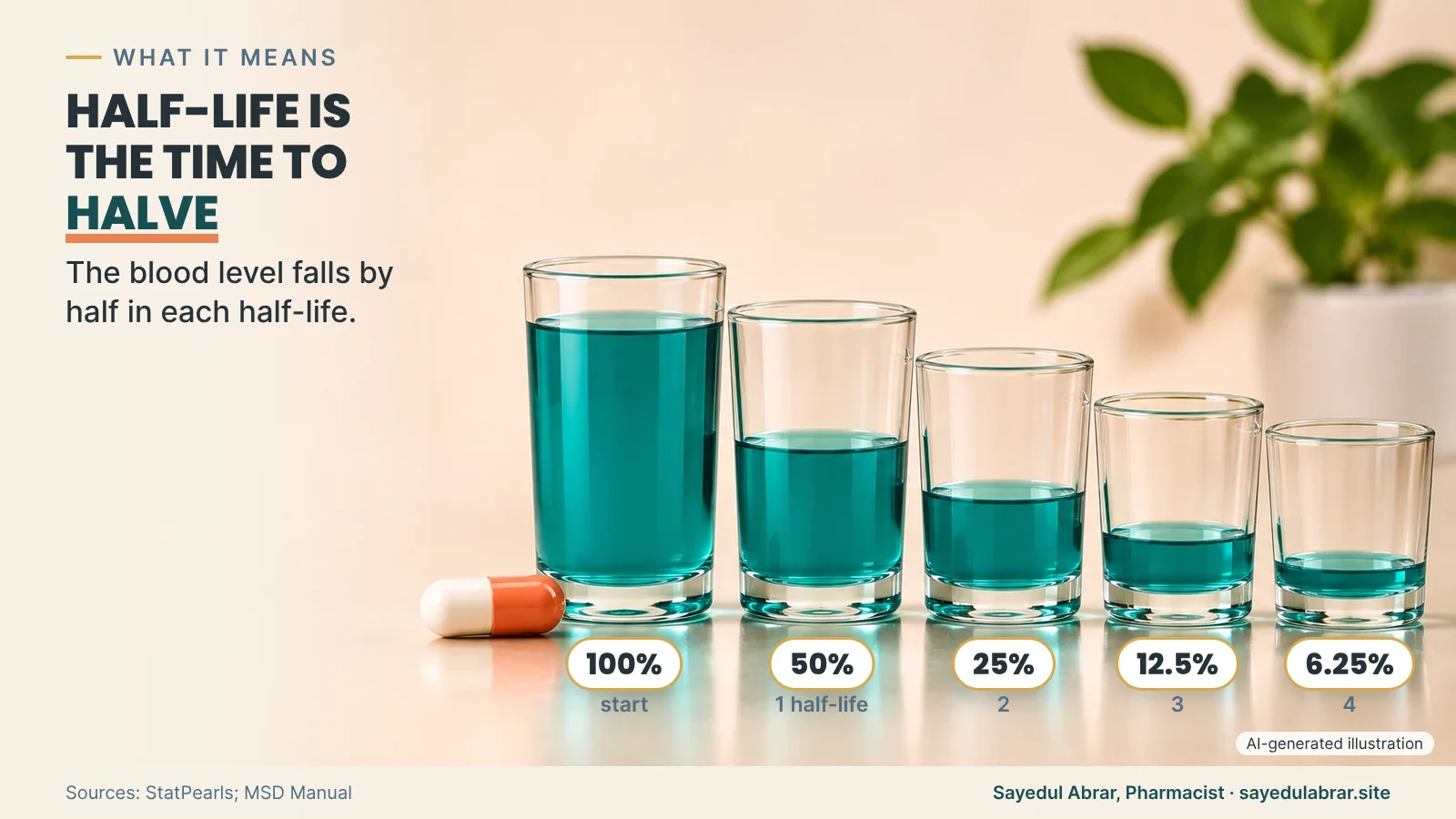
The elimination half-life (written t½) is the time needed for the concentration of a drug in the blood (plasma) to fall to half of its starting value. If a medicine has a half-life of 6 hours, the level falls from 100% to 50% in 6 hours, then from 50% to 25% in the next 6 hours, and so on.
Half-life is a time, not a strength. A medicine with a long half-life is not "stronger". It simply stays in the body longer.
2. The 4–5 half-lives rule
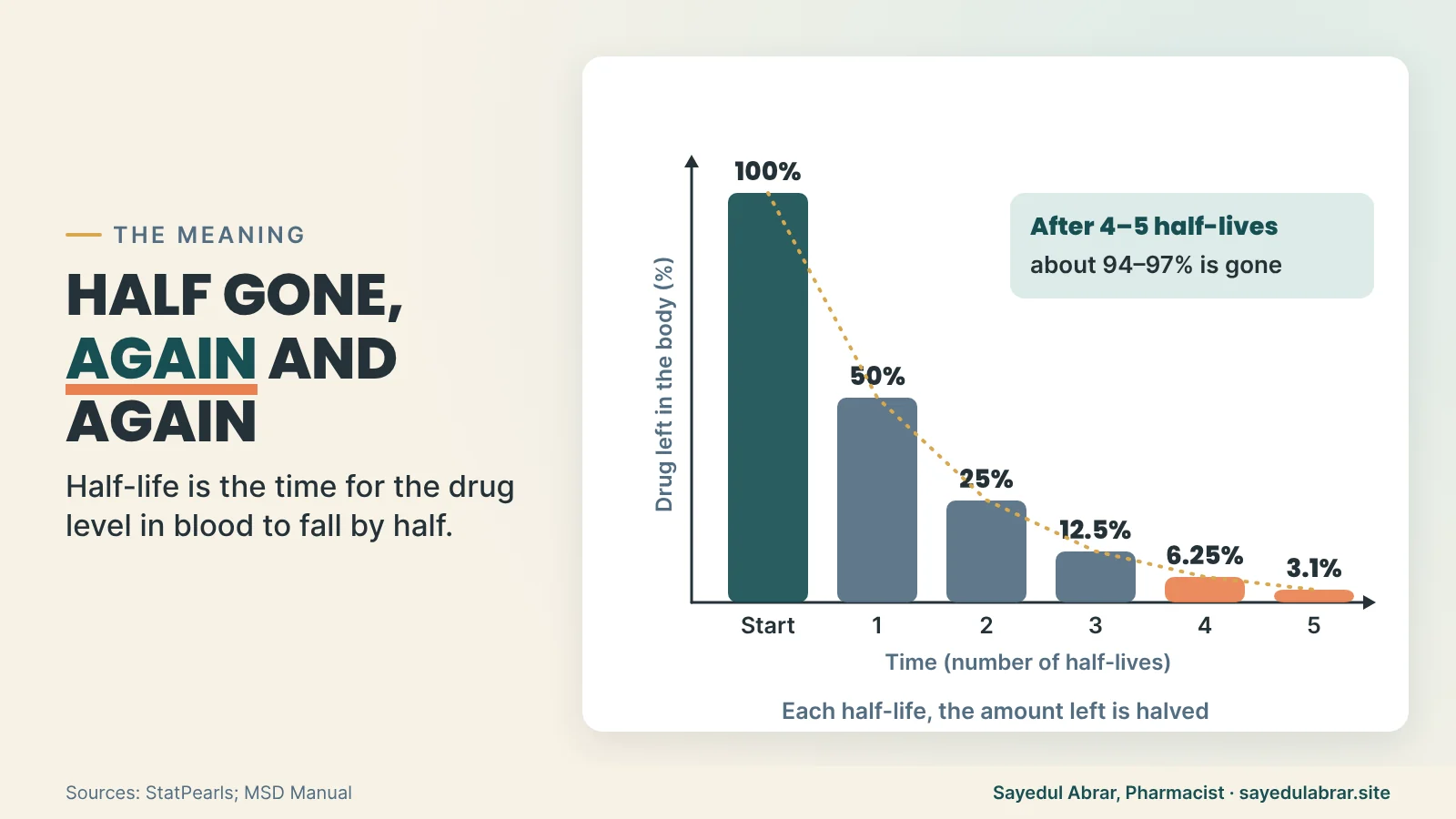
Because the level halves each time, the drug never disappears in one step. A simple count shows what is left after a single dose:
| Half-lives passed | Amount left | Amount removed |
|---|---|---|
| 1 | 50% | 50% |
| 2 | 25% | 75% |
| 3 | 12.5% | 87.5% |
| 4 | 6.25% | 93.75% |
| 5 | 3.1% | 96.9% |
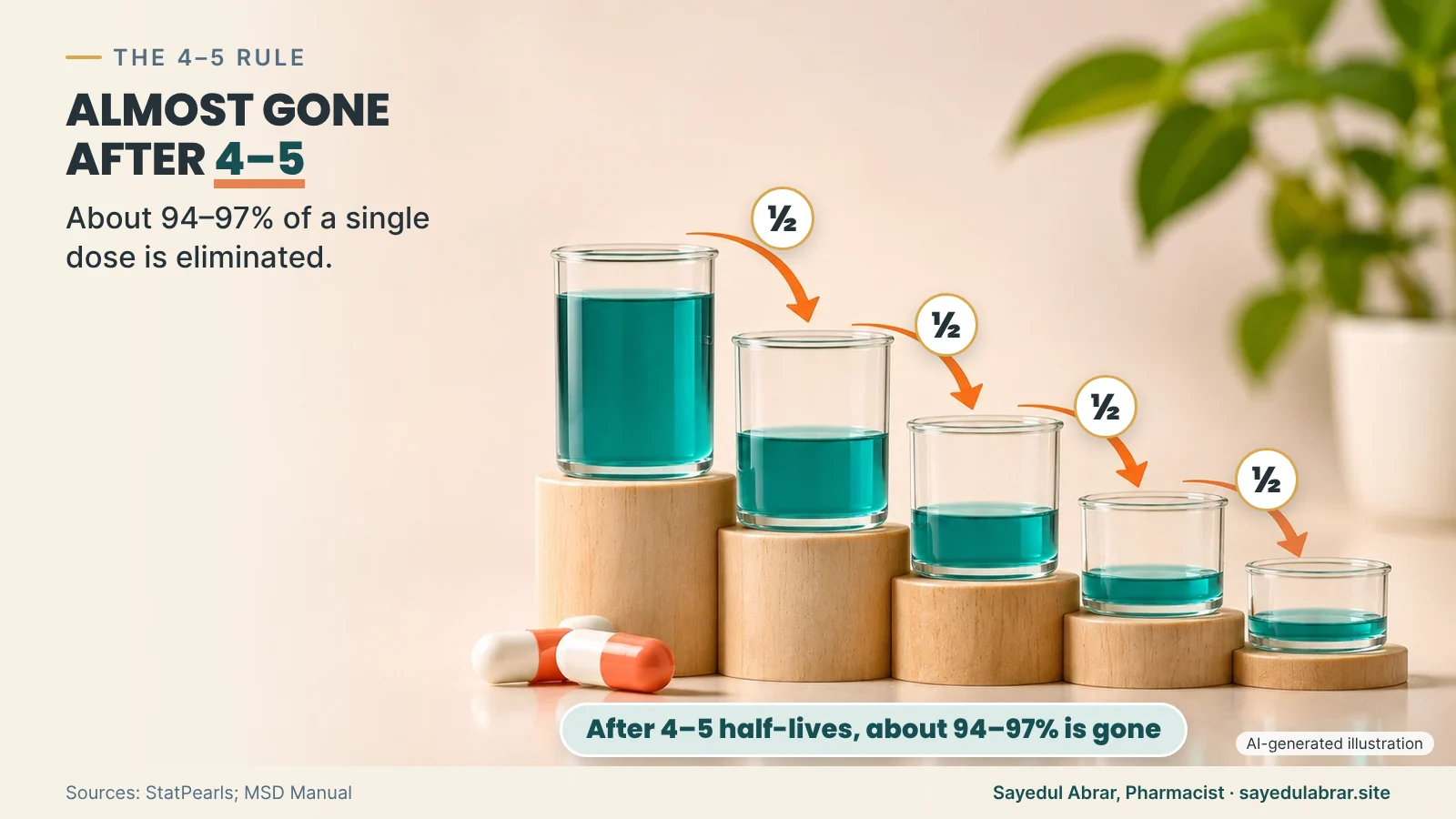
StatPearls notes that about 94–97% of a drug is eliminated after 4–5 half-lives. That is why pharmacists often say a single dose is "mostly gone" after about five half-lives. Some effects, and some active metabolites, can last longer than the parent drug.
3. What decides the half-life?
Two things matter most:
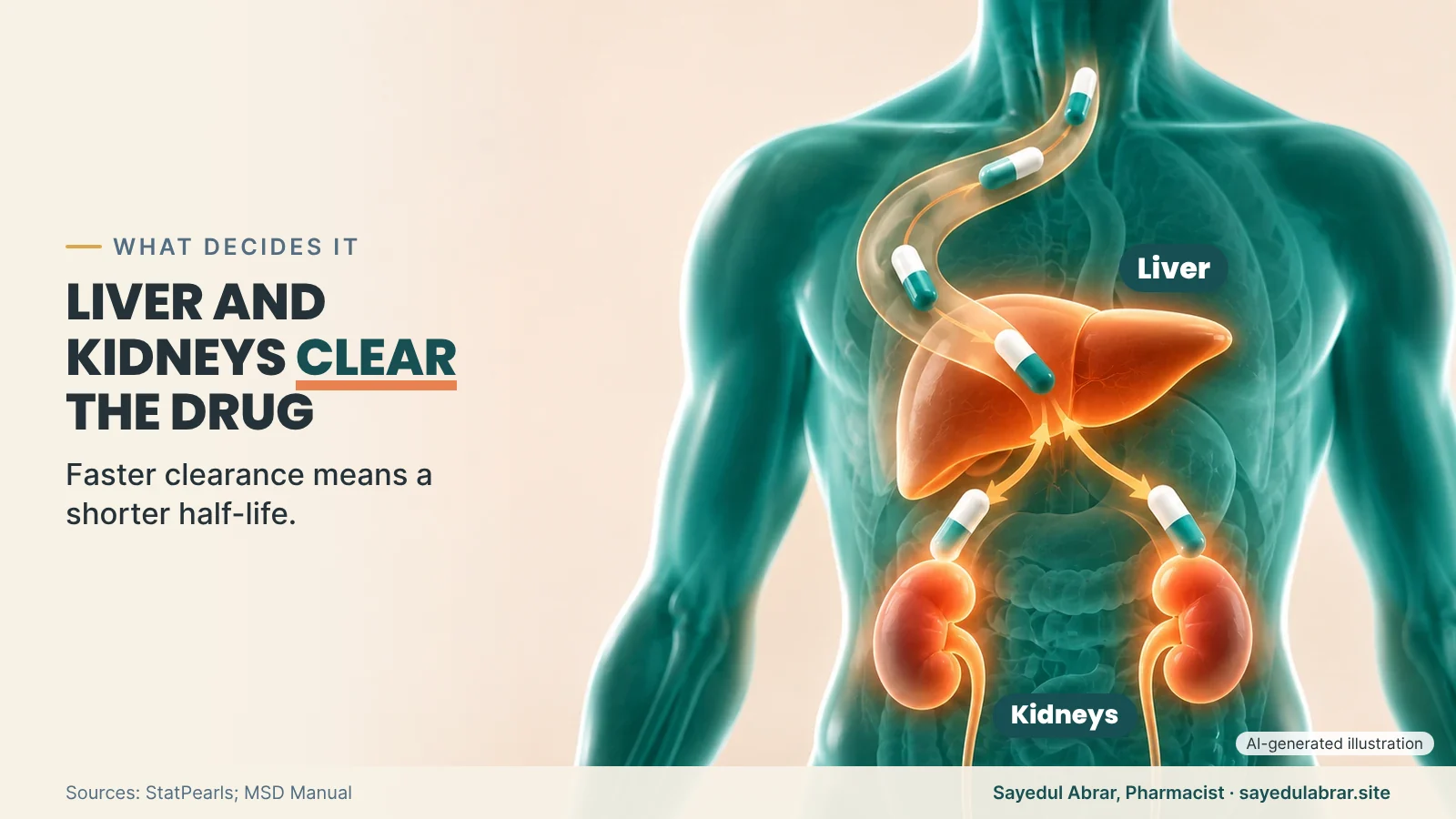
- Clearance: how fast the liver and kidneys remove the drug. Faster removal means a shorter half-life. (See Drug Metabolism and Drug Excretion.)
- Volume of distribution: how widely the drug spreads into body tissues. A drug that hides in fat or tissues leaves the blood slowly, so its half-life is longer. (See Drug Distribution.)
Pharmacists write this as t½ = 0.693 × Vd ÷ CL. You do not need the formula. Just remember: wider spread or slower removal gives a longer half-life.
4. Why half-life sets how often you take a medicine
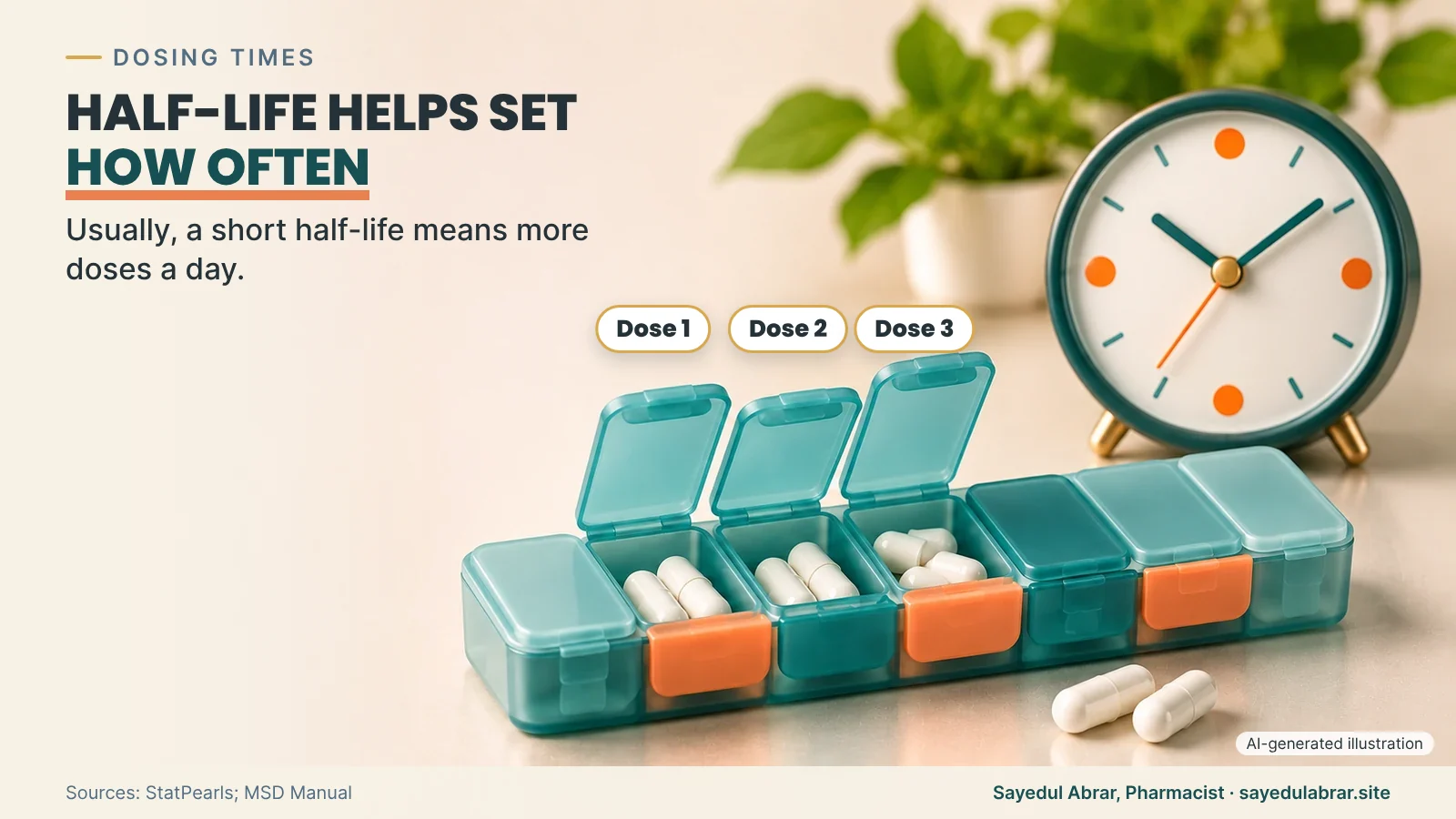
A short half-life usually means a shorter effect, so the medicine may need to be taken several times a day. A long half-life usually allows once- or twice-daily dosing. For example, StatPearls gives ibuprofen a half-life of about 2 hours, digoxin about 36–48 hours, and amiodarone several weeks. These are approximate values for adults; your own dose and timing always come from your prescription or the product leaflet.
Regular timing keeps the level in the useful range. This is one reason an antibiotic course is taken at fixed times. Read more in Why You Must Complete an Antibiotic Course.
5. Steady state: when the level stops climbing
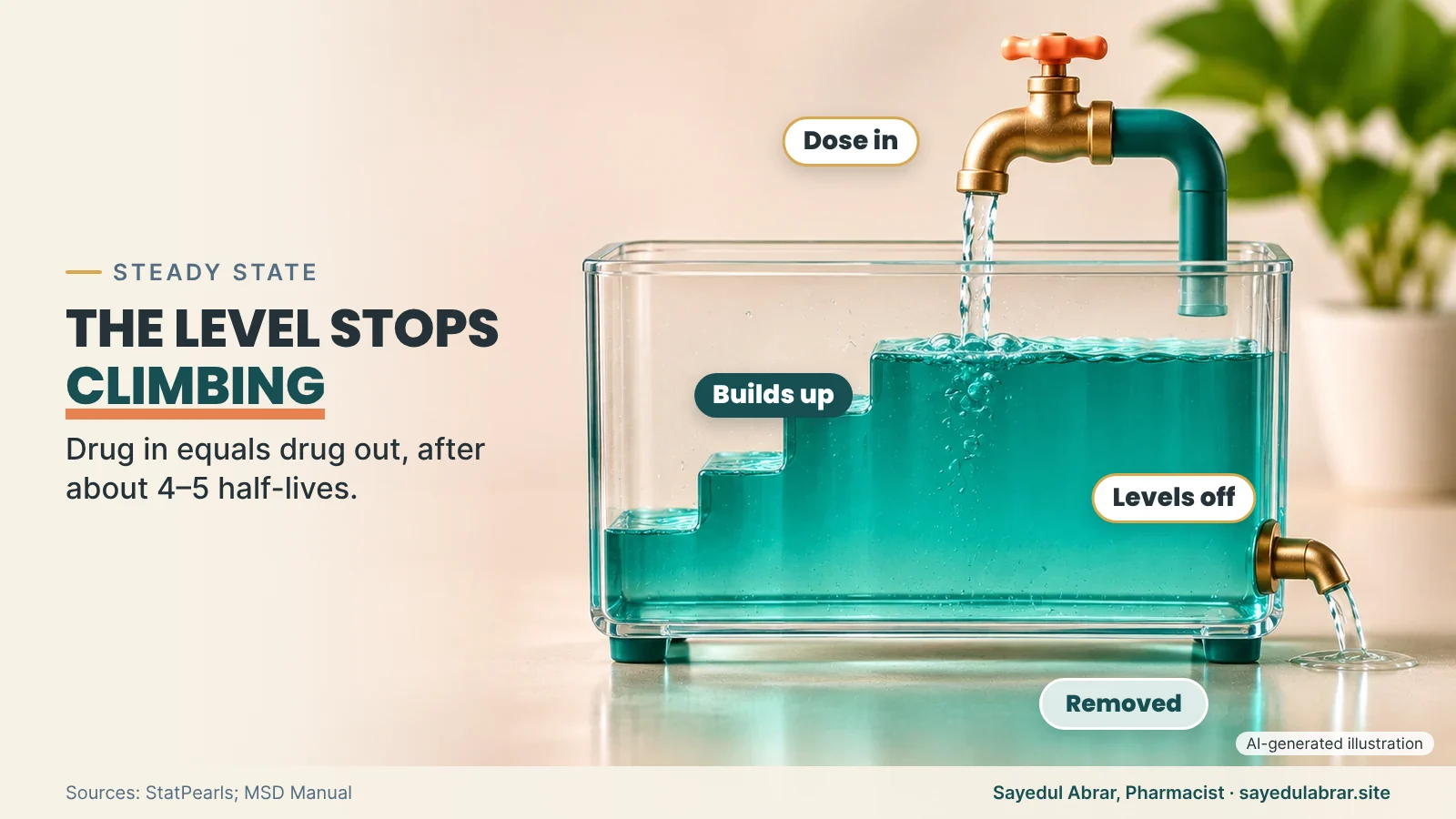
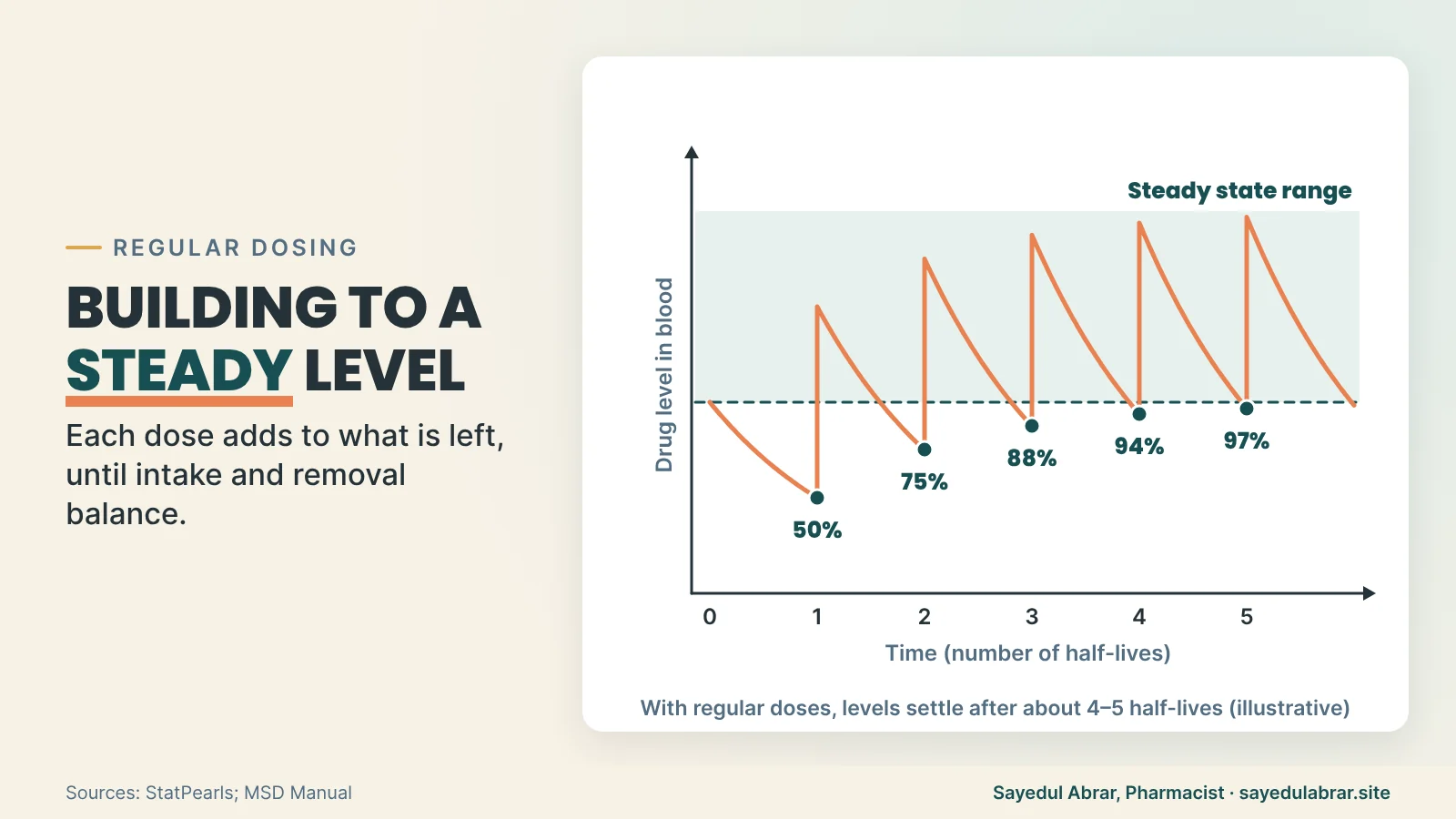
When you take a medicine regularly, each new dose adds to what is still left from the last one. The level rises step by step until the amount going in equals the amount being removed. This balance is called steady state. As a rule of thumb, it is reached after about 4–5 half-lives.
This explains why some long-acting medicines take days or weeks to show their full effect. For a few medicines with a very long half-life, doctors may start with a larger loading dose to reach the target level sooner. This is a medical decision and is never done on your own.
6. Things that change half-life
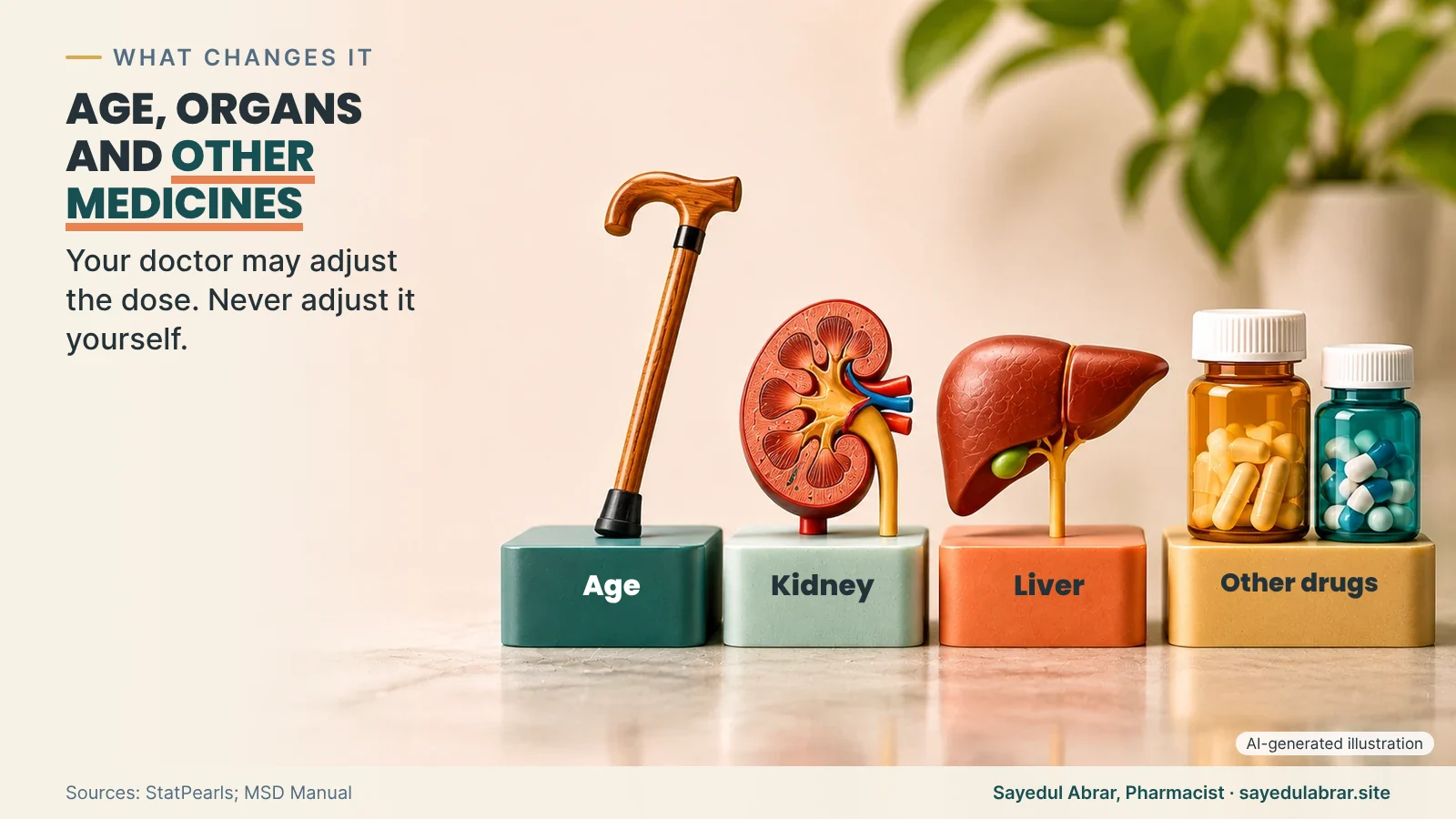
- Kidney disease: drugs removed by the kidneys can stay longer.
- Liver disease: drugs broken down by the liver can stay longer.
- Age: babies and older adults often handle medicines differently. The MSD Manual notes that some sedative medicines can reach half-lives of up to 96 hours in older people.
- Other medicines: some drugs speed up or slow down the enzymes that clear another drug.
This is why your doctor may change the dose or the timing for you. Never adjust it yourself.
7. Key takeaways
Half-life tells you how long a medicine stays, not how strong it is. It explains dosing times, steady state and why the same dose can act differently in different people.
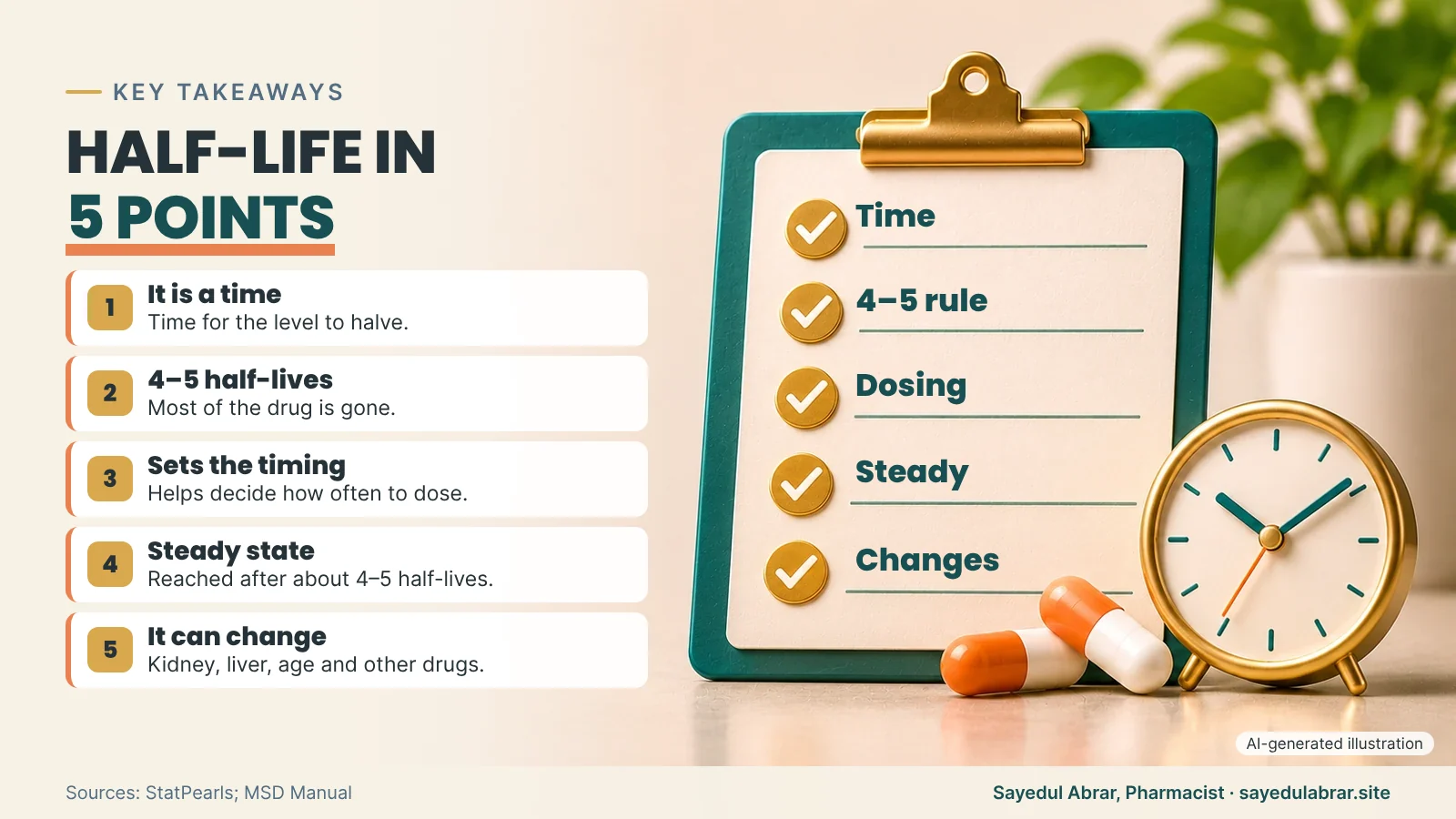
- Half-life is the time for the blood level of a medicine to fall by half.
- After about 4–5 half-lives, roughly 94–97% of a single dose is gone.
- Half-life helps decide how often a medicine is taken.
- With regular dosing, steady state is reached after about 4–5 half-lives.
- Kidney or liver disease, age and other medicines can change half-life, so follow your prescriber's timing.
Frequently asked questions
What is the half-life of a drug in simple words?
It is the time needed for the amount of a medicine in your blood to fall by half. After one half-life, 50% is left. After two, 25% is left.
Does half-life mean the medicine stops working after that time?
Not exactly. Half-life shows when the blood level has halved, not when the effect ends. How long the effect lasts depends on the medicine, the dose and the person.
How many half-lives until a drug is out of your system?
As a rule of thumb, about 4–5 half-lives. By then roughly 94–97% of a single dose has been eliminated. Some effects or active metabolites can last longer, and kidney or liver disease can slow removal.
Does a longer half-life mean a stronger medicine?
No. Half-life describes how long a medicine stays in the body, not how strong it is. Strength depends on the drug and the dose.
Why do some medicines take days to work fully?
With regular doses, the blood level builds up until it reaches steady state, which takes about 4–5 half-lives. For a medicine with a long half-life, this can take days or longer.
Can I take my dose earlier if I feel it wearing off?
Do not change the timing on your own. Doses taken too close together can push the level too high. Ask your doctor or pharmacist if you feel the medicine is not lasting.
Is half-life the same for everyone?
No. Age, kidney and liver function, body size, illness and other medicines can all change half-life. That is why doses are sometimes adjusted for a person.
Related reading
- Drug Excretion: How Do Medicines Leave the Body?
- Drug Metabolism: How Does the Body Process Medicines?
- Why You Must Complete an Antibiotic Course
- Drug Distribution: How Medicines Reach Their Target
Continue learning: How do medicines work in the body? explains how half-life fits into pharmacokinetics and how drug exposure connects with pharmacological effects.
References and further reading
- StatPearls. Elimination Half-Life of Drugs. NCBI Bookshelf. ncbi.nlm.nih.gov
- StatPearls. Steady State Concentration. statpearls.com
- StatPearls. Loading Dose. statpearls.com
- MSD Manual Professional Edition. Pharmacokinetics in Older Adults. msdmanuals.com
- Open RN. Nursing Pharmacology, 1.9 Examining Effect. opentextbc.ca
- StatPearls. Ibuprofen Toxicity. NCBI Bookshelf. ncbi.nlm.nih.gov
- StatPearls. Digoxin. statpearls.com
- StatPearls. Amiodarone. statpearls.com

Sayedul Abrar
A Grade Pharmacist · Registration Code: A-22040
Product Executive, Product Management Department (PMD) · Opsonin Pharma Ltd.