 Sayedul Abrar
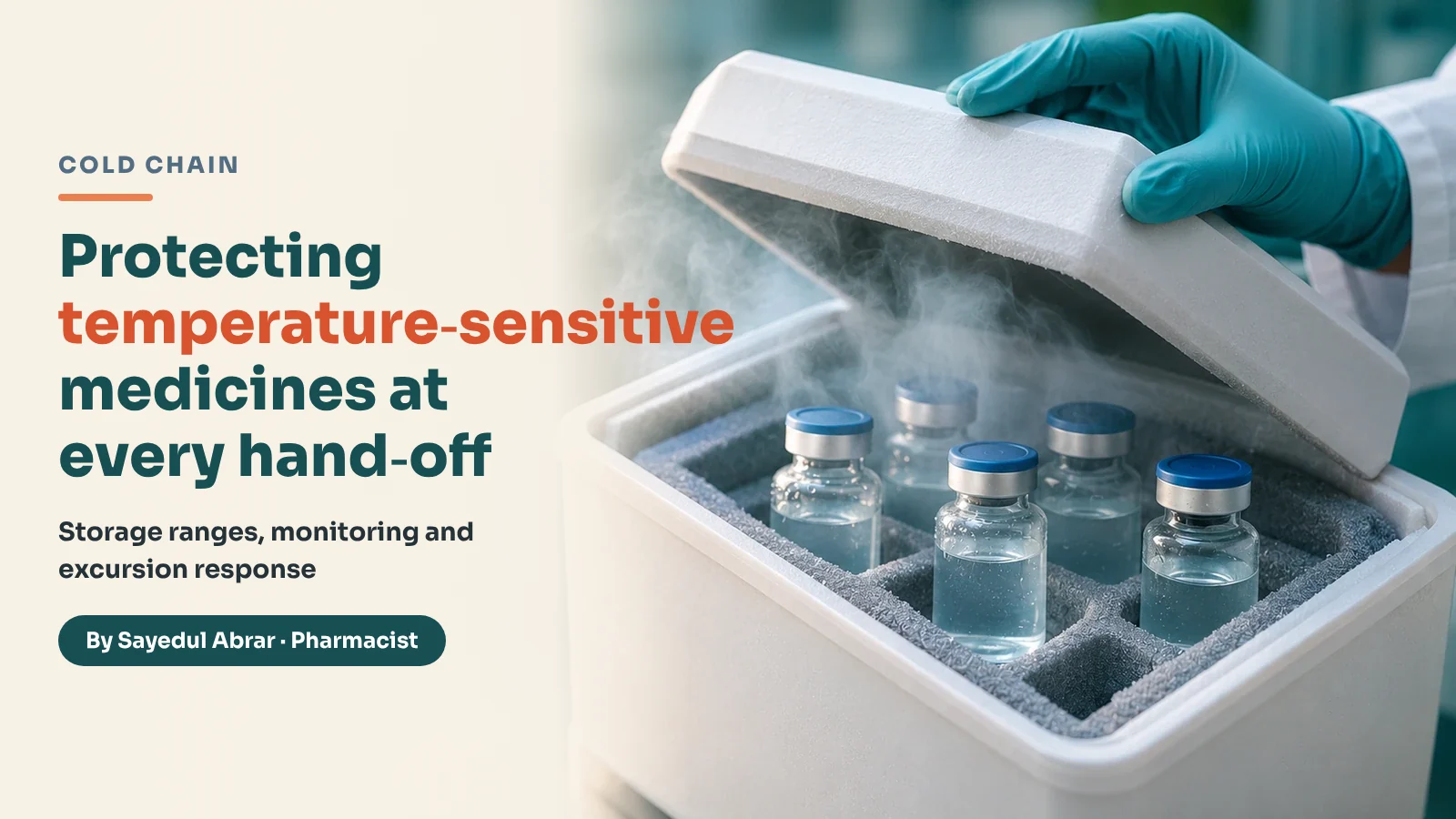
A medicine may leave a manufacturing site within specification, yet face heat, freezing, delays or a power failure before it reaches a patient. For some products, the journey must remain within defined temperature conditions from manufacture until use. This connected system is called the pharmaceutical cold chain.
The central rule is simple: protect each product within the conditions established by its manufacturer and supported by stability data. But a cold chain is more than a refrigerator, and 2–8°C is not a universal rule for all medicines.
1. What is a pharmaceutical cold chain?
A time- and temperature-sensitive pharmaceutical product can lose quality if it is kept outside its defined environmental conditions or time limits. WHO's TRS 961, Annex 9 provides model guidance for storing and transporting these products.
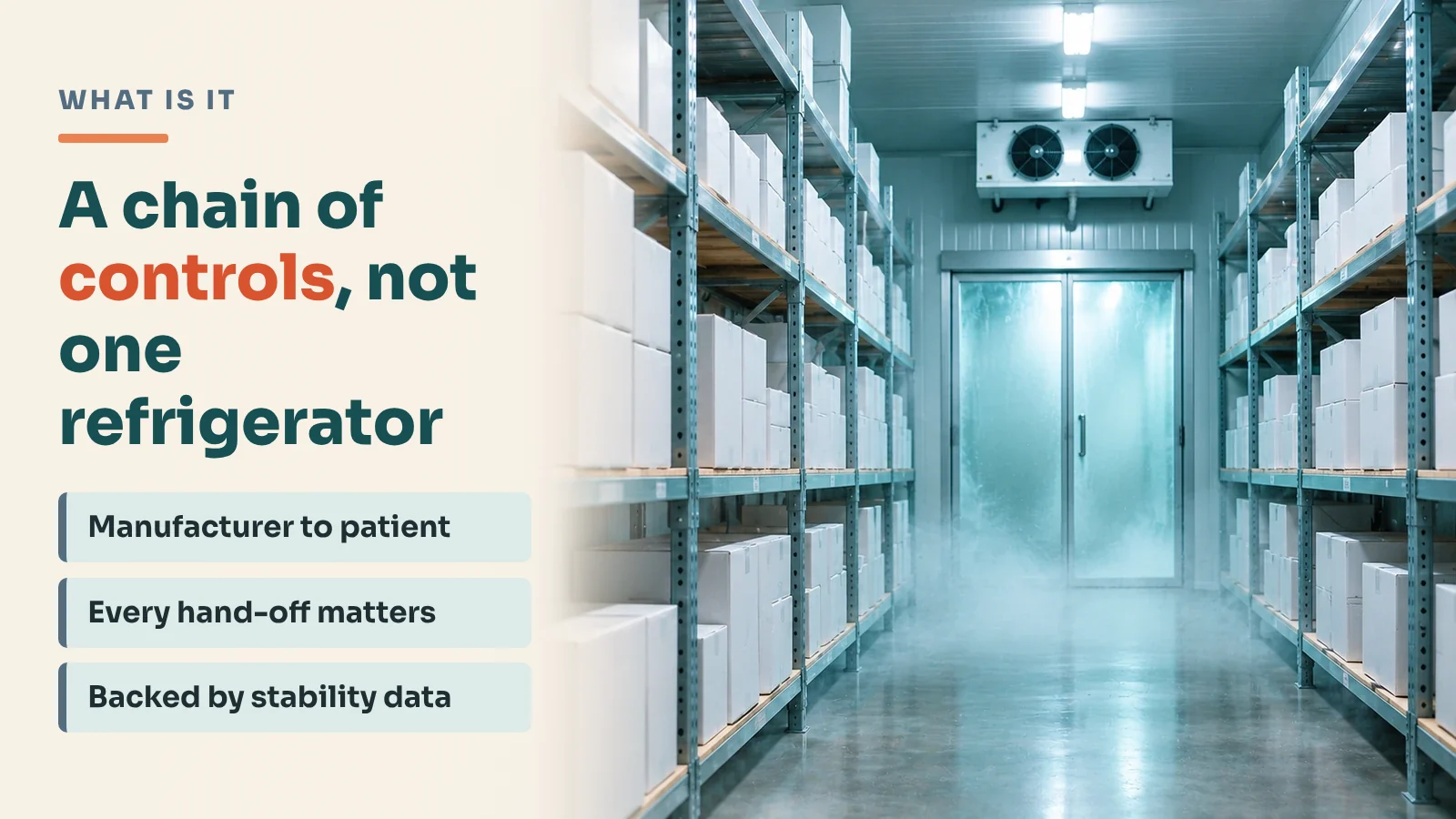
In practice, the cold chain links the manufacturer, warehouse, transport provider, distributor, pharmacy or hospital and patient. Each hand-off matters. Storage and transport limits may differ, but both must be supported by the manufacturer's stability data and approved product information.
2. Which medicines need temperature control?
Examples include vaccines, insulin, some monoclonal antibodies and other biologics, selected hormone products and certain medicines after reconstitution. Requirements vary by product, formulation and stage of use. An unopened vial may have a different in-use period after opening or preparation.
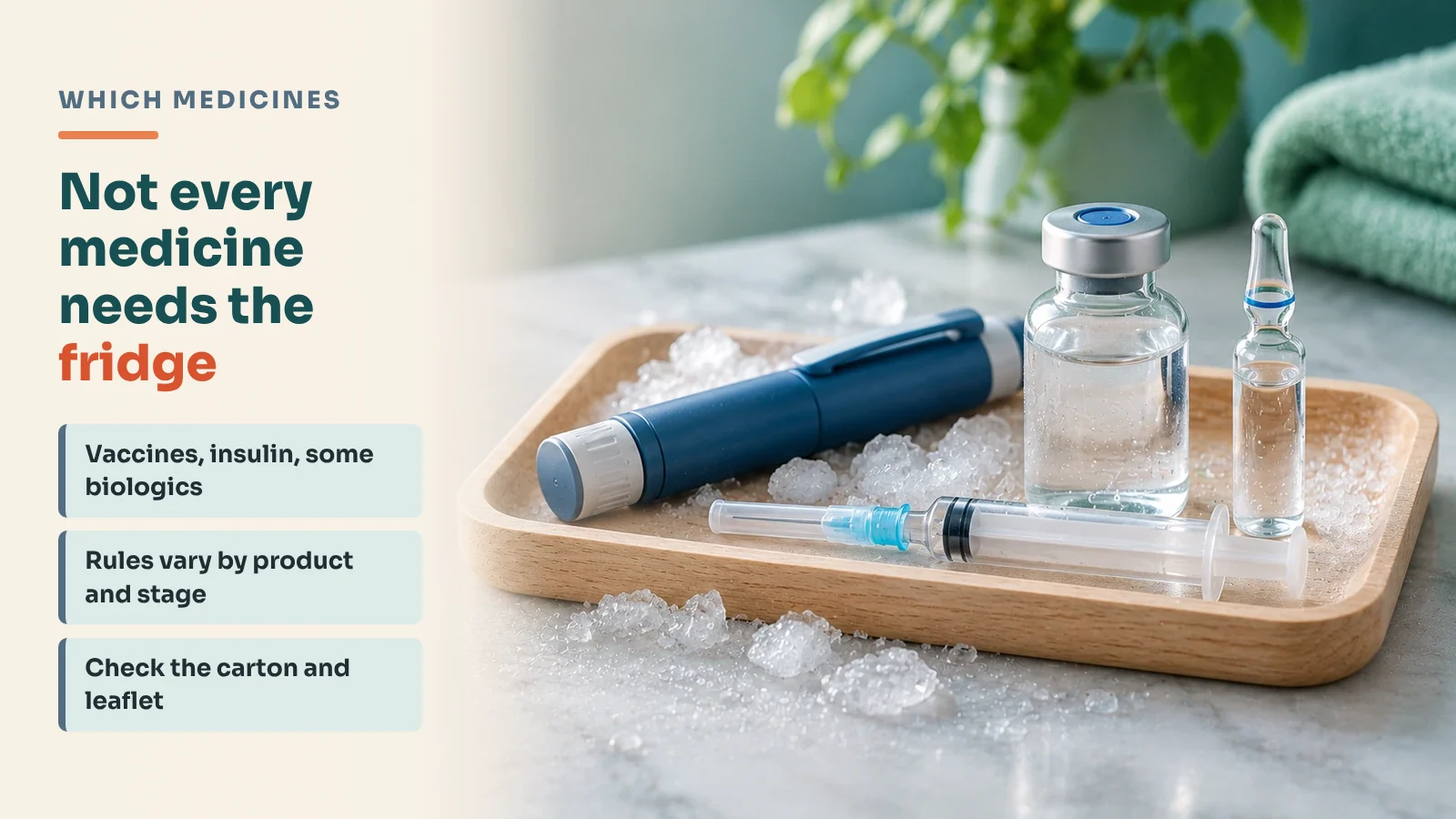
Not every injection or biologic needs refrigeration. Check the carton, package insert and current manufacturer instructions. WHO's TRS 1025, Annex 7 gives descriptive storage limits that help explain common label terms:
| Label description | WHO descriptive limit |
|---|---|
| Controlled room temperature | 15–25°C |
| Cool place | 8–15°C |
| Refrigerator | 5 ± 3°C (about 2–8°C) |
| Freezer | −20 ± 5°C |
| Deep freezer | −70 ± 10°C |
3. Why does temperature matter?
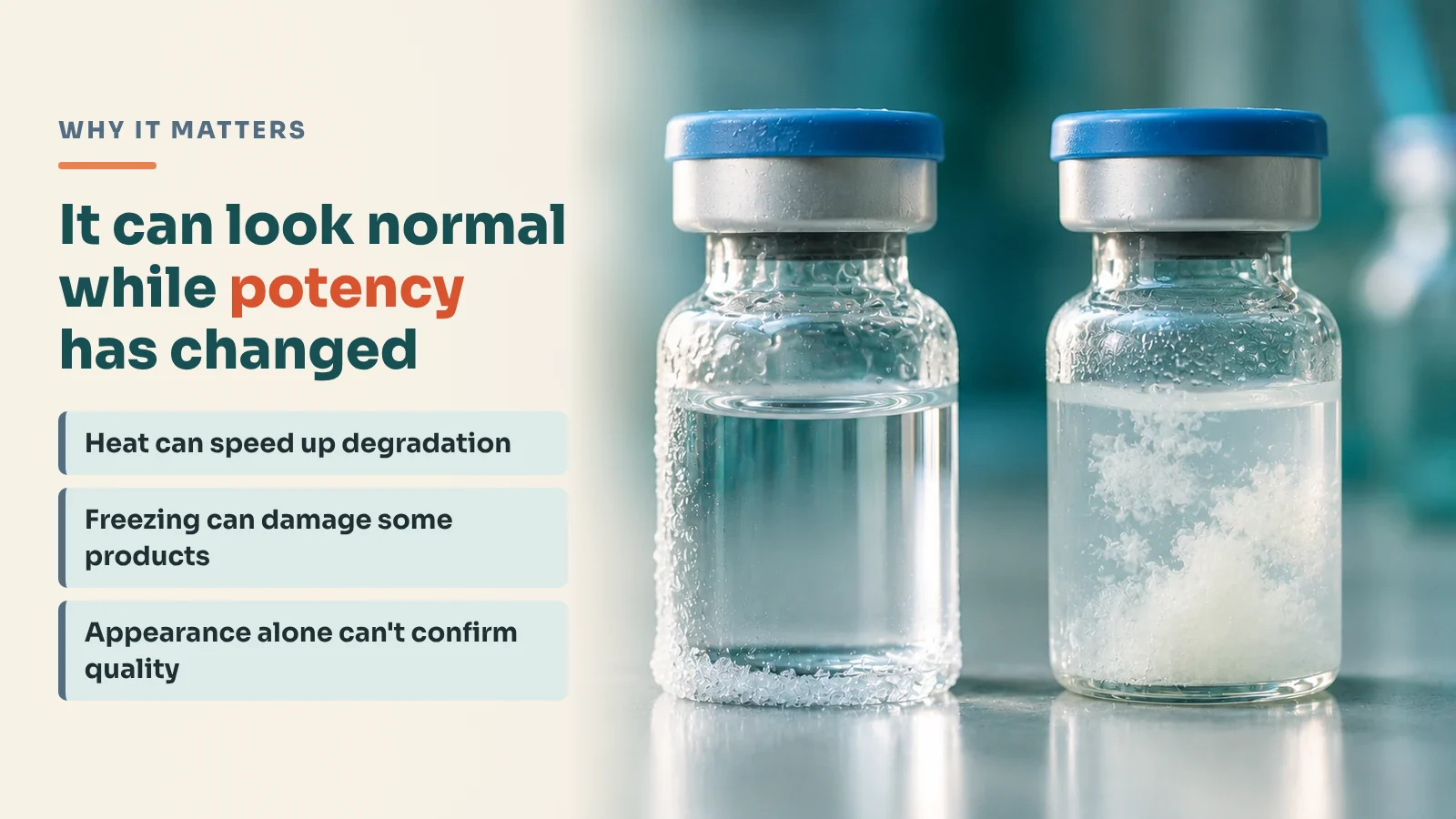
Heat can accelerate chemical degradation, oxidation and hydrolysis. In protein-based medicines, temperature stress may change protein structure or promote aggregation. Freezing can also damage some vaccines and biologics, especially products labelled “refrigerate — do not freeze”. A product may look normal even when its potency has changed, so appearance alone cannot confirm quality.
Evidence example: A 2023 Cochrane review included 17 eligible studies on human insulin: one small pilot clinical study and 16 laboratory studies. The authors noted evidence limitations. In a 2019 sensor study of 338 people in the US and Europe, 315 of 400 temperature logs (78.8%) were outside the recommended range, and 17% of sensors recorded below 0°C. That study measured exposure, not the potency of every dose; neither study creates a storage rule for other medicines.
4. How does the cold chain work?
It is a sequence of controls, not a single refrigerator. The required conditions should be maintained and documented from dispatch to the final point of use.
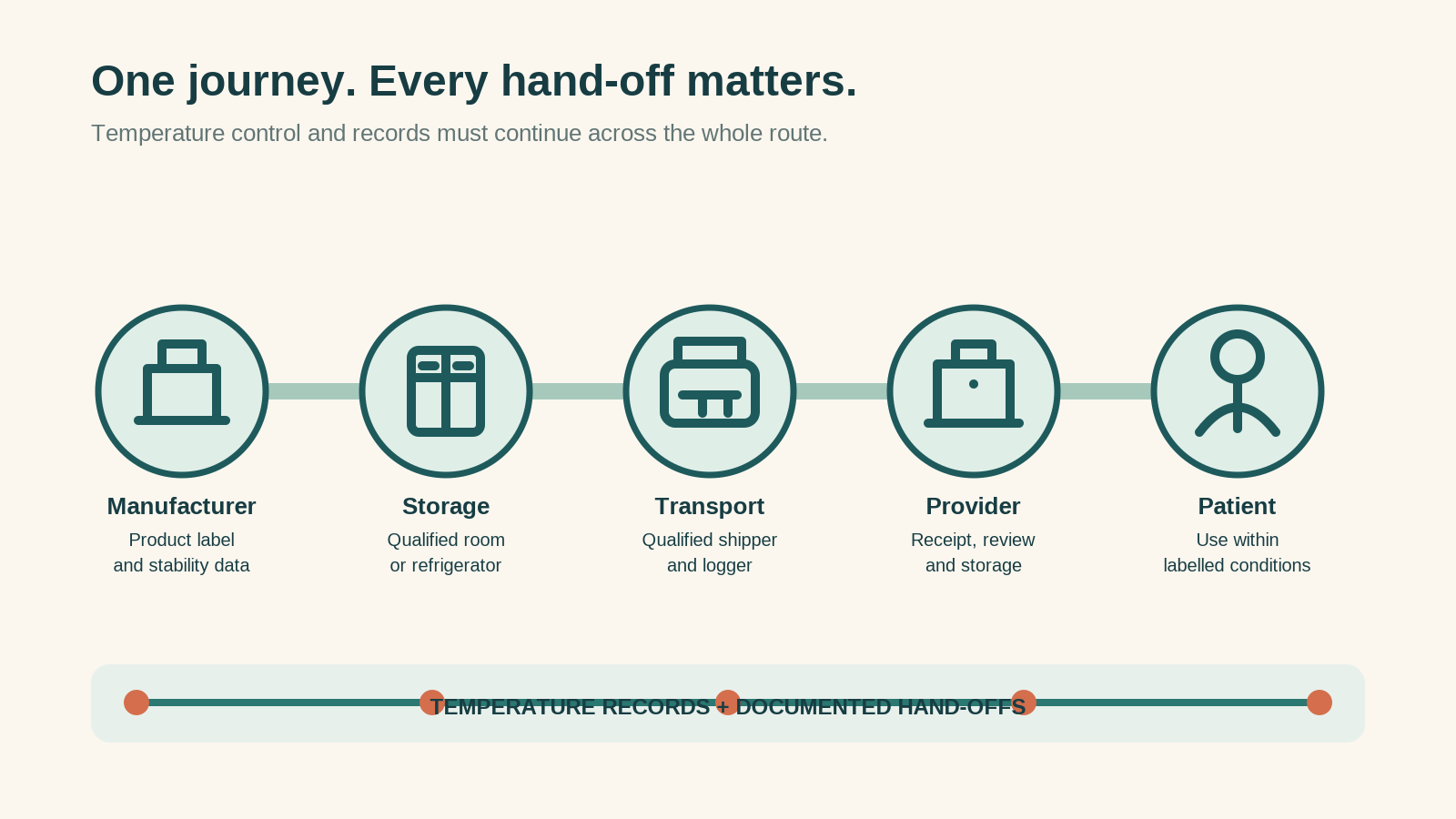
- Manufacturer: stability data and approved labelling define storage and in-use conditions.
- Warehouse: qualified rooms, refrigerators or freezers are monitored; temperature mapping identifies hot and cold spots.
- Packaging: insulated shippers and coolant arrangements are selected for the product, route, season and transit time.
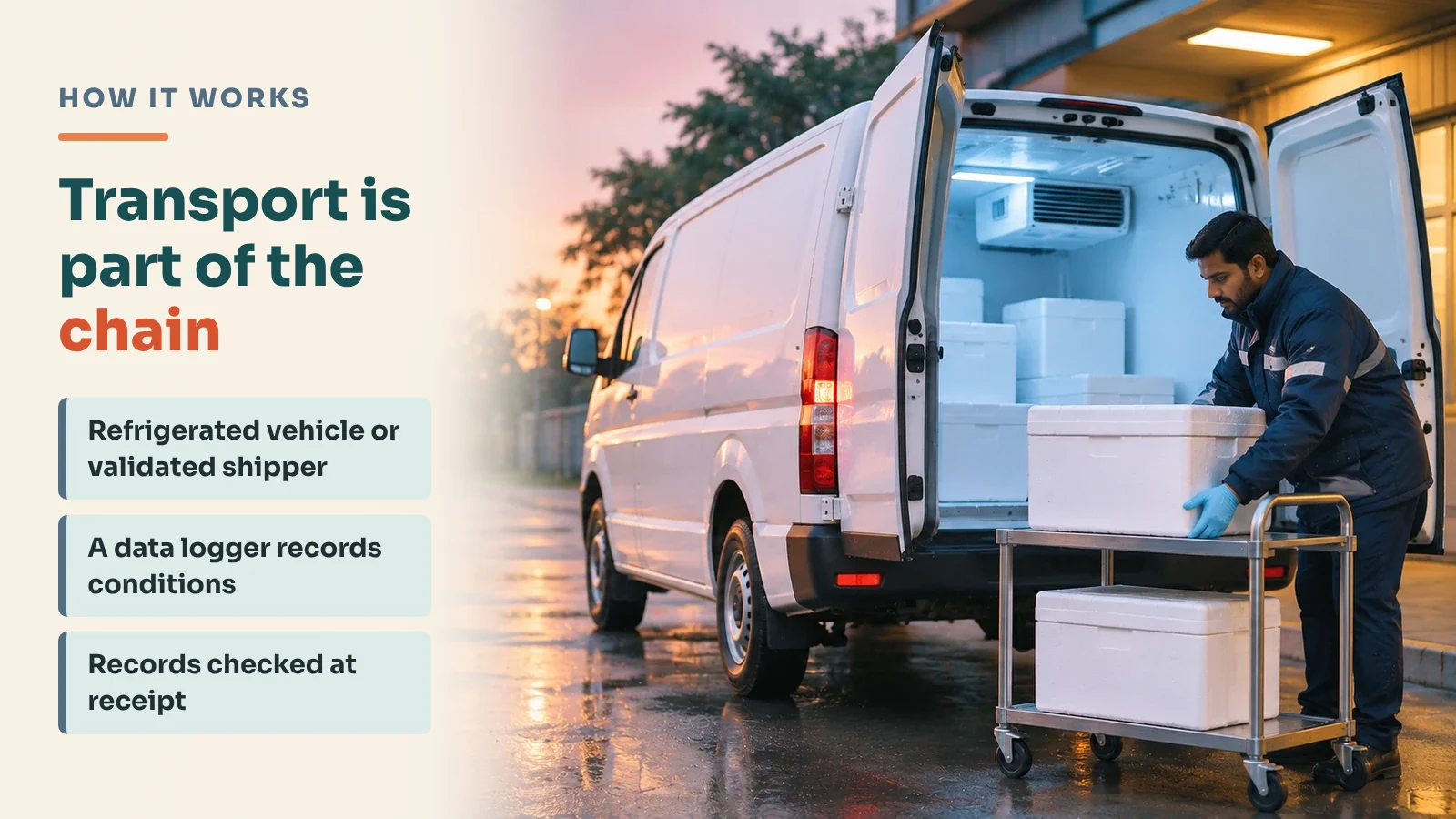
- Transport: active refrigerated systems or validated passive shippers protect the load; a suitable data logger records conditions.
- Receipt and dispensing: staff review shipment records, transfer products to suitable storage and hold any suspected excursion for assessment.
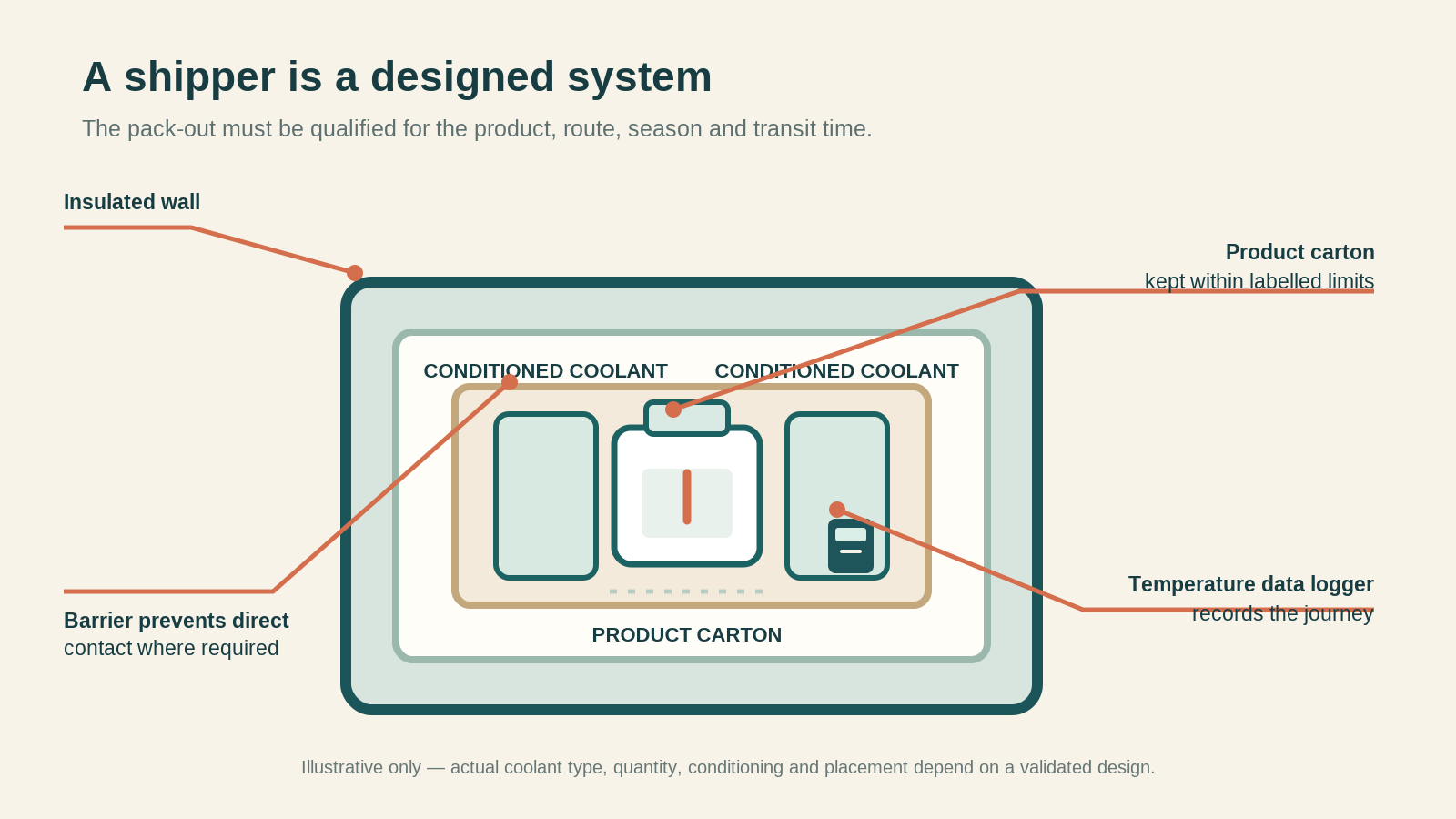
A passive shipper is not simply a box with ice packs. Poorly conditioned packs can create freezing points beside a product. WHO's TRS 992, Annex 5 provides technical supplements for temperature-sensitive distribution systems.
5. How is temperature monitored?
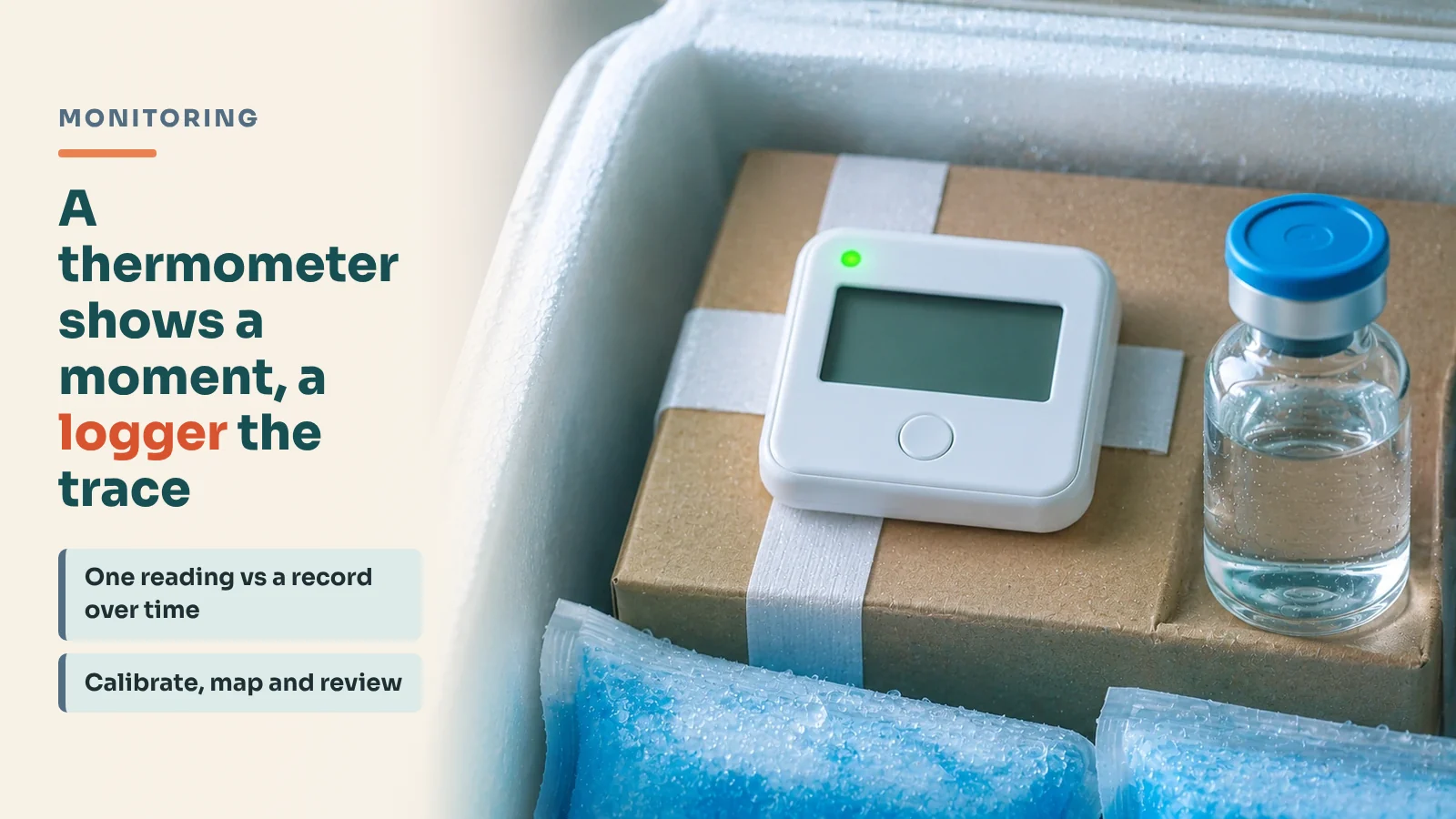
A thermometer shows one moment; a digital data logger records temperature over time. Monitoring plans may also use calibrated sensors, alarms and minimum–maximum checks. Temperature mapping helps determine where sensors should be placed, while calibration, maintenance and record review make the readings dependable.
Facilities should plan for power failure, equipment breakdown, transport delay and staff absence. Backup storage is useful only if it can maintain the required conditions and staff know how to activate it.
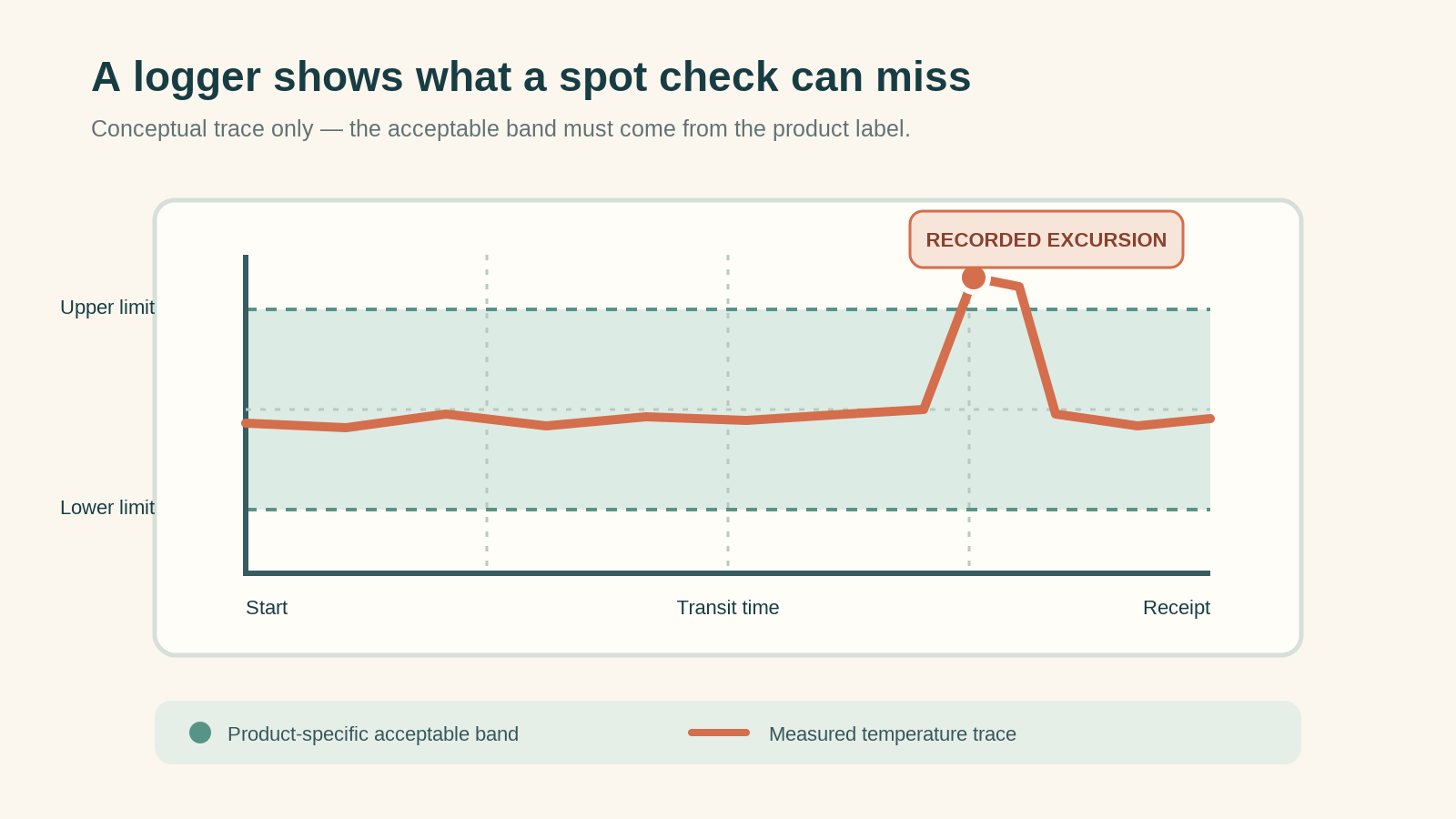
6. What happens after a temperature excursion?
A temperature excursion is exposure above or below a product's specified range. A brief event does not automatically prove a product is unusable, but it does not prove safety either. The decision depends on the product, minimum and maximum temperatures, duration, cumulative exposure, packaging and product-specific stability evidence.
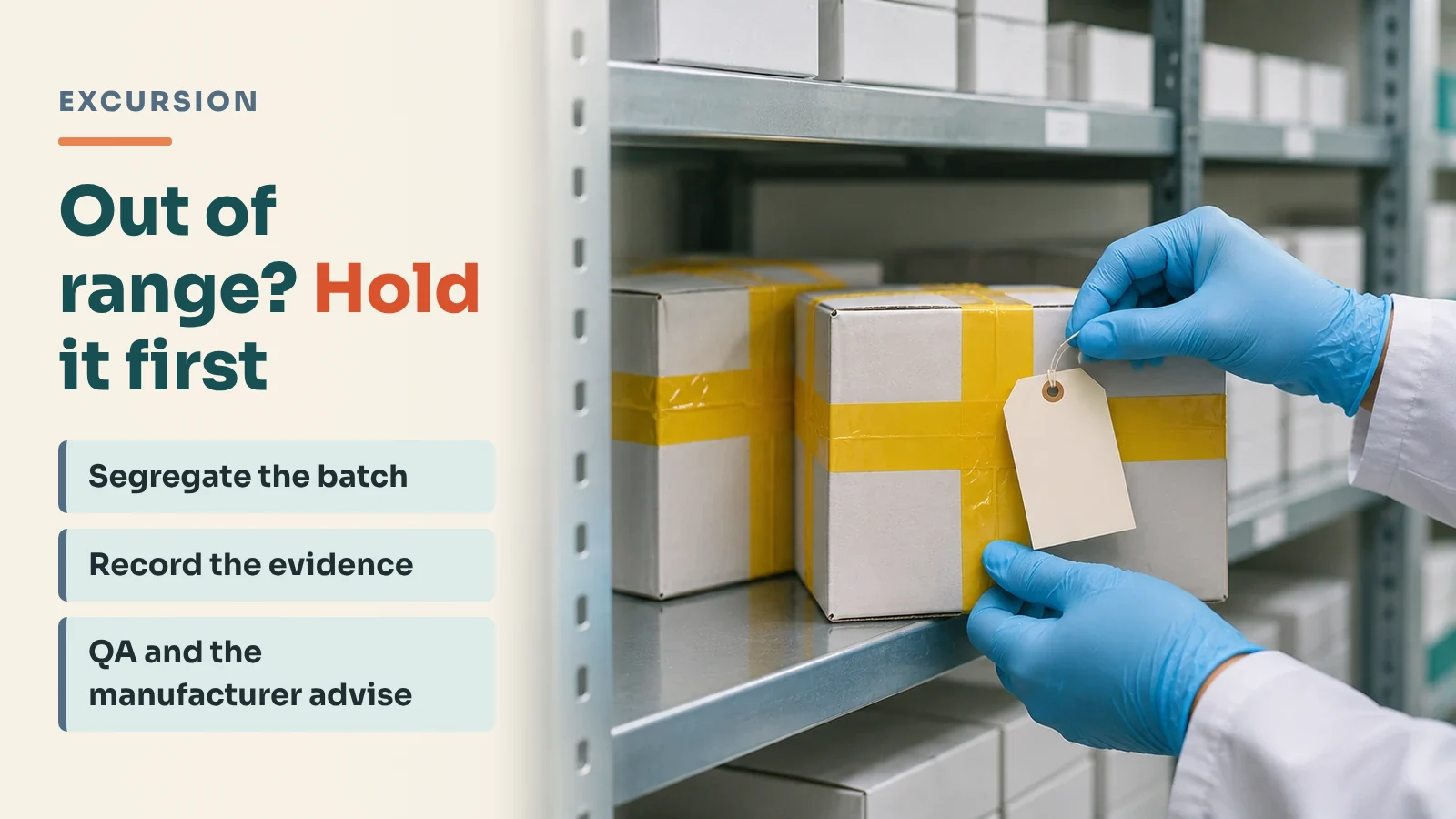
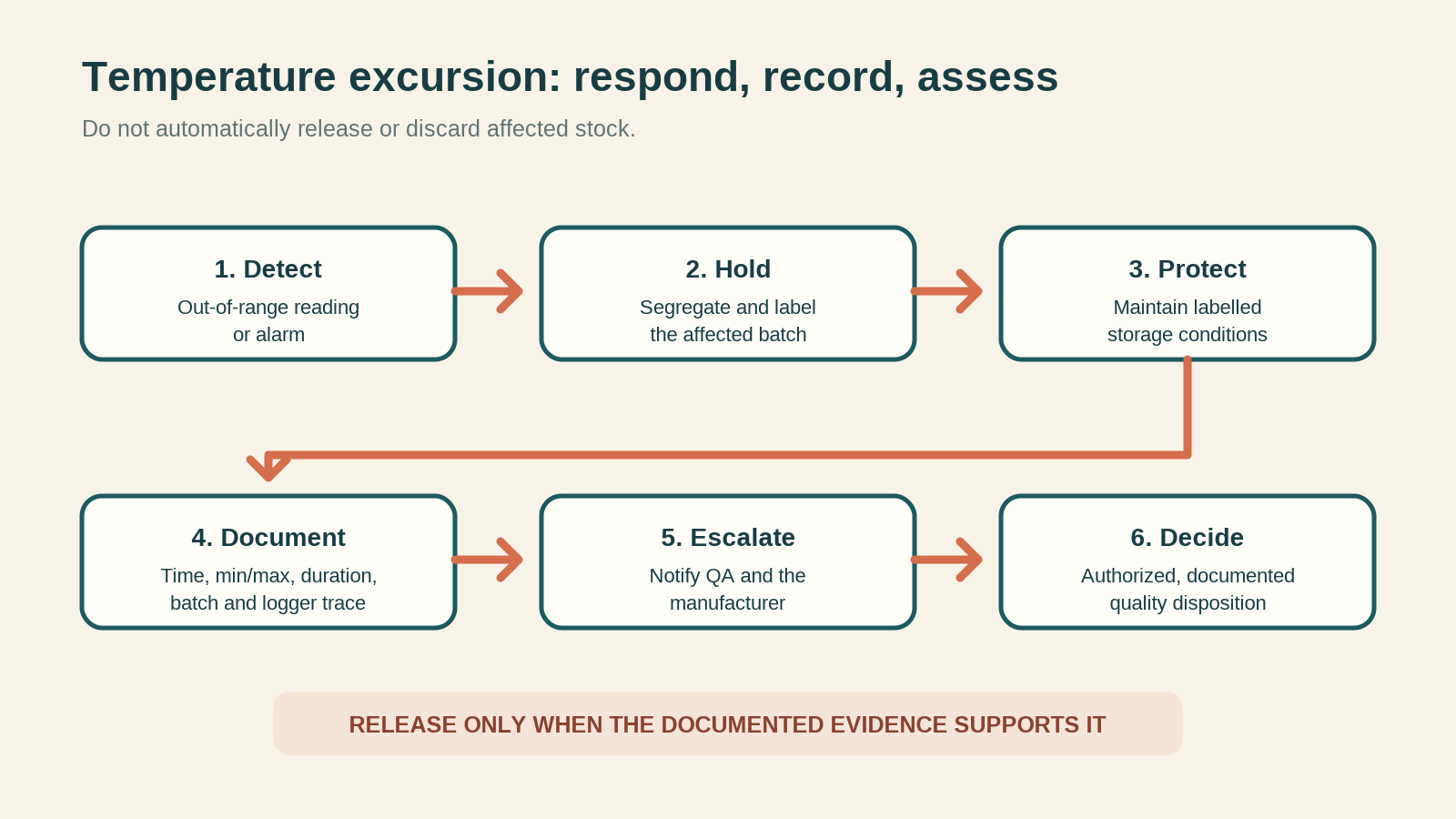
- Hold and segregate the affected batch so it cannot be supplied or used accidentally.
- Maintain the labelled condition while awaiting advice; do not deliberately warm or freeze the product.
- Record the evidence: product, batch, location, time, minimum and maximum temperature, logger trace, route and previous events.
- Notify QA and the manufacturer and follow the relevant company and regulatory procedures.
- Obtain a documented disposition based on product-specific stability data. Mean kinetic temperature may help assess cumulative exposure for certain non-biologic products, but it is not a universal tool for biologics, vaccines or frozen products and cannot replace the actual trace.
An authorized quality function or relevant authority decides whether stock can be released, returned, recalled or rejected. Do not automatically discard or use it based on guesswork.
7. What is the Bangladesh context?
DGDA's 2024 National Guideline on Accreditation of Model Pharmacy and Model Medicine Shop includes checks on preserving temperature-sensitive medicines and monitoring storage temperature; its Model Pharmacy framework includes a pharmacy-grade refrigerator.
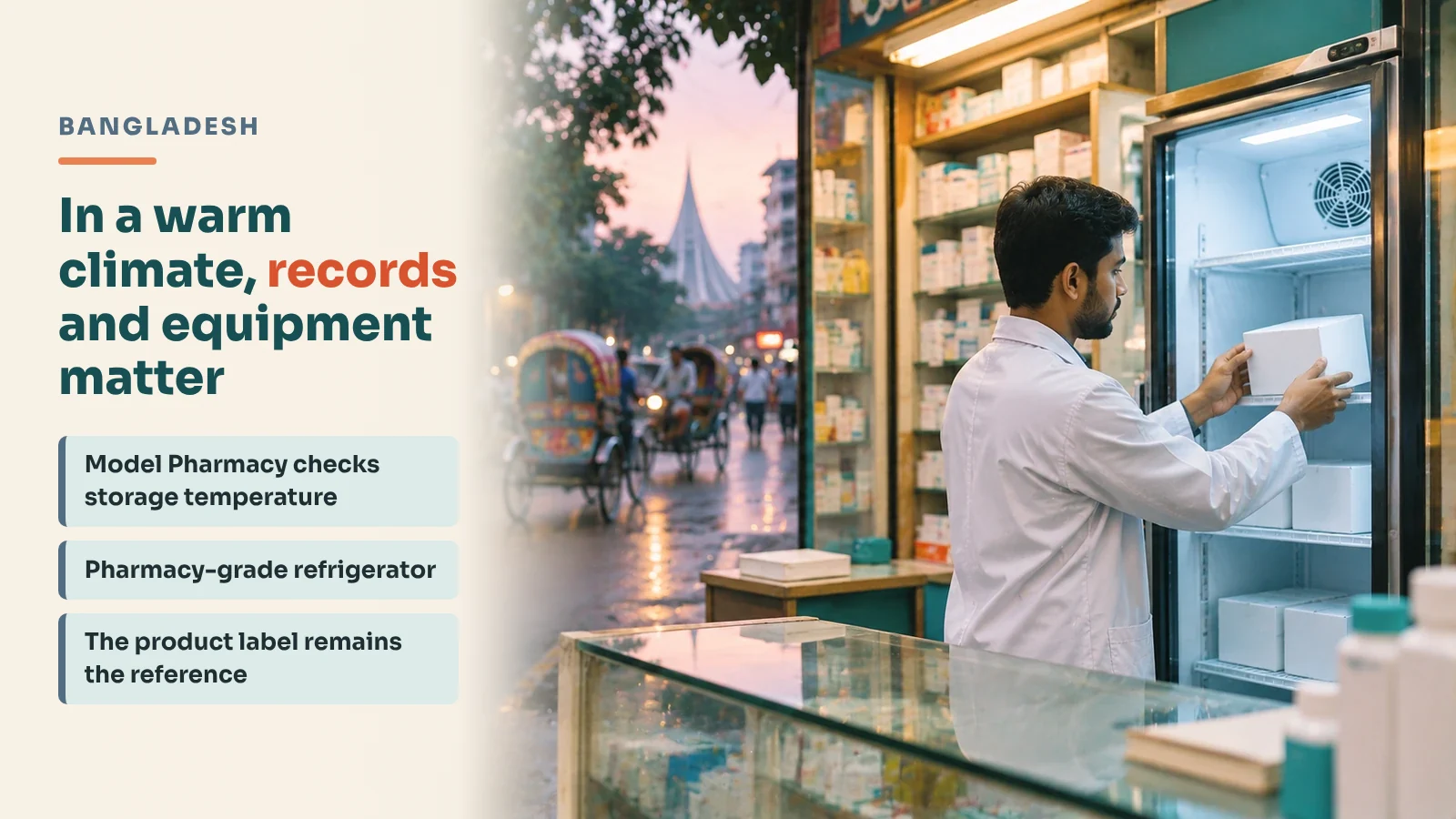
The guideline summarizes section 17.1 of the Drugs and Cosmetics Act 2023 on following WHO good-practice guidance in production, quality control, distribution, supply and storage. Its scope is the Model Pharmacy/Model Medicine Shop accreditation framework; it does not mean every medicine needs 2–8°C. In Bangladesh's warm climate, qualified equipment, transport packaging, monitoring records, backup arrangements and trained staff are especially important. Product labels and current DGDA requirements remain the reference.
8. What should pharmacists and patients do?
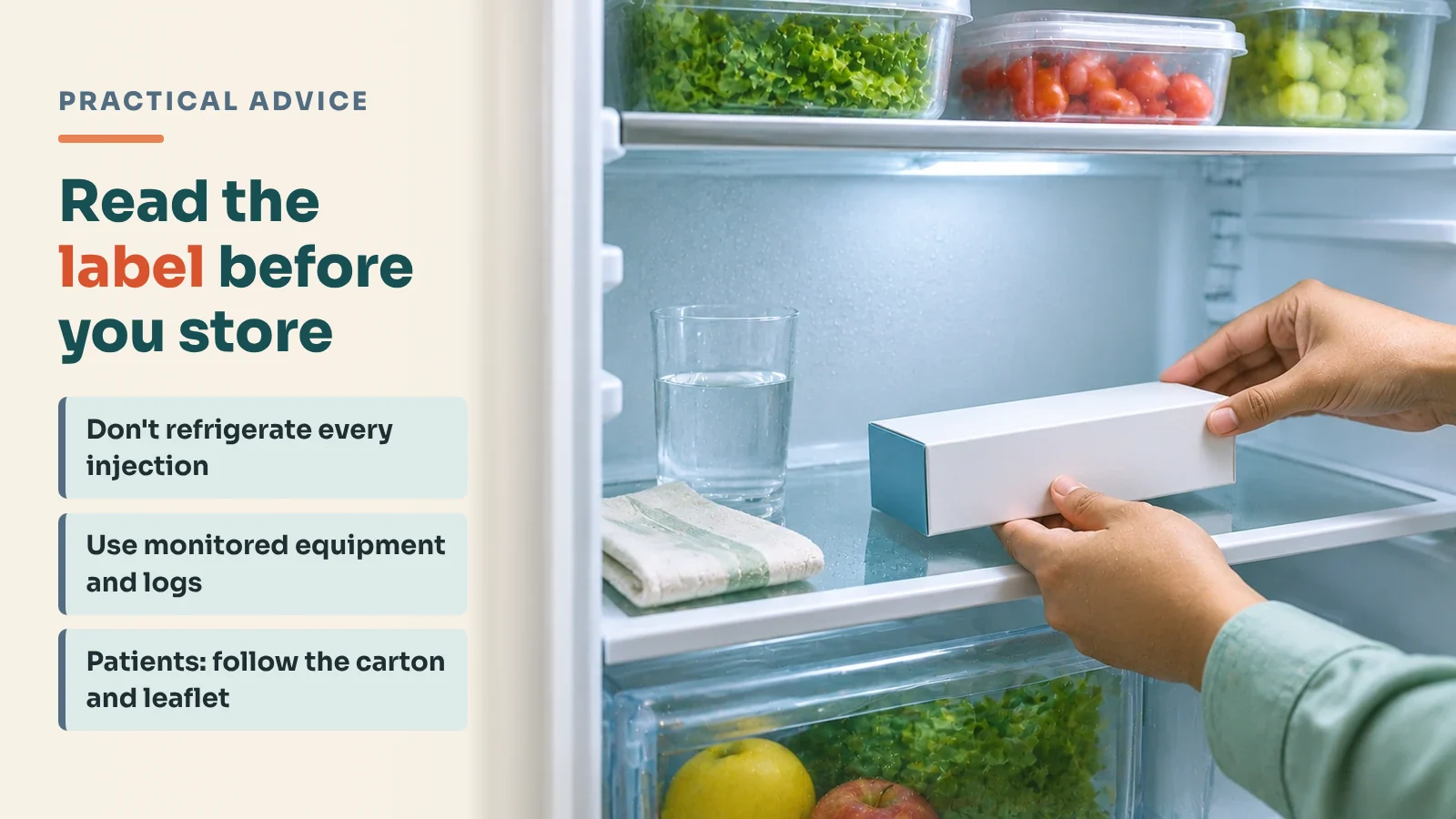
For pharmacists and healthcare facilities
- Read each product's storage statement; do not refrigerate every injection by default.
- Use suitable monitored equipment, follow temperature logs and respond to alarms.
- Follow validated transport-packaging instructions; avoid direct contact with frozen coolant unless the design allows it.
- Check the separate in-use period after opening or reconstitution.
For patients and caregivers
- Follow the carton and leaflet; do not refrigerate a medicine unless its instructions say so.
- Do not freeze a product labelled “refrigerate — do not freeze”, or leave it in a parked vehicle or direct sunlight.
- Ask the pharmacist how to transport it home. If it may have overheated or frozen, contact the pharmacy or clinic before use.
- Do not judge quality by appearance or change essential treatment without professional advice.
9. Key takeaways
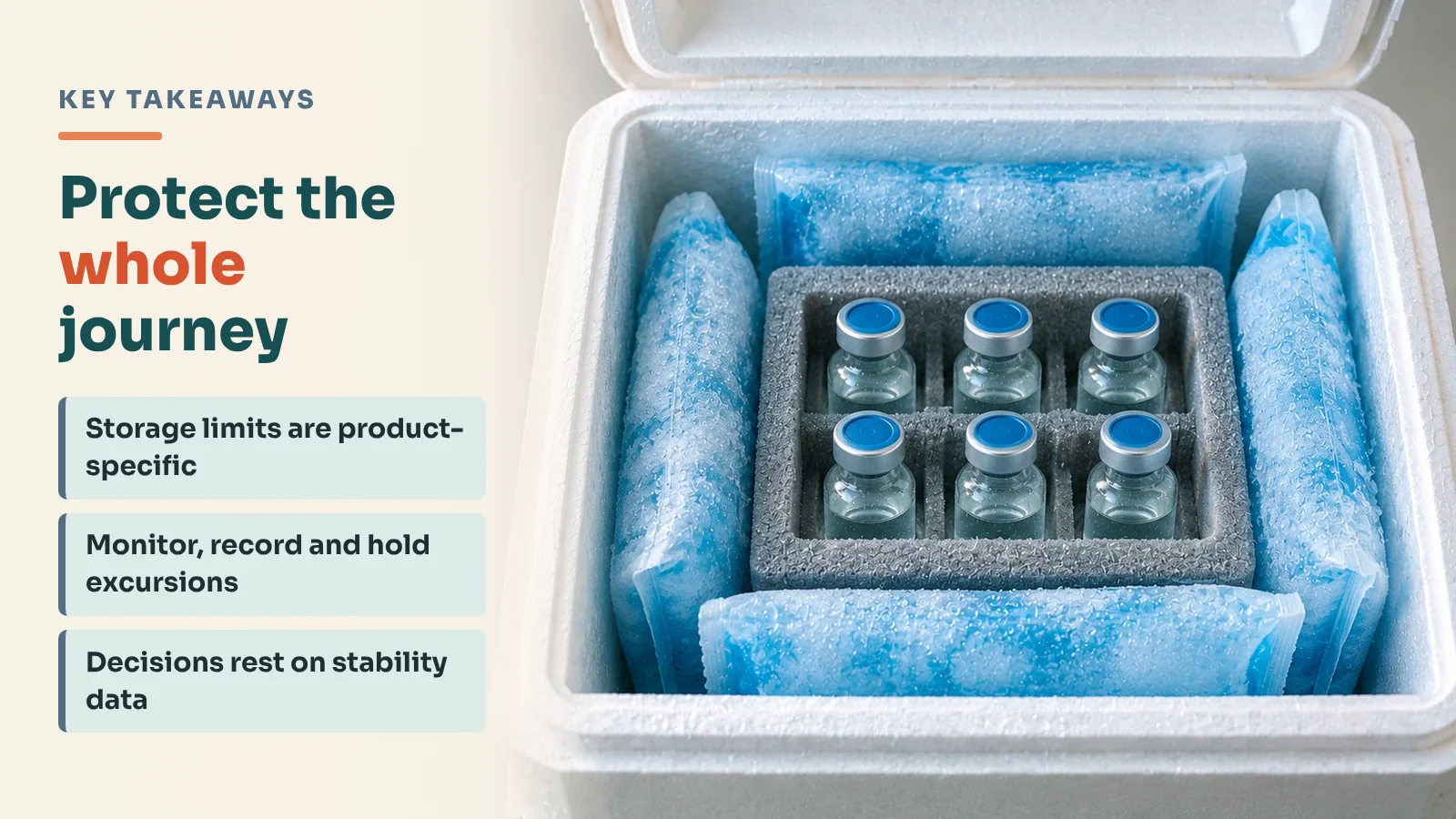
- Cold chain control continues from manufacturer to patient.
- Storage limits are product-specific; 2–8°C is not universal.
- Heat and freezing can both damage sensitive products.
- Monitoring, qualified packaging and trained staff protect quality.
- After an excursion, hold the stock and obtain a documented stability-based decision.
10. Frequently asked questions
Do all medicines need 2–8°C storage?
No. Some require refrigeration or freezing; many are labelled for controlled room temperature. Follow the exact product label.
Does every biologic need refrigeration?
No. Biologic products have different formulations and storage instructions. Check the specific product information.
Can a medicine be used after a temperature excursion?
Only after a product-specific assessment supports that decision. Keep affected stock segregated until the responsible quality unit and manufacturer or authority advise.
Does a refrigerator guarantee correct storage?
No. Equipment qualification, temperature mapping, calibrated monitoring, alarms and contingency plans are also needed.
What does a data logger do?
It records temperature over time, helping staff assess the duration and extent of exposure during storage or transport.
Can mean kinetic temperature decide product safety?
Not alone. It may help for certain non-biologic products, but cannot replace the actual temperature record and product-specific stability assessment.
What does DGDA guidance say in Bangladesh?
The 2024 Model Pharmacy/Model Medicine Shop accreditation guideline checks temperature-sensitive medicine preservation and monitoring, including a pharmacy-grade refrigerator for a Model Pharmacy. It does not set one temperature for every medicine.
References and further reading
- World Health Organization. Model guidance for the storage and transport of time- and temperature-sensitive pharmaceutical products. WHO Technical Report Series No. 961, Annex 9, 2011.
- World Health Organization. Good storage and distribution practices for medical products. WHO Technical Report Series No. 1025, Annex 7, 2020. See Appendix 1 for recommended descriptive storage limits.
- World Health Organization. Technical supplements to the model guidance for storage and transport of time- and temperature-sensitive pharmaceutical products. WHO Technical Report Series No. 992, Annex 5, 2015.
- Directorate General of Drug Administration, Bangladesh. National Guideline on Accreditation of Model Pharmacy and Model Medicine Shop, Version 1, 2024.
- Centers for Disease Control and Prevention. Vaccine Storage and Handling Toolkit, updated July 14, 2026. This is vaccine-specific U.S. guidance, not a general storage rule for all medicines or Bangladesh law.
- Richter B, Bongaerts B, Metzendorf M-I. Thermal stability and storage of human insulin. Cochrane Database of Systematic Reviews 2023, Issue 11, CD015385.
- Braune K, Krämer LA, Weinstein J, Zayani A, Heinemann L. Storage Conditions of Insulin in Domestic Refrigerators and When Carried by Patients: Often Outside Recommended Temperature Range, 2019.
- Latoz C, Huynh-Ba K, McCaig L, Wu Y. Systematic approaches to determining the disposition of temperature-compromised drug products: a regulatory and stability science-based review. AAPS Open 12, 65 (2026).
Evidence note: WHO documents provide international technical guidance; the CDC toolkit applies specifically to vaccines in the United States; the DGDA guideline has a defined Bangladesh Model Pharmacy/Model Medicine Shop accreditation scope. Research on insulin or one product cannot be generalized to every medicine. Always use the current approved product information and applicable local requirements.

A Grade Pharmacist · Registration A-22040
Product Executive, Product Management Department, Opsonin Pharma Ltd., Dhaka, Bangladesh.
Independent educational writing on medicines, pharmaceutical science and the healthcare industry.