 Sayedul Abrar
A common story (illustrative, fictional)
Karim, 38, is prescribed a seven-day antibiotic for a chest infection. By day three he feels much better, so he stops. He keeps the remaining tablets in a drawer, and a month later gives them to his brother for a cough. Each of those steps feels sensible. Each one goes against official advice. This is an example, not a real patient.
What is an antibiotic, and what can it treat?
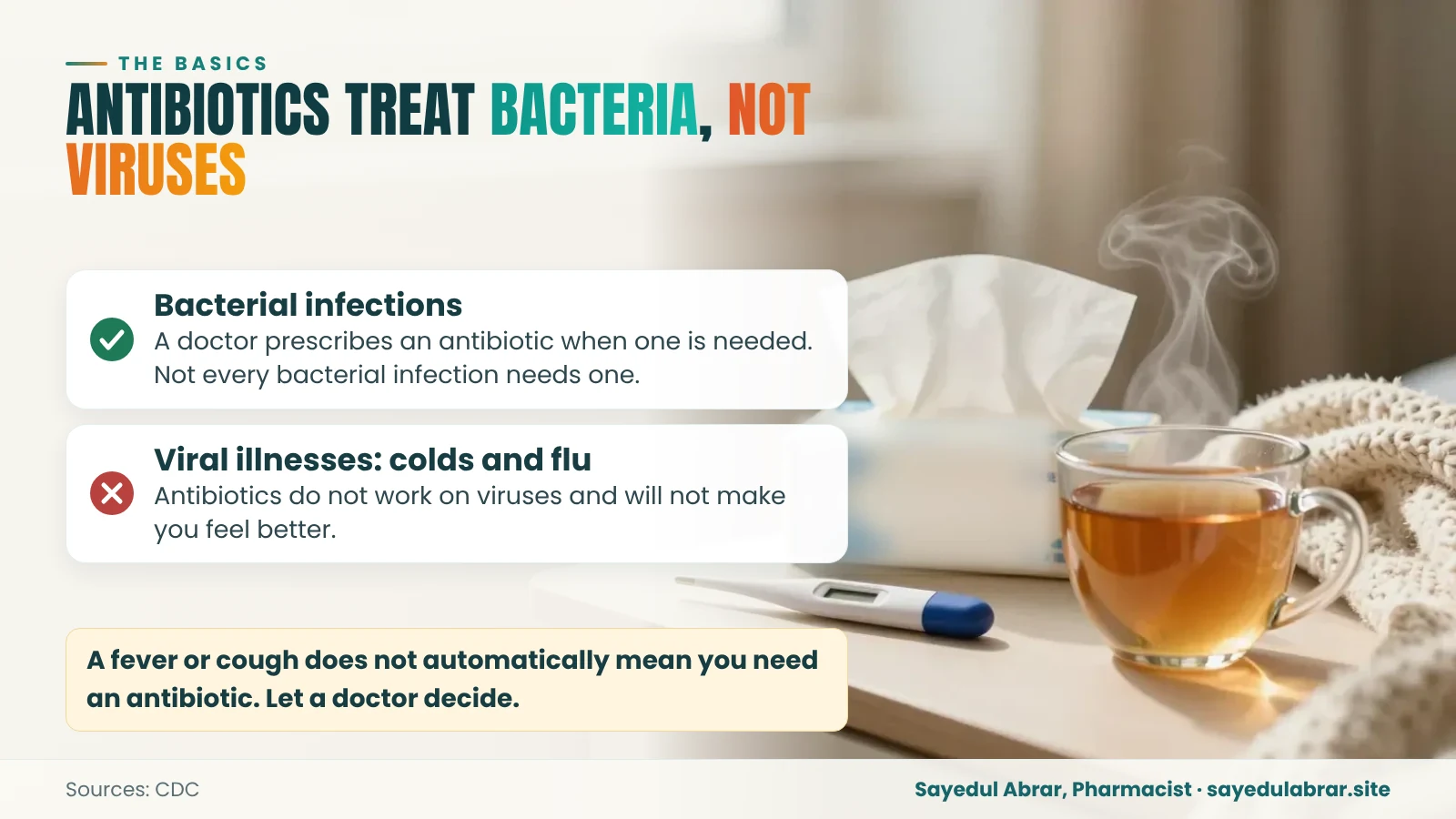
An antibiotic is a medicine that treats infections caused by bacteria. It does not treat viruses. The CDC states that antibiotics do not work on viruses, such as those that cause colds and flu, and will not make you feel better if you have a virus. The CDC also notes that some common bacterial infections do not need antibiotics at all. That is why the decision belongs to a doctor, not to a fever or a cough on its own. If the words are confusing, my article on drug vs medicine explains the basics.
What is antibiotic resistance?
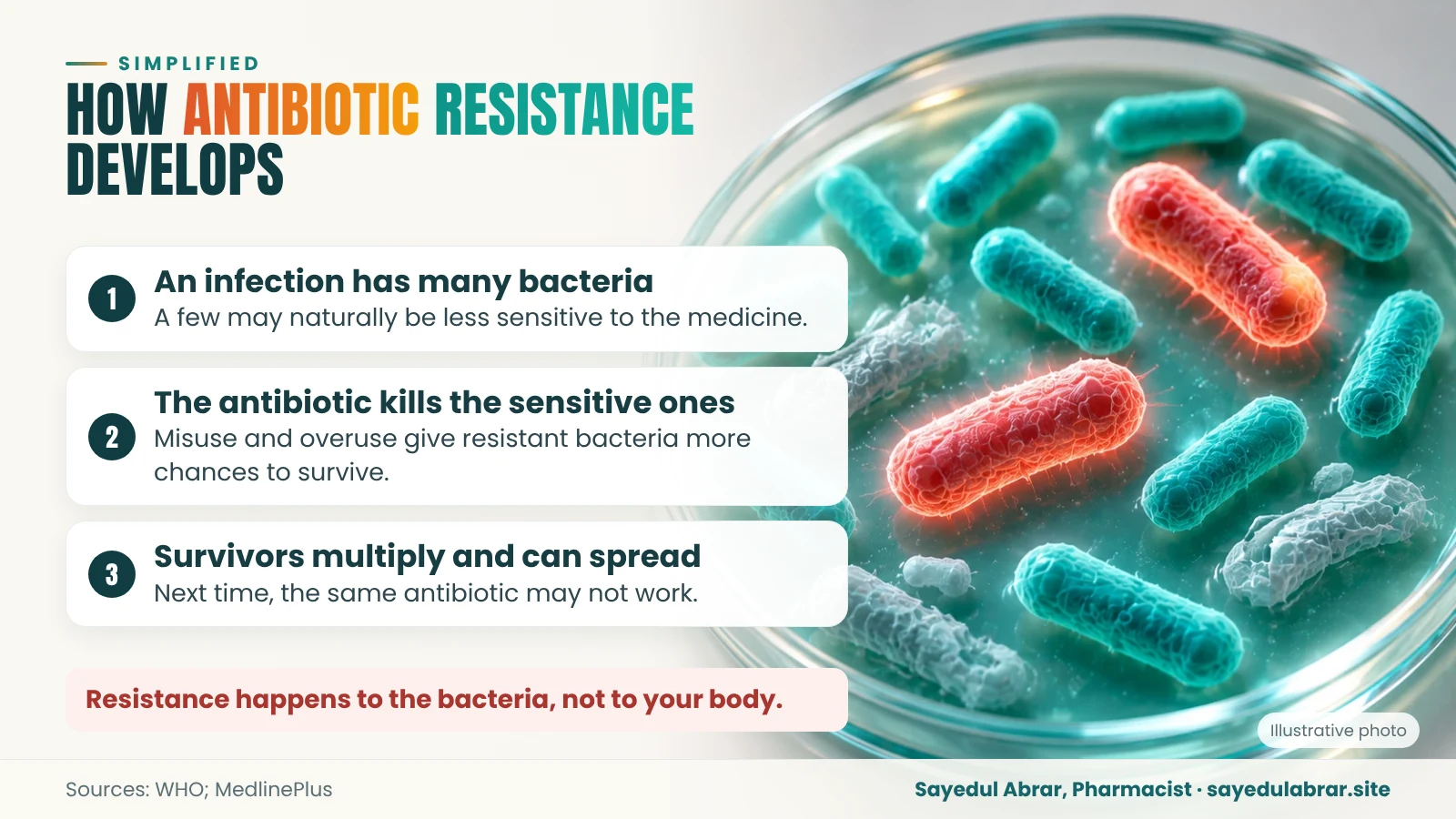
MedlinePlus describes antibiotic resistance as bacteria no longer responding well to one or more antibiotics. WHO defines the wider problem, antimicrobial resistance (AMR), as bacteria, viruses, fungi and parasites no longer responding to antimicrobial medicines. Two points are easy to miss:
- It is the bacteria that become resistant, not your body.
- Resistant bacteria can spread to other people, so one person’s misuse can affect a family or a community.
WHO says that the misuse and overuse of antimicrobials are driving the development and spread of drug-resistant germs. MedlinePlus says the same about antibiotics.
How big is the problem?
According to WHO’s 2025 global surveillance report, one in six laboratory-confirmed bacterial infections worldwide was resistant to antibiotic treatment in 2023. Resistance was highest in WHO’s South-East Asia and Eastern Mediterranean regions, where one in three reported infections was resistant. Bangladesh is in WHO’s South-East Asia region, although regional figures do not describe any single country. The WHO fact sheet also estimates that bacterial AMR was associated with more than 4.7 million deaths globally in 2021.
Why finish the course, even if you feel better?
Official patient advice is consistent on this point:
| Source | What it says |
|---|---|
| NHS patient leaflet (2025) | It is essential to finish the full prescribed course, even if you feel better, unless a healthcare professional tells you otherwise. |
| NHS, pneumonia treatment | If you are given antibiotics to take at home, keep taking them until you have finished them all, even if you start to feel better. |
| MedlinePlus | It is important to complete the course of treatment. Never skip a dose. |
| CDC | Take antibiotics exactly as prescribed. |
Feeling better tells you the medicine is working. It does not tell you how long your particular infection needs treatment. Your doctor chose the dose and the number of days for your infection, and that is the plan to follow.
What about the debate on shorter courses?
To be fair to the science: in 2017, a group of UK infection specialists argued in the BMJ that the “complete the course” message has little evidence behind it, and that taking antibiotics for longer than needed may also add to resistance. That analysis is about how doctors and guidelines should set the length of treatment. It is not permission to stop early on your own.
The practical rule does not change: the length of the course is your prescriber’s decision. If your doctor prescribes a short course, that is fine. If you think you should stop, ask first.
Antibiotic do’s and don’ts
| Do | Don’t |
|---|---|
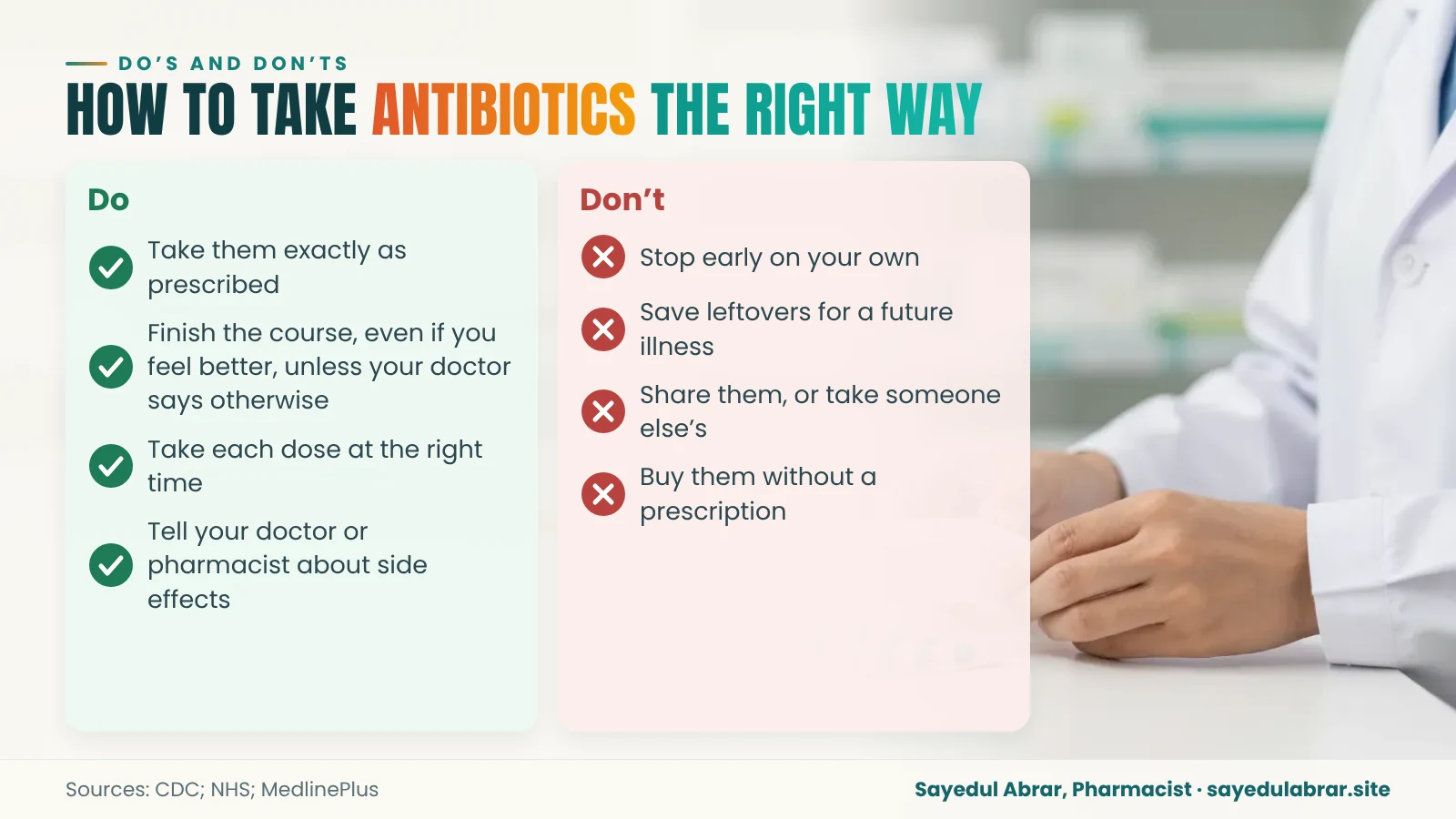
| Take them exactly as prescribed (CDC) | Stop early on your own |
| Finish the course unless a healthcare professional says otherwise (NHS) | Save leftovers for later (CDC, MedlinePlus) |
| Take each dose at the right time, as the label says | Share them, or take antibiotics prescribed for someone else (CDC) |
| Tell a healthcare professional about side effects (CDC) | Buy them without a registered doctor’s prescription |
Keep the pack until you finish it. The pack shows the generic name, strength and expiry date. My guides on generic name vs brand name and expiry date vs manufacturing date show how to read them.
What if you miss a dose?
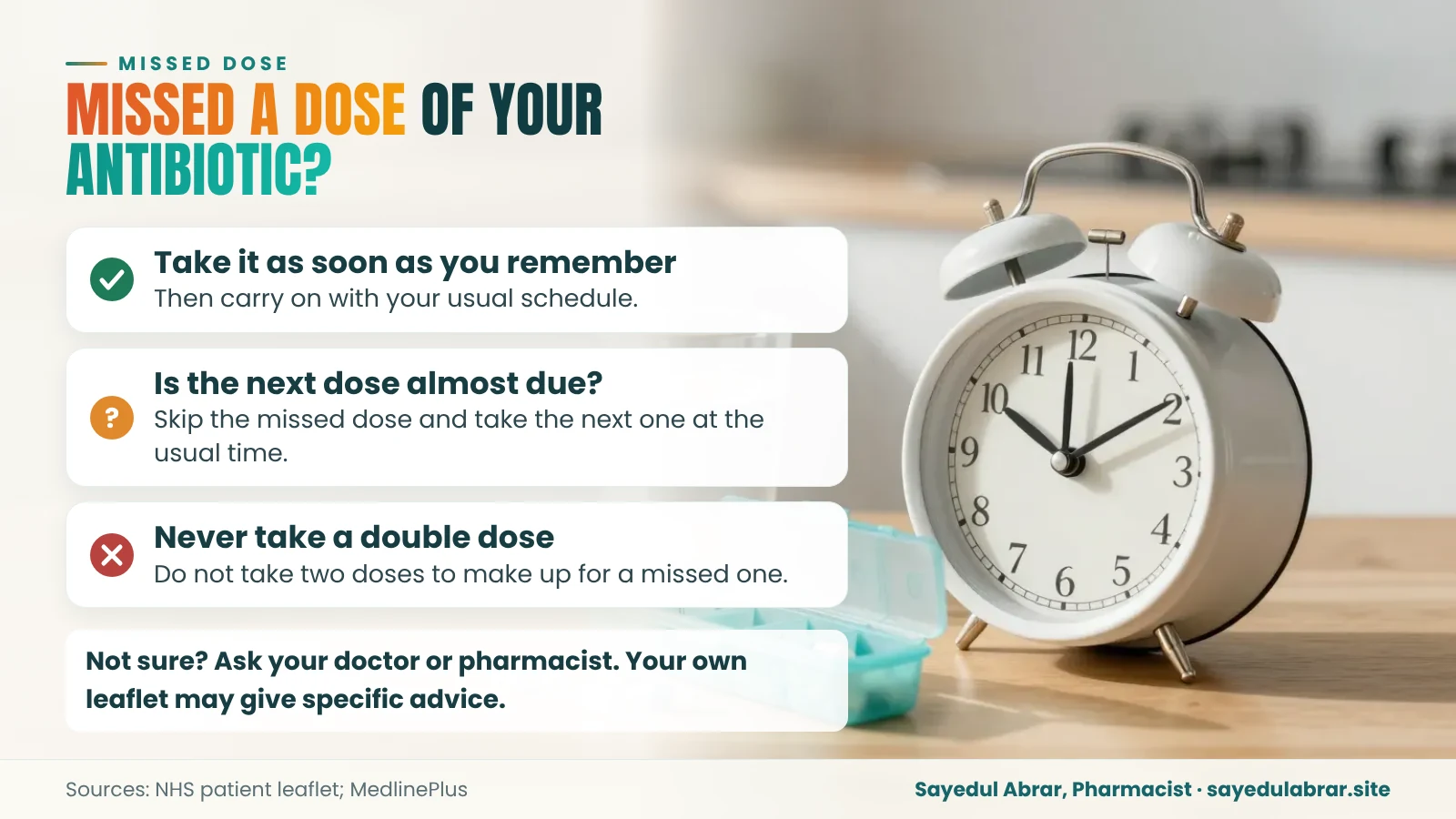
An NHS patient leaflet gives this general advice: take the missed dose as soon as you remember and carry on as normal. If the next dose is almost due, skip the missed one. Do not take a double dose to make up for it. MedlinePlus advises asking your provider what to do. Some antibiotics have specific timing rules, so your own leaflet and your pharmacist come first.
Side effects: when to get help
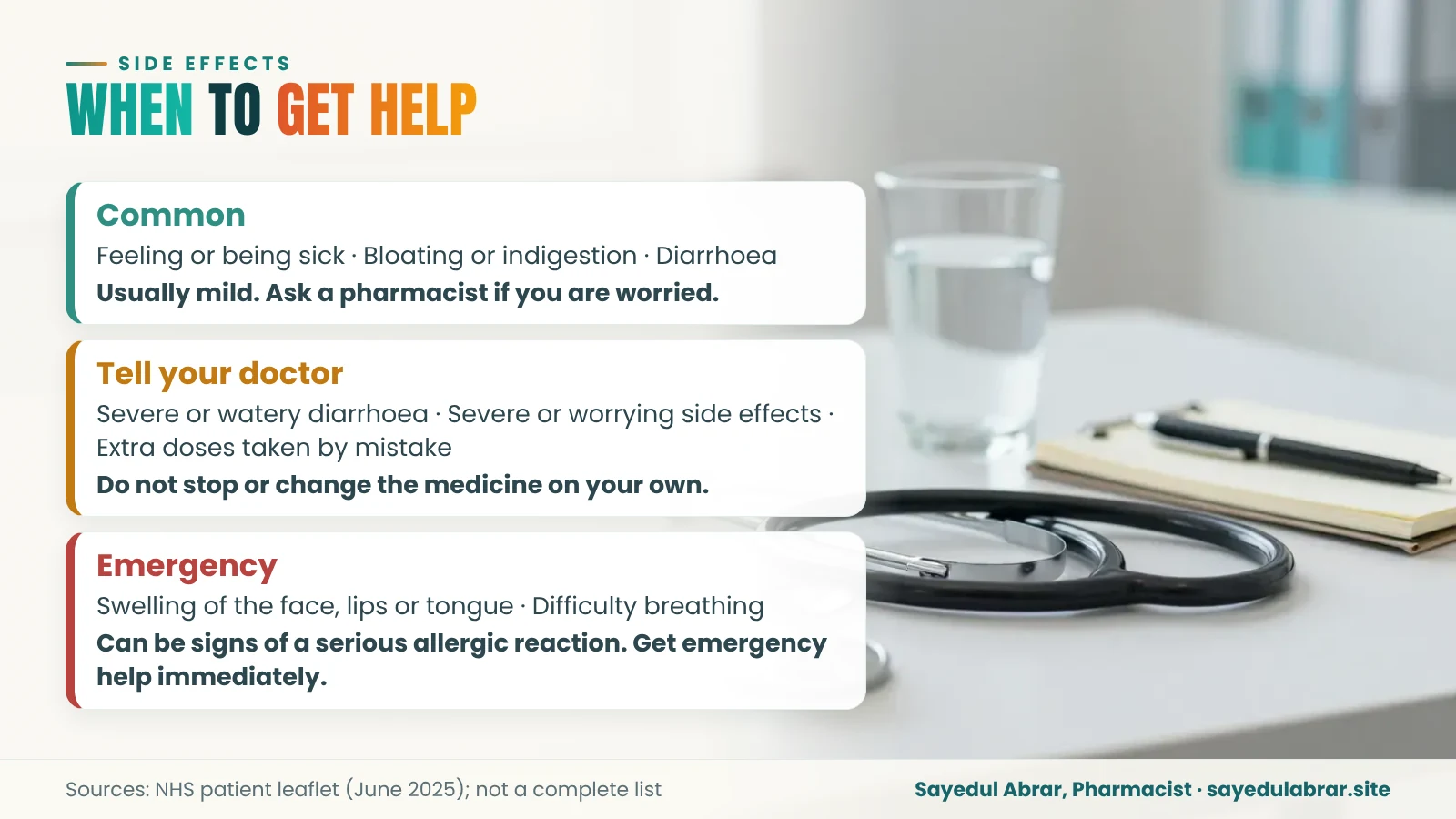
The same NHS leaflet says most antibiotics do not cause problems when used properly and serious side effects are rare. Common ones include feeling or being sick, bloating or indigestion, and diarrhoea. Report severe or watery diarrhoea to your doctor. Swelling of the face or tongue and difficulty breathing can be signs of a serious allergic reaction, which is a medical emergency. If you have ever had an allergic reaction to an antibiotic, tell every doctor and pharmacist who treats you.
In Bangladesh: look for the red mark
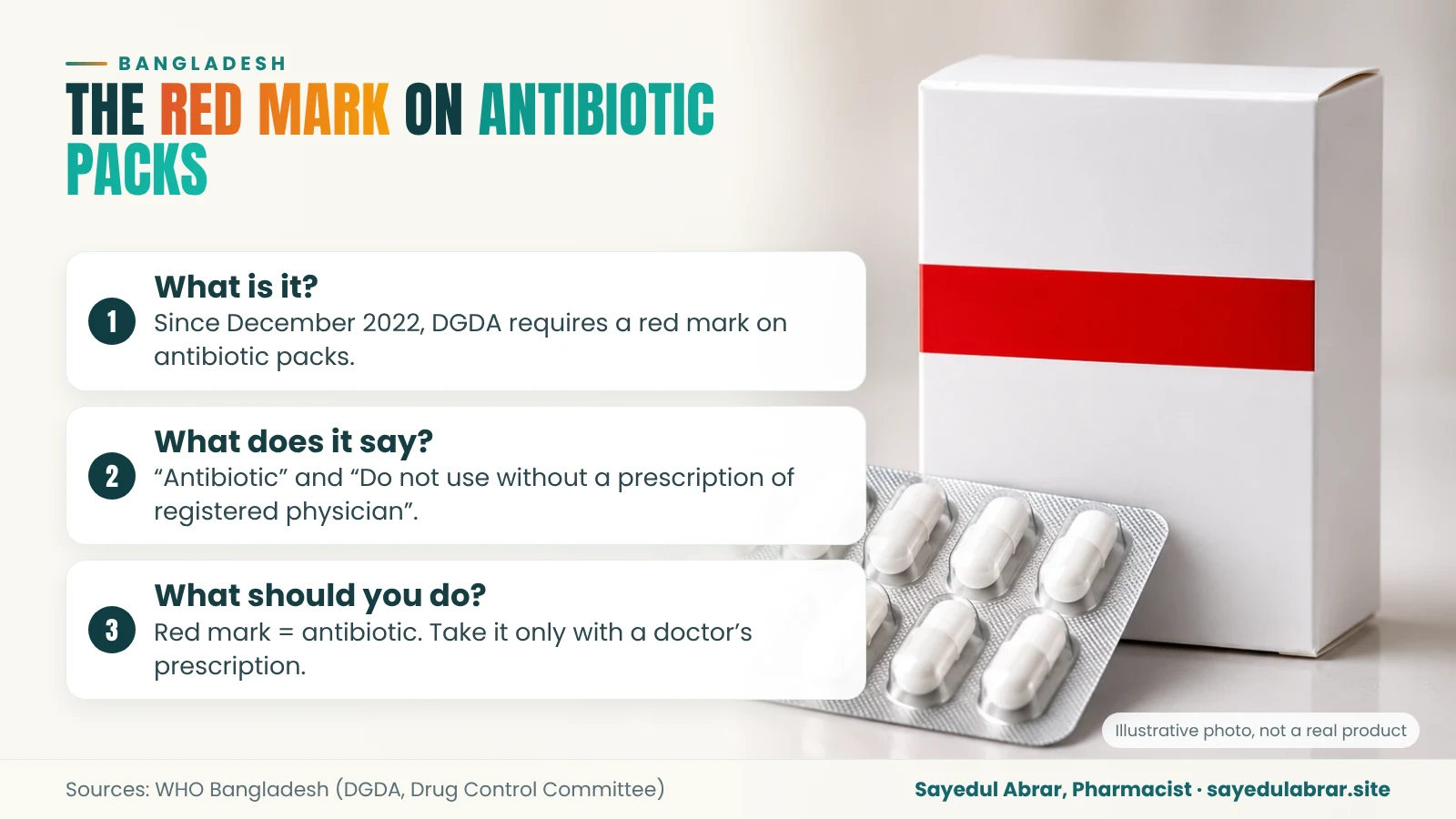
WHO Bangladesh reports that the Drug Control Committee approved a “RED identification mark for antibiotics” for human and veterinary use, starting from December 2022. Manufacturers were asked to add a red label reading “antibiotic” and the message “Do not use without a prescription of registered physician” to every antibiotic pack. If you see the red mark, you are holding an antibiotic. Take it only with a registered doctor’s prescription.
What to do with leftover antibiotics
If you follow the prescription, there should be little or nothing left. Leftovers usually mean doses were missed or the course was stopped early. Do not keep them for the next illness and do not give them to anyone else. MedlinePlus says never to save antibiotics and to dispose of leftovers as your local rules direct. Ask your pharmacist how to dispose of them safely where you live.
Key takeaways
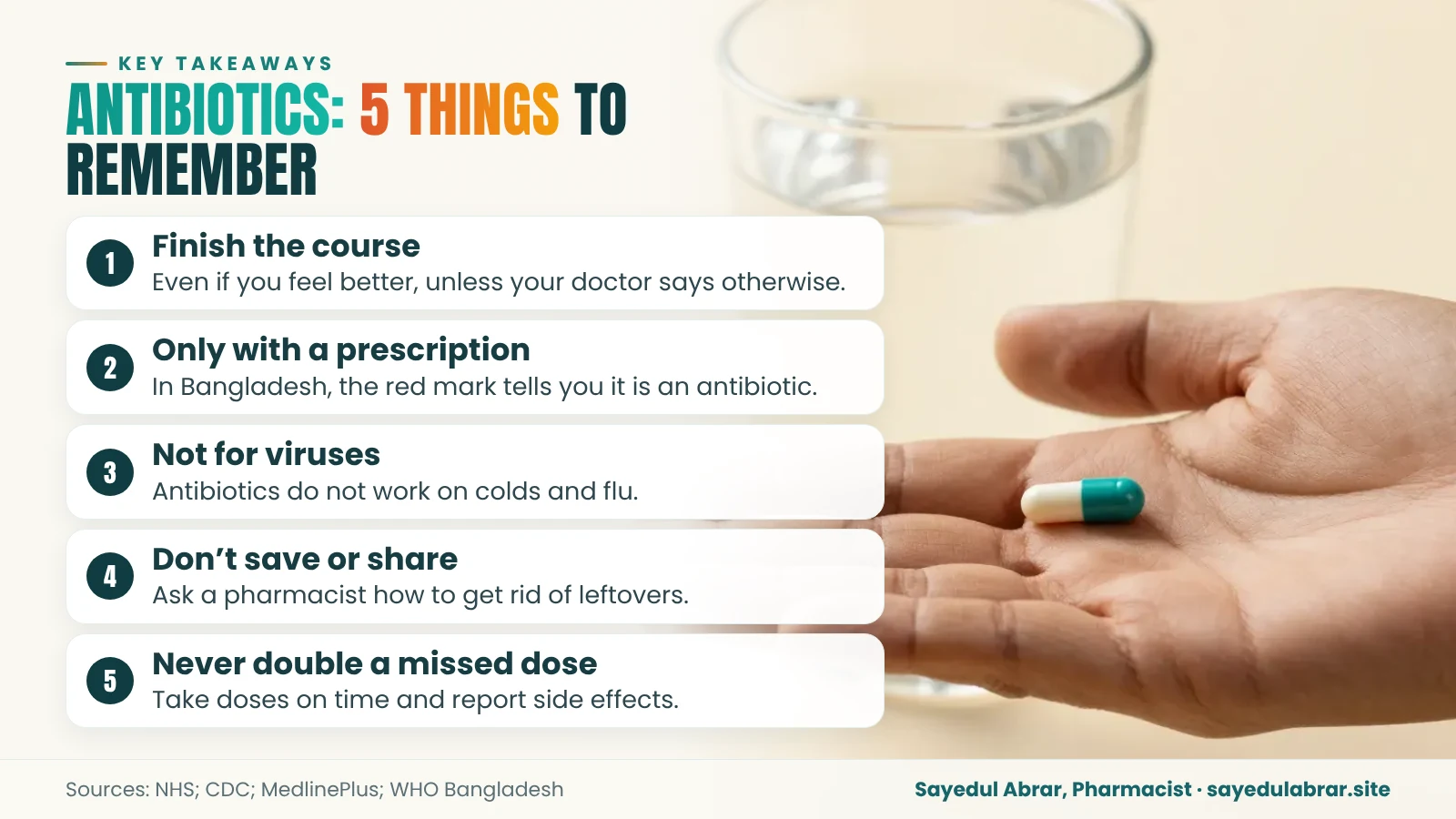
- Finish the course as prescribed, unless a healthcare professional tells you otherwise.
- Use antibiotics only with a registered doctor’s prescription.
- Antibiotics do not work on colds and flu.
- Do not save, share or borrow antibiotics.
- Never take a double dose to make up for a missed one.
Frequently asked questions
Can I stop taking antibiotics when I feel better?
Not on your own. NHS guidance says it is essential to finish the full prescribed course, even if you feel better, unless a healthcare professional tells you otherwise. If you think you need to stop, for example because of side effects, speak to your doctor or pharmacist first.
Is it true that some experts question the “complete the course” advice?
Yes. A 2017 analysis in the BMJ argued that the message has little evidence behind it and that taking antibiotics for longer than needed may also add to resistance. It did not tell patients to stop early by themselves. The practical message is the same: the length of the course is your prescriber’s decision, so follow the prescription and ask before changing it.
Can I keep leftover antibiotics or give them to family?
No. The CDC advises not to save antibiotics for later, not to share them and not to take antibiotics prescribed for someone else. MedlinePlus says never to save antibiotics. Ask your pharmacist how to dispose of any that are left.
Do antibiotics help a cold or the flu?
No. The CDC says antibiotics do not work on viruses, such as those that cause colds and flu, and will not make you feel better if you have a virus.
What should I do if I miss a dose?
An NHS leaflet says to take it as soon as you remember, unless the next dose is almost due, in which case skip the missed dose. Never take a double dose to make up for it. MedlinePlus advises asking your provider what to do, so check with your doctor or pharmacist if you are unsure.
Does my body become resistant to antibiotics?
No. Antibiotic resistance means the bacteria no longer respond well to the antibiotic. It is the bacteria that change, not your body, but resistant bacteria can then cause infections that are harder to treat.
Can I drink alcohol while taking antibiotics?
It depends on the antibiotic. The NHS leaflet notes that some antibiotics can react unpredictably with alcohol and other medicines. Read your medicine leaflet and ask your pharmacist.
How can I tell if a medicine is an antibiotic in Bangladesh?
Look for the red identification mark. Following a DGDA decision, antibiotic packs from December 2022 should carry a red label reading “antibiotic” and the warning “Do not use without a prescription of registered physician” (WHO Bangladesh). You can also read the generic name on the pack.
References and further reading
- Royal Berkshire NHS Foundation Trust. Antibiotics, patient information leaflet (June 2025). www.royalberkshire.nhs.uk — finishing the course, missed doses, side effects, alcohol, when to get help.
- NHS. Pneumonia: treatment. www.nhs.uk — keep taking antibiotics until finished, even if you start to feel better.
- U.S. Centers for Disease Control and Prevention (CDC). Healthy Habits: Antibiotic Do’s and Don’ts. www.cdc.gov — take as prescribed, do not save or share, antibiotics do not work on viruses.
- MedlinePlus (U.S. National Library of Medicine). Using antibiotics wisely. www.medlineplus.gov — complete the course, never save, do not take antibiotics given to another person.
- MedlinePlus. Antibiotic resistance. medlineplus.gov — what antibiotic resistance means.
- World Health Organization. Antimicrobial resistance, fact sheet. www.who.int — definition, burden and drivers of AMR.
- World Health Organization. WHO warns of widespread resistance to common antibiotics worldwide (13 October 2025). www.who.int — GLASS 2025 report, 2023 data.
- WHO Bangladesh. Establishing red label of antibiotics for curbing antimicrobial resistance in Bangladesh (7 March 2023). www.who.int — DGDA red identification mark from December 2022.
- Llewelyn MJ, et al. The antibiotic course has had its day. BMJ 2017;358:j3418. doi.org — analysis questioning the “complete the course” message.
Editorial note: Sources checked on 13 November 2026. UK and US guidance may not match every product label in Bangladesh word for word, so follow your own prescription and pack leaflet.

Sayedul Abrar
A Grade Pharmacist · Registration Code: A-22040
Product Executive, Product Management Department (PMD) · Opsonin Pharma Ltd.